
Each way betting splits your stake into a win bet and a place bet on the same selection. Here's how it works, how place terms affect your returns, worked examples and how to calculate your potential profit or loss.
Quick answer
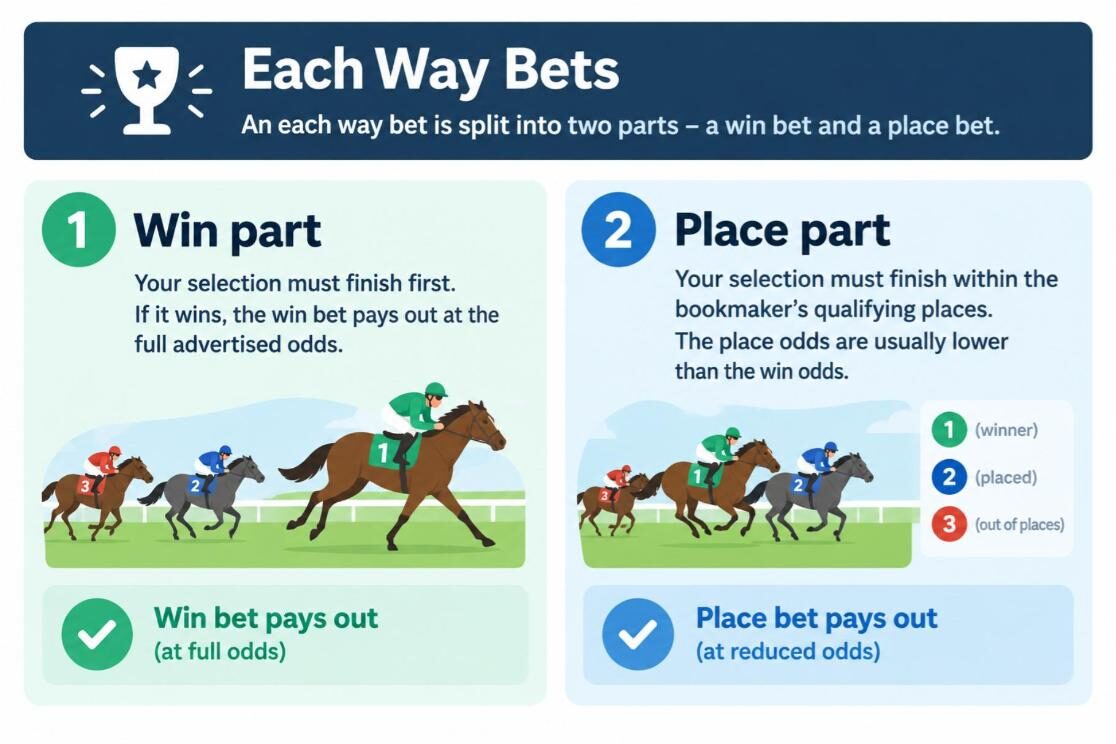
Each-way betting combines two bets on the same selection: one for it to win and another for it to finish in a bookmaker's qualifying places. Your total stake is twice your chosen each-way stake. If the selection wins, both parts pay out; if it places without winning, only the place part pays out. Your overall profit or loss depends on the odds, place terms and total stake.
Each way betting is a popular type of bet in the UK, particularly in horse racing and golf. It gives you two ways to get a return from the same selection: by predicting the winner or by predicting that the selection will finish within a bookmaker's specified places.
However, an each way bet costs twice the advertised each way stake, and a place finish does not necessarily mean you will make a profit. Understanding how the win and place parts work is essential before placing a bet.
In this guide, we'll explain what each way means, how the odds and place terms affect your returns, how to calculate your potential profit and how OddsMonkey's betting tools can help you understand the numbers.
An each way bet combines two separate bets on the same competitor or selection:
For example, if you back a horse each way, you're betting on it to win the race and to finish in one of the qualifying places. The place bet can pay out even if your horse doesn't win, provided it finishes within those positions.
The place odds are usually calculated as a fraction of the win odds, such as 1/4 or 1/5. The exact terms vary between bookmakers, races and other sporting events.
An each way bet is therefore not simply a win bet with extra protection. You're paying for two bets, and the amount returned depends on the result and the terms offered.
Term
What it means
Each-way stake
The amount staked on each part of the bet
Win part
The bet that pays out if your selection wins
Place part
The bet that pays out if your selection finishes within the specified places
Place fraction
The fraction of the win odds used to calculate the place odds
Total stake
The combined amount staked on the win and place parts
Total return
The money returned from the winning part or parts, including returned stakes
Net profit or loss
Your total return minus the full amount staked
When you place an each way bet, your chosen stake is applied separately to the win and place parts.
If you select a £10 each way stake, for example, you place £10 on the selection to win and another £10 on it to place. Your total stake is £20.
Here's how the two parts work:
Result
Win part
Place part
Horse wins
Wins
Wins
Horse places but doesn't win
Loses
Wins
Selection finishes outside the places
Loses
Loses
The important distinction is that a winning selection pays out on both parts, while a selection that finishes second, third or another qualifying position only pays out on the place part.
If your selection finishes outside the places, you generally lose the entire stake.
Suppose you back a horse at odds of 8/1 (9.0 decimal), with bookmaker place terms of 1/5 odds for the first three places.
You choose a £10 each-way stake, which means £10 goes on the win part and £10 goes on the place part. Your total stake is £20.
The place odds are calculated using one-fifth of the 8/1 win odds. This gives place odds of 8/5, equivalent to decimal odds of 2.60.
The examples below show the total return and net profit or loss for each possible finishing outcome, assuming the stated terms apply and there are no settlement adjustments.
Bet detail
Calculation
Amount
Win stake
£10
£10
Place stake
£10
£10
Total stake
£10 + £10
£20
Win odds
8/1
9.0 decimal
Place odds
8/1 × 1/5
8/5 (2.60 decimal)
The following examples show how the outcome affects your return.
Finishing position
Win return
Place return
Total return
Net profit/loss
1st
£90
£26
£116
+£96
2nd or 3rd
£0
£26
£26
+£6
4th+
£0
£0
£0
-£20
If the horse wins, both the win and place parts return money, giving a total return of £116 and a net profit of £96 after deducting the £20 stake.
If the horse finishes second or third, only the place part pays out. The £26 place return leaves a net profit of £6 after the original £20 total stake is deducted.
If the horse finishes outside the first three, both parts lose and the full £20 stake is lost. This shows why an each-way bet can return a profit without winning, but a qualifying place does not guarantee an overall profit.
Figures assume the stated odds and place terms apply, with no deductions, dead heats or other settlement adjustments. Returns include the winning stakes.
This example illustrates why an each way bet can still return a profit when your selection doesn't win. However, a place finish does not automatically guarantee a profit: the place return must be greater than your total stake for you to come out ahead.
Want to see how different odds, stakes or place terms affect your result? Use the OddsMonkey Each Way Bet Calculator to calculate your total stake, potential return and profit or loss for different outcomes.
The calculator can also account for relevant inputs such as Rule 4 deductions. Check the applicable bookmaker terms before relying on any calculation.
The place odds are normally a fraction of the win odds. Common fractions include 1/4 and 1/5, although other terms can apply.
For example, if your selection has win odds of 10/1 and the bookmaker offers 1/5 odds for a qualifying place, the place odds are 2/1.
Win odds
Place fraction
Place odds
Decimal place odds
4/1
1/4
1/1
2.00
8/1
1/5
8/5
2.60
10/1
1/5
2/1
3.00
20/1
1/4
5/1
6.00
The fraction alone doesn't tell you everything you need to know. You must also check how many places are paid and which finishing positions qualify.
Each way place terms tell you two key things:
A bookmaker offering three places at 1/5 odds is not offering the same bet as one paying four places at 1/4 odds. The latter may cover an additional finishing position and offer a higher place fraction, but you should compare the full terms rather than assuming one offer is automatically better.
Expert insight
“An extra place can look attractive, but its value depends on more than the number of positions covered. Compare the place terms alongside the odds available and the likely competitiveness of the field; a bigger place offer isn't automatically the better bet.”
James, OddsMonkey Betting Expert
Always check the terms displayed on your bet slip before confirming the bet. These may vary by event, field size, bookmaker promotion and the number of declared runners.
Each way betting is most closely associated with horse racing, but it is also available on selected markets in other sports and competitions where there are multiple competitors and defined finishing positions.
The availability of each way markets and their terms depends on the bookmaker.
What the data says
The Gambling Commission’s 2025 survey found that 4% of adults in Great Britain had bet on horse racing in the four weeks covered by its July–October 2025 survey. This provides useful context for a guide explaining how each-way betting works, particularly for horse racing markets.
Source: Gambling Commission, Statistics on gambling participation
Sport
How each way betting can work
What to check
Horse racing
Back a horse to win or finish in the specified places
Number of runners, place terms and non-runners
Golf
Back a golfer to win a tournament or finish within the paid places
Number of places, place fraction and field size
Darts
Back a player to win a tournament or finish in a specified position, where offered
Tournament market and bookmaker terms
Football
Back a team to win a qualifying outright competition or finish in a specified position, where offered
Outright market and qualifying places
For a standard head-to-head football match or darts match, an each way bet is not normally applicable in the same way as it is for a tournament. Each way betting is generally associated with markets where several competitors can finish in a ranked order.
Explore our specialist guides for more detail:
Whether an each way bet is suitable depends on the odds, place terms, your assessment of the selection and the total stake required.
An each way bet can be worth considering when you want exposure to both the win and place outcomes. For example, a golf player might be unlikely to win a large tournament but could still finish within the bookmaker's paid places.
However, a larger potential return doesn't automatically make a bet good value. The place fraction, the number of places paid and the probability of your selection finishing in those places all matter.
Expert insight
“The key question is whether the potential return justifies the combined stake. Assess the win and place parts separately, compare the available odds and place terms, and consider the likelihood of your selection finishing in a qualifying position. A bigger potential payout does not necessarily mean a better-value bet.”
James, OddsMonkey Betting Expert
Before placing an each way bet, consider:
If you're exploring different approaches, our guide to each way betting strategies can explain how each way bets fit into different betting approaches.
Not every race is equally suitable for each way betting. The value of the place part depends on the odds, the number of places paid, the number of runners and the likelihood of your selection finishing in a qualifying position.
A race may be less attractive for an each way bet when:
A race isn't necessarily a bad one simply because it has a short-priced favourite or a large field. The important question is whether the odds and place terms make sense for the bet you're considering.
What the data says
The British Horseracing Authority reported that the average British race field in 2025 contained 8.90 runners on the Flat and 7.84 over Jumps. These differences reinforce the importance of checking the number of runners and the bookmaker's qualifying place terms before placing an each-way bet.
Read our guide to bad each way races for more detail on the factors to examine before choosing a race.
Calculating an each way bet manually involves working out two potential returns: one from the win bet and another from the place bet.
The basic process is:
Identify the win odds and the bookmaker's place fraction.
Calculate the place odds using the advertised fraction.
Calculate the return from the win bet if your selection wins.
Calculate the return from the place bet if your selection finishes within the qualifying places.
Add the applicable returns together and subtract the total stake to establish your net profit or loss.
For example, a £5 each way bet costs £10 in total. If the win odds are 6/1 and the bookmaker offers 1/4 odds for a place, the place odds are 6/4, or 1.50 in decimal odds.
If the selection finishes second, the £5 win stake loses and the £5 place stake returns £12.50, including the stake. Your net result is therefore a £2.50 profit.

Each Way Betting Calculator
Free betting calculation tool
The OddsMonkey calculator lets you enter your stake, odds, place terms and applicable Rule 4 deductions to calculate the total stake, return and profit or loss.
The calculator is particularly useful when comparing different place fractions or checking what happens if your selection finishes in a particular position. It also helps you avoid confusing the stake on each part with the total amount you need to fund.
Each way betting can also be used as part of matched betting, which involves placing bets with a bookmaker and using opposing bets to manage the outcome.
With a conventional each way bet, you have a win bet and a place bet. When matching the bet through an exchange, you generally need to account for the corresponding win and place markets, the available odds and any exchange commission. Some specialist tools support different matching methods.
The aim of matched betting is to calculate the positions carefully so that the combined bookmaker and exchange outcomes produce the intended result, subject to the prices, settlement rules and other conditions. It is not enough simply to place an each way bet and assume a profit is guaranteed.
An each-way bet combines a win bet and a place bet on the same selection. Your chosen stake applies to each part, so the total cost is twice the each-way stake. If your selection places without winning, only the place part pays out.
Before placing a bet, check the odds, place fraction, number of qualifying places and any settlement conditions. Calculate the total stake and potential return so you understand the possible profit or loss across different outcomes.
Remember that betting involves financial risk. Set a budget you can afford to lose, and don't chase losses. For independent information and support, visit the Gambling Commission's safer gambling guidance or GamCare.
An each way bet consists of two bets on the same selection: one to win and one to finish in a specified place. The win bet pays out if the selection wins, while the place bet can pay out if it finishes within the bookmaker's qualifying positions. The total stake is twice the amount quoted as the each way stake.
You choose a selection and stake an equal amount on it to win and to place. If it wins, both parts pay out. If it finishes in a qualifying place without winning, only the place part pays out. If it finishes outside the places, both parts normally lose.
Yes. A £10 each way bet normally costs £20: £10 on the win and £10 on the place. Always check whether the stake displayed on your bookmaker's bet slip is the stake for each part or the combined total.
The winning part of an each way bet returns its stake alongside the winnings. If your selection places but doesn't win, the place bet returns its own stake plus any winnings, but the win stake is lost. Whether you make an overall profit depends on the place return compared with your total stake.
It means the place odds are calculated at one-fifth of the win odds. For example, if a horse is priced at 10/1 to win, the place odds at 1/5 are 2/1. The number of qualifying places is a separate term that you should check on the bet slip.
Neither option is automatically better. A win-only bet costs less for the same quoted stake and pays out only if the selection wins. An each way bet costs twice as much but includes a separate place bet, which may return money when the selection doesn't win. The right choice depends on the odds, place terms, likely outcomes and your assessment of the value.
Yes, it is possible. The place part may return more than the combined win and place stake, even though the win part loses. However, a second-place finish does not guarantee a profit because the place odds and total stake determine the result.
Horse racing and golf are two common examples. Each way markets may also be available for selected darts tournaments, football outright markets and other competitions with multiple ranked competitors. Availability and terms depend on the bookmaker and event.
Use the OddsMonkey Each Way Betting Calculator to enter your stake, odds, place fraction and relevant deductions. The calculator helps you see the total stake, potential return and profit or loss for the selected outcome.

Unlock £29+ with our offer guides. Each guide will walk you through the back and lay bets needed to make your first matched betting profits.
Earn immediately. No payment details required
Start your FREE Trial
*DISCLAIMER: We’re legally required to state that there is no guarantee of specific results each month. The amount of money that you earn can vary dependant on the time and effort that you commit each month.
This website is strictly for over 18’s. If you do have any concerns about gambling please contact GambleAware
© Copyright 2011-2026 Terms of Use | Privacy Statement