
Both strategies use maths rather than predicting winners, but they make money in completely different ways. Arbitrage betting is price-led. Matched betting is promotion-led. Here is how they compare.
Quick answer
Arbitrage betting and matched betting are not the same strategy. Arbitrage betting aims to profit from differences in odds between bookmakers or betting exchanges, while matched betting primarily uses bookmaker promotions, such as free bets, alongside opposing bets to extract promotional value.
In simple terms: arbitrage betting is price-led; matched betting is promotion-led.
Arbitrage betting involves finding differences in odds between bookmakers or betting exchanges and placing bets that cover all possible outcomes to create a mathematical profit. Matched betting uses bookmaker promotions, such as free bets, together with opposing bets to extract value from those offers.
Both strategies can involve multiple bookmakers and betting exchanges, but the way profits are generated, the opportunities available and the risks involved are different.
Factor
Arbitrage betting
Matched betting
Primary opportunity
Differences in odds
Bookmaker promotions
Free bets required
No
Usually
Betting exchange
Optional but useful
Commonly used
Main skill
Finding price discrepancies
Completing offers accurately
Speed required
Often high
Usually lower
Main risks
Odds movement, limits and liquidity
Incorrect stakes, terms and missed steps
Opportunity source
Market pricing
Promotions and offers
Best suited to
Bettors comfortable monitoring prices
Bettors who prefer a structured process
In this guide, we'll compare arbitrage betting vs matched betting, explain how each strategy works and explore how betting exchanges fit into both approaches.
Arbitrage betting, sometimes called arb betting or sure betting, involves taking advantage of differences in the odds offered by different betting operators.
The basic idea is simple: if the available odds are sufficiently different, you can place bets covering every possible outcome and structure your stakes so that the overall position produces a mathematical profit regardless of which outcome occurs.
For example, imagine a two-way tennis market where one bookmaker offers odds of 2.20 on Player A while another offers 2.10 on Player B. Rather than trying to predict which player will win, an arbitrage bettor looks at whether those prices can be combined to create an arbitrage opportunity.
The key is not simply finding two different odds. The combined implied probabilities must be low enough to create a profitable position after taking all relevant costs into account. You need the combined probability to be less than 100%.
Outcome
Platform
Odds
Implied probability
Player A
Bookie A
2.20
45.45%
Player B
Bookie B
2.10
47.62%
Combined implied probability
93.07%
Using our example, the combined percentage of implied probability means there's an arbitrage betting opportunity.
The use of arbitrage betting calculators and implied probability calculators can make this process much easier by calculating the required stake on each outcome and showing the potential return.
Read our arbitrage betting strategies guide for more information about placing arbitrage bets and how to calculate them.
Matched betting is a different strategy. Instead of relying primarily on differences in standard betting odds, matched betting typically involves taking advantage of bookmaker promotions such as free bets and bonus offers.
A common matched betting process involves placing a qualifying bet with a bookmaker while placing an opposing bet, known as a lay bet, on a betting exchange. The purpose is to cover the outcome of the event and minimise exposure to the sporting result.
Once the qualifying conditions of the promotion have been met, the bettor can then use the resulting free bet and an exchange lay bet to convert part of the promotional value into cash.
Example
A bookie offers a free £10 bet if you place a bet of £10 (the qualifying bet).
Arsenal are playing Chelsea in an upcoming Premier League match. You back and lay Arsenal as follows:
Selection
Platform
Stake
Odds
Arsenal (back)
Bookmaker
£10
2.0
Arsenal (lay)
Betfair
£10
2.04
Irrespective of whether Arsenal lose or not, you'll lose 20p on your qualifying bet — but this is normal. The objective is to keep losses to a minimum so you can make the real money from the bonus (free) bet.
Man City are playing Man United in an upcoming Premier League match. You back and lay Man United as follows:
Selection
Platform
Stake
Odds
Man United (back)
Bookmaker
£10 (free)
5.0
Man United (lay)
Betfair
£7.84
5.1
Profit
£7.84
This time, you'll be able to lock in a profit even if Man United lose. When the process is followed correctly, you can expect to make approximately £7.86 or £7.84.
The OddsMonkey Matched Betting Calculator tells you what stakes to place in a flash. Here's what the above inputs would look like:
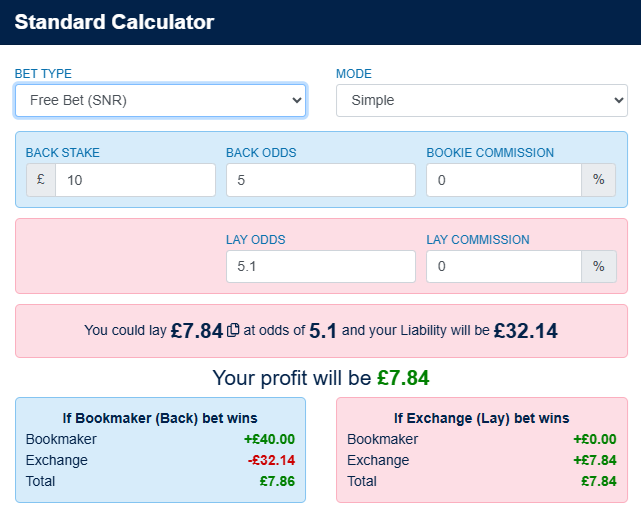
This means matched betting is fundamentally based on extracting value from bookmaker promotions, rather than identifying a pricing discrepancy between different bookmakers. Our guide to what matched betting is has more in-depth information if you wish to know more.
Betting exchanges can be important to both strategies, but they serve different purposes.
For arbitrage bettors, an exchange can provide an alternative source of odds. Instead of finding two bookmakers offering the required prices, a bettor might back at a bookmaker and lay at an exchange.
This can create an arbitrage opportunity when the relationship between the bookmaker's back price and the exchange's lay price is favourable enough. Exchange commission also needs to be incorporated into the calculation, because a price difference that looks profitable before commission may produce little or no profit after exchange charges.
In matched betting, exchanges are often used to lay the same selection backed at the bookmaker. For example, suppose a bookmaker promotion requires a £20 qualifying bet on a horse. The bettor can back the horse at the bookmaker and lay the horse on the exchange.
If the horse wins, the bookmaker's return is offset by the exchange liability. If the horse loses, the qualifying back bet is lost while the lay bet wins. The resulting difference is the qualifying cost of accessing the promotion, which can then lead to profit when the promotional free bet is used correctly.
For more information, take a look at our guide to lay betting.
The easiest way to understand the difference between arbitrage betting and matched betting is to compare how each strategy creates its potential profit.
Comparison
Arbitrage betting
Matched betting
Main source of profit
Difference in odds
Bookmaker promotions
Free bet required
No
Usually
Multiple bookies?
Often
Often
Exchange useful?
Sometimes
Commonly
Relies on odds variance
Yes
Not necessarily
Promotion dependency
No
Yes
Profits after offers
Yes
Yes
Main execution risk
Odds movement
Incorrect qualifying/lay bet
Main constraint
Limits and liquidity
Offer availability and terms
Main tools
OddsMatcher and calculators
OddsMatcher and calculators
Best suited to
Market monitoring
Structured offer completion
The biggest distinction is where the opportunity comes from. With arbitrage betting, the opportunity comes from price differences. With matched betting, it generally comes from promotional value.
Find different prices. You compare odds from different bookmakers and, where relevant, betting exchanges.
Identify an arbitrage opportunity. The available odds are checked to determine whether they create a profitable mathematical position.
Calculate the stakes. The correct amount is allocated to each outcome.
Place every required bet. All sides of the arbitrage need to be successfully placed at the intended prices.
Collect the return. Provided the bets are correctly placed and market conditions remain as expected, the result should produce the calculated return regardless of the winning outcome.
This makes arbitrage betting primarily a price-discovery and execution strategy.
Find a bookmaker promotion. The bettor identifies a qualifying offer or free bet.
Understand the terms. The qualifying stake, minimum odds, expiry date and other conditions need to be understood before placing the bet.
Place the qualifying bet. A back bet is placed with the bookmaker.
Place the corresponding lay bet. The opposing position is placed on a betting exchange where available.
Complete the promotion. Once the qualifying requirements are satisfied, the free bet or promotional reward becomes available.
Convert the free bet. The promotional value is matched with an opposing exchange position to turn as much of its value as possible into cash.
Matched betting is therefore more closely associated with promotion optimisation than price arbitrage.
For many newcomers, matched betting can be easier to understand because the process tends to follow a defined promotion. A bettor finds an offer, follows the qualifying instructions and uses a calculator to determine the correct back and lay stakes.
Arbitrage betting can be more dynamic. Prices constantly move, and an arbitrage opportunity can disappear before both sides of the bet have been placed. That means arbitrage betting tends to place greater emphasis on:
Neither strategy is necessarily "easy", but the skill sets involved are different.
This depends on the bettor's approach. Matched betting opportunities are tied to the promotions available from bookmakers. When attractive introductory offers or ongoing promotions are available, there may be a large number of opportunities to work through.
What the data says
The Gambling Commission found that around 9 in 10 people surveyed had received an online gambling promotional offer in the previous four weeks, and 76% of those who received an offer went on to use it. The findings demonstrate how prominent promotional incentives remain within online gambling.
Arbitrage betting does not depend on promotional offers. Instead, opportunities can occur whenever bookmakers or exchanges offer sufficiently different prices. This means arbitrage betting can remain relevant even when there are fewer attractive promotions available. The trade-off is that the opportunities must actually exist in the market, and they may disappear quickly.
With matched betting, a promotion can provide a relatively defined amount of potential value. For example, a bookmaker might offer a free bet with specified qualifying conditions, so the potential return can be estimated before the offer is completed.
Arbitrage betting works differently. The potential profit depends on:
The percentage return from an individual arbitrage can therefore vary from opportunity to opportunity. Our guide to how much you can make arbitrage betting looks at realistic returns in more detail.
Expert quote
"A headline arbitrage percentage can be misleading if you cannot secure the advertised stake at both prices. The real measure is executable profit: what remains after account limits, exchange commission, partial fills and any price movement between placing the first and final bet."
Ian, OddsMonkey Sports Betting Expert
This is one reason experienced arbitrage bettors often use software or calculators to identify opportunities and calculate stakes efficiently.
Although arbitrage betting is designed around mathematical outcomes, there are still practical risks.
Odds can move. The biggest issue is that one price may change before the other bet is placed. If that happens, the expected arbitrage may no longer exist.
Bets can be limited. Bookmakers can impose restrictions on accounts, stakes or available markets in accordance with their terms and applicable requirements.
What the data says
The Gambling Commission's 2025 data request found that 4.31% of 14.9 million active customer accounts had some form of commercial restriction, with 2.68% subject to stake-factor restrictions. For bettors relying on multiple bookmakers, account restrictions can therefore materially affect available staking capacity.
Exchange bets may not be fully matched. A betting exchange requires another market participant to take the other side of your bet. If there is insufficient liquidity, your desired stake may not be fully matched.
Calculation errors. A small mistake in stake sizing can turn a mathematically profitable opportunity into an unwanted exposure. This is why specialist calculators can be useful.
Matched betting also involves practical risks. The most common problems include:
Matched betting may reduce reliance on predicting sporting outcomes, but it still requires the bettor to follow the process carefully.
Expert quote
"The biggest matched betting mistakes often happen before the bet is placed. A promotion can look highly profitable on paper, but one overlooked condition — such as qualifying odds, excluded markets or a restricted payment method — can materially change the expected return."
James, OddsMonkey Matched Betting Expert
Yes, you can use both. In fact, arbitrage betting and matched betting can complement one another. A bettor might use matched betting to take advantage of bookmaker promotions while also monitoring the market for arbitrage opportunities. For example, a bookmaker's promotional odds could occasionally create an attractive pricing discrepancy when compared with another bookmaker or betting exchange.
There is no universal winner. Matched betting may suit beginners who want a structured, promotion-led strategy, while arbitrage betting may suit bettors who are comfortable monitoring odds and acting quickly when pricing discrepancies appear.
Matched betting may suit you if
Arbitrage betting may suit you if
Some bettors may ultimately use both approaches rather than choosing between them. If you are considering running them side by side, read our guide on whether it is ever safe to arb as part of your matched betting strategy.
Arbitrage betting and matched betting share some similarities, but they are fundamentally different strategies. Matched betting focuses on bookmaker promotions. Arbitrage betting focuses on differences in odds.
Both can involve multiple bookmakers, calculators and betting exchanges, but the way opportunities are identified and executed is different. Matched betting tends to be more promotion-led and structured, while arbitrage betting is more market-led and dependent on finding temporary pricing discrepancies.
Betting exchanges can play an important role in both strategies. In matched betting, they are commonly used to lay selections and offset bookmaker bets. In arbitrage betting, exchange prices can be compared with bookmaker odds to uncover additional opportunities.
Rather than viewing arbitrage betting vs matched betting as an either-or decision, some experienced bettors may use both approaches as part of a broader strategy. Whatever approach you take, accurate calculations, disciplined bankroll management and a clear understanding of bookmaker and exchange terms are essential.
Arbitrage betting focuses on differences in available odds between bookmakers and betting exchanges, while matched betting focuses primarily on bookmaker promotions. In simple terms, arbitrage is price-led, whereas matched betting is promotion-led.
Matched betting may be easier for beginners because bookmaker promotions provide a more structured process to follow. Arbitrage betting can require faster decisions, more active odds monitoring and a greater understanding of market prices.
Yes. Arbitrage betting does not depend on free bets or bookmaker promotions. The opportunity comes from finding sufficiently favourable differences between available prices and covering the relevant outcomes.
Not always, but betting exchanges are commonly used because they allow bettors to place lay bets against bookmaker selections. This helps offset the outcome of a qualifying bet or promotional bet.
Yes. An exchange can provide an alternative price for an arbitrage, such as backing with a bookmaker and laying on an exchange. Commission, available liquidity and the amount that can actually be matched all need to be considered.
Neither strategy should be considered completely risk-free. Arbitrage betting can be affected by changing odds, limits and unmatched exchange bets, while matched betting can be affected by incorrect stakes, promotion terms and missed qualifying conditions.
There is no fixed answer. Matched betting opportunities depend on the promotions available from bookmakers, while arbitrage opportunities depend on temporary differences in market prices, so the number and availability of opportunities can vary over time.
Yes. Some bettors use matched betting to take advantage of bookmaker promotions while also looking for arbitrage opportunities across bookmakers and exchanges. The strategies are different, but the same bookmakers, exchanges and calculation tools can sometimes be used for both.
Arbitrage betting is a recognised betting activity in Great Britain, where the Gambling Commission regulates licensed commercial gambling. Bettors should still check individual operator terms and use appropriately licensed businesses, as operators may impose commercial restrictions.

Unlock £29+ with our offer guides. Each guide will walk you through the back and lay bets needed to make your first matched betting profits.
Earn immediately. No payment details required
Start your FREE Trial
*DISCLAIMER: We’re legally required to state that there is no guarantee of specific results each month. The amount of money that you earn can vary dependant on the time and effort that you commit each month.
This website is strictly for over 18’s. If you do have any concerns about gambling please contact GambleAware
© Copyright 2011-2026 Terms of Use | Privacy Statement