
Arbing looks like a natural extension of matched betting — until a price moves, a stake is refused or a lay bet goes unmatched. Here are the real risks of arbing alongside matched betting, and how to manage them.
Quick answer
Arbitrage betting can be relatively low-risk from the sporting outcome, but it is not risk-free. A correctly calculated arbitrage can theoretically lock in a profit if all bets are successfully placed at the assumed odds and settled according to the assumed rules. The execution is not guaranteed.
In practice, odds can move, stakes can be limited, bets can be rejected or partially accepted, exchange bets may not be fully matched and bookmaker accounts can be commercially restricted. If you are considering arbing alongside matched betting, treat it as a separate strategy and check the prices, stakes, liquidity, commission and settlement rules before placing either side.
If you have been matched betting for a while, you may eventually come across arbitrage betting, or "arbing". At first glance, it looks like a natural extension of matched betting. Instead of relying solely on bookmaker promotions and free bets, you look for discrepancies between prices offered by different bookmakers or between a bookmaker and a betting exchange.
The attraction is obvious: if the prices are right, you can potentially cover every outcome and lock in a theoretical profit. But there is an important distinction between mathematical arbitrage and practical betting risk. The mathematics behind a genuine arbitrage opportunity can be highly predictable. The betting environment around it is not.
The better question isn't simply "is arbitrage betting safe?" — it is "what risks do I take when I arb, and how can I manage them?"
Factor
Matched betting
Arbitrage betting
Main opportunity
Bookmaker promotions and offers
Price discrepancies
Requires a free bet?
Often
No
Uses betting exchanges?
Frequently
Sometimes
Main objective
Convert promotions into profit
Exploit differing odds
Outcome covered?
Yes, when correctly matched
Yes, when correctly constructed
Main practical risks
Calculation, rule and settlement errors
Odds movement, stake limits, rejected bets
Long-term consideration
Bookmaker restrictions
Restrictions and availability of arbs
If you want the broader distinction between the two approaches, see our guide to arbitrage betting vs matched betting.
A genuine arbitrage opportunity exists when the available prices allow you to bet on all relevant outcomes and still have a positive expected return after accounting for stakes, commissions and other costs.
Selection
Odds
Implied probability
Bookmaker A: Team A
2.20
45.45%
Bookmaker B: Team B
2.10
47.62%
Combined implied probability
93.07%
Because the combined implied probability is below 100%, there is theoretically an arbitrage opportunity. That doesn't mean you should immediately place both bets. The opportunity only exists while those prices remain available and the bets can actually be placed as calculated. This is where practical risk enters the picture.
OddsMonkey expert insight
"The smaller the arbitrage margin, the less room you have for execution errors. A 0.5% theoretical edge can disappear surprisingly quickly through a price tick, commission or small stake discrepancy, so the headline profit should never be confused with a safety margin."
Arbitrage risk
What can happen
How to reduce the risk
Odds movement
One side of the arb becomes less attractive before both bets are placed
Recheck both prices immediately before betting
Stake limits
A bookmaker will not accept the calculated stake
Check the maximum stake before placing the first side
Rejected or partial bets
You are left with an uncovered position
Confirm the full stake has been accepted
Exchange liquidity
Your required lay stake is not fully matched
Check liquidity at the exact price you need
Calculation errors
The two sides do not balance as intended
Use an arbitrage calculator
Settlement rules
Different operators settle the same market differently
Check the rules before placing either bet
Account restrictions
Maximum stakes or betting access may be reduced
Understand operator terms and allow for restrictions
This is probably the most obvious practical risk. Arbitrage opportunities can disappear quickly. You might find a price that creates a 1% theoretical return, calculate your stakes and then discover that one bookmaker has moved the odds before you place the bet.
For example, you identify an arb at 2.20 at a bookmaker and a lay price of 2.10 at a betting exchange. You place the first bet. Before you place the lay bet, the other bookmaker changes from 2.10 to 2.00. The calculation you originally made is no longer valid, and you may now have an unmatched position.
Tip: recheck the odds immediately before placing each side of an arbitrage bet. OddsMonkey's Arbitrage Calculator can help you calculate the required stakes and potential returns rather than relying on mental arithmetic.
Finding an arbitrage opportunity doesn't guarantee that you can stake enough money to exploit it. Your calculation might tell you to place £100 on one side and £104.76 on another, but if the bookmaker only accepts £35, you cannot simply assume the original arb still works.
This is particularly relevant because bookmaker limits can affect bettors who consistently target price discrepancies. Your available stake may also vary between markets and accounts. Never treat a displayed arbitrage opportunity as guaranteed profit until both sides can actually be placed at the required prices and stakes.
Imagine you've calculated an arb and successfully placed the first £100 bet. You then attempt to place the second £105 bet, and the bookmaker accepts only £40. You now have a much larger exposure on one outcome than intended.
This is why the order in which you place bets matters, particularly when dealing with fast-moving markets. You should also check whether a bookmaker has accepted the full stake before assuming your position is completely covered.
Arbitrage betting involves mathematics. That doesn't necessarily mean the mathematics is complicated, but small errors can have significant consequences when stakes increase. Common mistakes include:
A mathematical arbitrage opportunity is only as good as the assumptions behind it. One bookmaker might settle a market according to one set of rules while another uses different conditions. Potential complications can include abandoned matches, postponements, player withdrawals, dead heats, void bets, extra time and different interpretations of markets. Don't simply compare the headline odds — check the market and settlement rules before placing the bets.
Bookmakers can manage their commercial exposure by applying restrictions to customer accounts. These can include reducing maximum stakes, restricting particular markets, withdrawing betting facilities or closing an account for commercial reasons.
This does not mean that every bookmaker restricts customers who place arbitrage bets, nor does the available data establish that arbing itself causes an account to be restricted. However, account availability is an important practical consideration for anyone relying on bookmaker price discrepancies over the longer term.
What the data says
4.31% of 14,923,840 active customer accounts were subject to some form of commercial restriction, according to Gambling Commission data covering a majority of the British online real-event betting market. Account closures for commercial reasons affected 2.23% of active accounts, demonstrating that account availability can be a genuine practical consideration for bettors.
Source: UK Gambling Commission, commercial restrictions by betting operators
The practical takeaway: don't build an arbitrage strategy around the assumption that every bookmaker will always accept the stake you need.
It depends on what you mean by "safe". If you're talking purely about the sporting result, a correctly constructed arbitrage can be considerably more controlled than simply backing one team and hoping it wins. The purpose of an arb is to cover all relevant outcomes. But that doesn't make the overall activity risk-free.
Normal betting risk
Arbitrage risk
Arbitrage doesn't remove risk. It changes where the risk sits.
Here are a couple of examples of where an arbitrage bet can go wrong using two different arb strategies.
Bookmaker to bookmaker arb
Suppose you identify £100 on Player A at 2.20 with Bookmaker A, and £104.76 on Player B at 2.10 with Bookmaker B. Once you input your figures into the Dutching Calculator, there's a profitable arb:
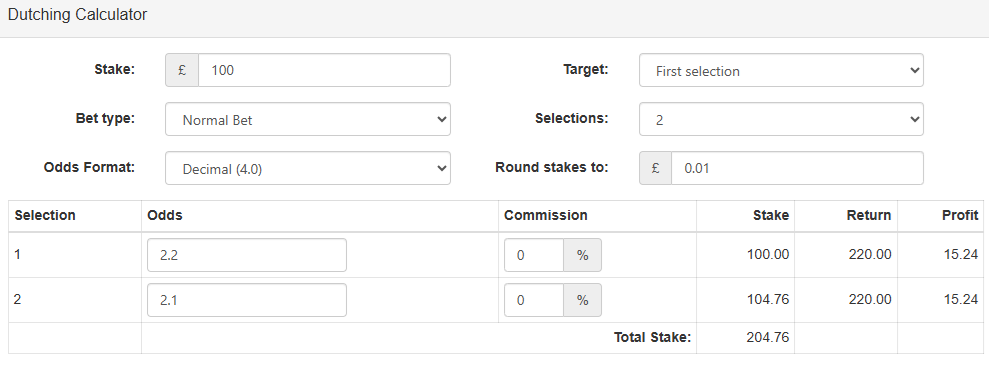
Your calculation suggests a profit regardless of the winner. You place the £100 bet. Then Bookmaker B reduces the odds to 1.95. You now have three choices:
Place the original calculated stake anyway, knowing the position has changed.
Recalculate the required stake at the new odds.
Decide not to place the second bet and accept the exposure created by the first bet.
The important lesson is that an arb is not complete until the position is properly covered. This is why arbitrage is better thought of as an execution strategy rather than simply a way of finding "free money".
Bookmaker to exchange arb
The same problem can occur when one side of the arb is placed with a bookmaker and the other on a betting exchange. Suppose you identify £100 on Player A at 2.20 with Bookmaker A, and a £104.76 lay stake against Player A at 2.10 on the exchange.
You place the £100 bookmaker bet on Player A. Before you can place the exchange bet, however, the available lay price moves from 2.10 to 2.30 — and there may no longer be enough liquidity at the price you originally identified. You now have several choices:
Accept the new exchange price and recalculate the lay stake, potentially reducing or eliminating your expected profit.
Place the lay bet at the available price, knowing your final position will differ from the original calculation.
Wait for the original price to become available again, while remaining exposed to the bookmaker bet.
Cancel the strategy and manage the resulting position, if the exchange price no longer allows a suitable hedge.
There is another risk unique to exchanges: your bet may not be fully matched. You might successfully place the lay bet but only £60 of the required £104.76 gets matched. You would then remain partially exposed to the outcome. This illustrates why exchange liquidity is just as important as the displayed odds.
OddsMonkey expert insight
"Exchange liquidity needs to be judged at the exact price you need, not simply by the amount shown on the market. A market can look highly liquid overall while having very little available at your required odds, leaving you exposed if the price moves."
An apparent arb is not necessarily an executable arb. The prices, available stakes, liquidity and commission all need to work at the moment you place the bets.
If you're an experienced matched bettor considering arbitrage, don't think of arbing as simply "matched betting with bigger stakes". Instead, treat it as a separate strategy with its own process.
Start small. Don't begin by committing a large bankroll. Use smaller stakes while you become comfortable finding opportunities, checking markets, calculating stakes, placing both sides and monitoring settlements.
Calculate before betting. Don't improvise stake sizes. Enter the prices into an appropriate calculator and check the result.
Confirm the odds. Prices can move between finding an opportunity and placing the bet. Check them again before committing.
Check maximum stakes. Make sure the bookmaker will actually accept the amount you need.
Check both bets. Don't assume a bet has been accepted. Confirm the stake and odds shown on your bet slip or account history.
Keep records. Track the date, event, market, bookmaker, odds, stake, exchange commission, expected profit and actual result.
Don't chase an arb. If an opportunity disappears, let it go. Forcing a second bet after one side has already been placed can turn a calculated position into an ordinary directional bet.
Risk
What can happen
How to reduce it
Odds move
One side becomes less profitable or creates exposure
Recheck prices immediately before betting
Stake limit
You cannot place the calculated amount
Check the maximum stake first
Partial acceptance
Only part of a bet is accepted
Confirm the full stake
Exchange liquidity
Your lay bet isn't fully matched
Check available liquidity at the required price
Calculation error
Stakes don't balance correctly
Use an arbitrage calculator
Settlement rules
Bets are settled differently
Check market rules at both operators
Account restrictions
Your available stake may be reduced
Read operator terms and don't assume unlimited access
No betting tool can eliminate the practical risks involved in arbitrage betting. However, the right tools can help reduce avoidable calculation errors and make it easier to assess an opportunity before you commit your stakes.
The OddsMonkey Arbitrage Calculator can help you calculate the stakes required for an arbitrage position and account for factors such as the available odds and exchange commission. Best used for checking whether the mathematics of a potential arb works before placing the bets.
The OddsMatcher compares bookmaker and betting exchange prices and can help you find relevant opportunities without checking every price manually. Best used for comparing available prices before checking whether they form a genuine arbitrage opportunity.
The Implied Probability Calculator converts decimal odds into their implied probability, helping you assess whether the combined implied probabilities of the relevant outcomes are below 100%. Best used for quickly checking the underlying mathematics of a potential arbitrage opportunity.
If you're combining arbing with conventional matched betting, don't forget the standard Matched Betting Calculator. It calculates the required lay stake and potential return when placing qualifying bets and free bets. Best used for keeping your traditional matched betting activity separate from your arbitrage calculations.
These tools help with calculation and comparison. They cannot guarantee that an operator will accept your required stake or that an exchange bet will be fully matched.
Arbitrage opportunities can appear across many sports, but the characteristics of each market differ. Football can provide opportunities across major leagues and markets, particularly where multiple bookmakers offer different prices. Tennis can also be interesting because many matches have two primary outcomes, making the mathematics of a two-way market relatively straightforward.
However, neither sport is automatically "safe". Player withdrawals, retirements, abandoned matches, market suspensions and different settlement rules can all affect an apparently straightforward arb. For more detail, see our guides to football arbitrage betting and tennis arbitrage betting, or explore what sports you can place arbitrage bets on.
Is arbing a good addition to matched betting?
"For an experienced matched bettor, it can be worth understanding arbitrage as another tool in the wider betting toolkit. However, it shouldn't be viewed as a replacement for disciplined matched betting. Matched betting typically focuses on extracting value from bookmaker promotions; arbitrage focuses on price discrepancies. A bettor may choose to use both, but each requires its own calculations, processes and risk management."
Yes, arbitrage can be relatively low-risk when the mathematics is correct and every part of the bet is executed properly — but it is never completely risk-free. The key risks aren't necessarily whether your chosen team wins or loses. They're things such as:
The safest approach is therefore not to ask whether an arb is "guaranteed". Instead, ask: have I checked the prices, calculated the stakes, confirmed the rules and ensured I can place both sides? If the answer is yes, you've removed many of the avoidable risks.
If you're new to the concept, start with our main arbitrage betting guide before moving into more advanced approaches, then explore arbitrage betting strategies to understand the different methods you can use. Our guide on how to get started arbitrage betting covers the practical setup.
18+ only. Gambling should be conducted responsibly. Arbitrage and matched betting involve real-money gambling and are not guaranteed ways to make money. Never stake more than you can afford to lose. If gambling is causing you harm, consider using GAMSTOP or other gambling-blocking and support tools. The UK Gambling Commission states that GAMSTOP allows consumers to self-exclude from online operators licensed in Great Britain with one request.
No. A correctly calculated arb can reduce exposure to the sporting outcome, but it cannot eliminate practical risks such as odds changes, rejected or partially accepted bets, settlement differences and bookmaker restrictions.
The biggest practical risk is that the position changes between finding the opportunity and successfully placing all sides of the arb. Odds can move, available stakes can change or an exchange bet may not be fully matched, leaving you with an unintended exposure.
Yes. Although a genuine arb is designed to cover all outcomes, you can lose money if one side is not placed as planned, odds change, a bet is partially matched or the market is settled differently than expected. This is why an apparent arb should not be treated as guaranteed profit.
Yes. Arbitrage can be used as a separate strategy alongside matched betting because the two approaches generate opportunities in different ways. Matched betting primarily uses bookmaker promotions, while arbitrage looks for discrepancies between available prices.
Bookmaker policies and account management practices vary, so you should not assume that a bookmaker will accept every stake or price indefinitely. Always check the relevant bookmaker's terms and conditions and be prepared for stake restrictions or other account limitations.
Neither approach is completely risk-free. Bookmaker-to-exchange arbing introduces additional considerations such as exchange commission, available liquidity and the possibility that a bet is only partially matched, while bookmaker-to-bookmaker arbing still carries risks from changing odds, stake limits and rejected bets.
Check that the combined implied probability of all relevant outcomes is below 100%, then confirm the actual odds, available stakes, market rules, commission and liquidity before placing the bets. A calculator can help verify the mathematics, but it cannot guarantee that the required prices and stakes will still be available.
Beginners should understand how arbitrage works and practise with small stakes before committing significant money. Using an arbitrage calculator and carefully checking both sides of every position can help reduce avoidable errors.
Check the current odds, required stakes, maximum accepted stake, exchange commission and available liquidity, as well as the market and settlement rules. You should also confirm that both sides of the arb can actually be placed before considering the position covered.
Don't automatically place the second bet at the new price. Recalculate the position first and decide whether the revised odds still provide an acceptable outcome; if necessary, accept that the original arbitrage opportunity has disappeared rather than chasing it.

Unlock £29+ with our offer guides. Each guide will walk you through the back and lay bets needed to make your first matched betting profits.
Earn immediately. No payment details required
Start your FREE Trial
*DISCLAIMER: We’re legally required to state that there is no guarantee of specific results each month. The amount of money that you earn can vary dependant on the time and effort that you commit each month.
This website is strictly for over 18’s. If you do have any concerns about gambling please contact GambleAware
© Copyright 2011-2026 Terms of Use | Privacy Statement