
How much money can you make hedge betting? See realistic £50, £100 and £500 examples, learn what affects profits and calculate your potential hedge stake.
Quick answer
There is no fixed amount you can make from hedge betting. Your potential profit depends mainly on your original stake, the odds you backed at, the price available when you hedge, exchange commission and whether enough liquidity is available to place the required hedge.
For example, a £100 back bet at 3.00 followed by a hedge at 2.00 could produce a profit of around £48.48 when using a 2% exchange commission and equalising the outcome. This is an illustrative example, not a typical or guaranteed return.
If you're researching how to make money hedge betting, one of the first questions you're likely to have is: how much money can you make hedge betting?
The honest answer is that there is no fixed figure.
Hedge betting is a strategy for managing the potential outcome of a bet by placing another bet against your original position. Depending on the odds available and the stakes involved, hedging can be used to lock in a profit, reduce a potential loss or protect an existing position.
However, a hedge is not automatically profitable. The potential return depends on the relationship between your original bet and the hedge, as well as factors such as exchange commission, changing odds and the opportunities available.
In this guide, we'll explain how hedge betting profits work, show some examples and look at the factors that determine how much you can make hedge betting in the UK.
Your potential hedge betting profit is determined by the numbers behind the two bets rather than by a fixed percentage or guaranteed return.
The main factors are:
This means two people could use the same hedge betting strategy and achieve very different results.
OddsMonkey expert insight
"The biggest mistake I see with hedging is treating the headline profit as the opportunity itself. What matters is whether you can actually secure the required hedge at the quoted price, with enough liquidity available and all commission costs included."
James, OddsMonkey Hedge Betting Expert
For example, someone staking £20 on an initial bet might only be able to lock in a small profit, while a £500 initial position could potentially produce a much larger monetary return from the same movement in odds.
Here are some hypothetical profit scenarios:
Initial stake
Back odds
Hedge odds
Example profit
£50
3.00
2.00
£24.24
£100
3.00
2.00
£48.48
£250
3.00
2.00
£121.21
£500
3.00
2.00
£242.42
*Illustrative example based on a 2% exchange commission and an equal-profit hedge.
But bigger stakes also mean greater exposure before the hedge is placed. Potential profit should therefore never be confused with guaranteed income.
Hedge betting is primarily a position-management technique.
A favourable price movement can create a profit opportunity, but hedging can also:
To understand how to make money hedge betting, it helps to look at a simple example.
Imagine you back Arsenal at odds of 3.00 with a £100 stake.
Your potential return if the team wins is:
£100 × 3.00 = £300
Now imagine the team performs well and the odds move significantly. You may find that you can lay the same team at odds of 2.00 on a betting exchange.
Because the price has moved in your favour, you can potentially use the second bet to hedge your original position.
The precise hedge stake depends on the odds, commission and the outcome you're trying to achieve. Rather than calculating it manually, you can enter the figures into the OddsMonkey Hedging Calculator, which calculates the amount required for the hedge.
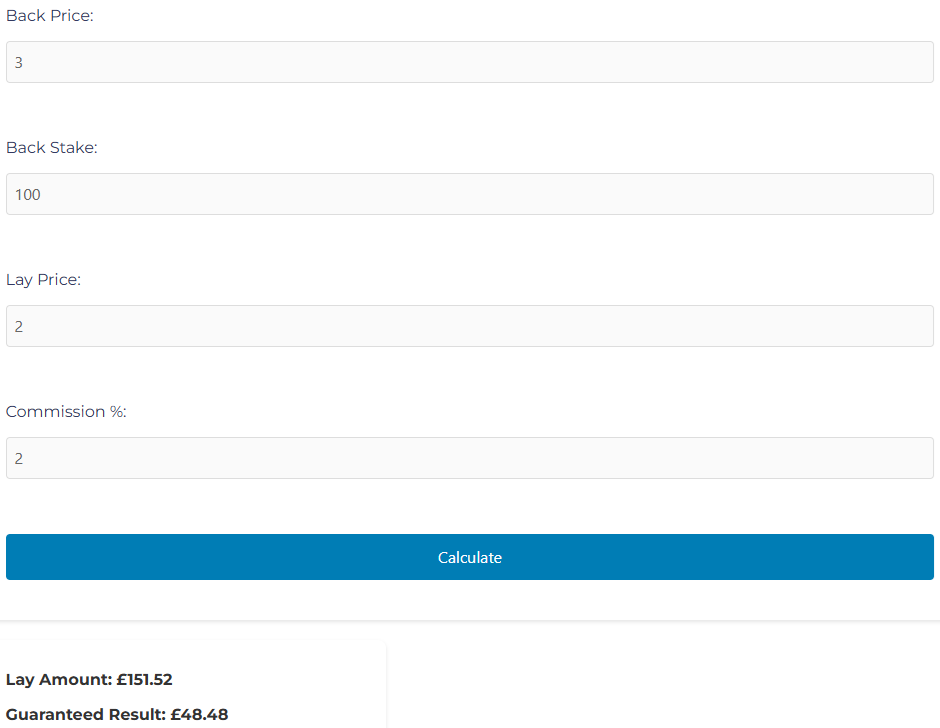
As you can see, the calculator suggests laying £151.52 against Arsenal winning to lock in a positive return of £48.48.
A basic hedge bet like this does not cover the draw but let's see how the calculations work should Arsenal win or lose.
This is where the difference between simply placing a second bet and strategically hedging becomes important.
The objective isn't just to place another wager. It's to calculate the second stake so that the combined position produces the outcome you're targeting.
Want to see what a particular hedge could produce? Enter your original back odds and stake, the current lay odds and your exchange commission into the OddsMonkey Hedging Calculator to calculate the required hedge stake and potential outcome.
No. This is one of the most important points to understand if you're looking at how to make money hedge betting.
Hedging does not automatically create a profit.
A hedge may be used because:
If the odds movement is not favourable enough, placing the hedge may simply crystallise a loss.
For example, imagine you back a horse at 4.00 and its price later moves to 6.00. Laying at 6.00 may not give you the type of favourable position that existed when the odds shortened.
This is why successful hedging is about calculating the position, not simply betting on the opposite outcome.
There are several variables that can have a significant impact on your results.
Factor
Effect on potential profit
Initial stake
Larger stakes can increase monetary profit and exposure
Original odds
Higher or lower starting odds affect the hedge calculation
Hedge odds
A more favourable price movement can improve the position
Exchange commission
Reduces profit on qualifying exchange winnings
Liquidity
Determines whether the required hedge can actually be matched
Market movement
Determines whether hedging is favourable
Number of opportunities
Affects potential cumulative results
Generally, larger stakes mean that a favourable movement in odds can produce a larger monetary result.
For example, a strategy producing a £5 return on a £50 position could potentially produce a £50 return on a £500 position if all other variables remained proportionally identical.
However, increasing your stake also increases your exposure before the hedge is placed.
You should never increase stakes simply because you want to make more money.
The size and direction of the odds movement is critical.
A relatively small change may not produce enough of an advantage to make hedging worthwhile after commission.
A larger favourable movement can create a more significant difference between your original position and the hedge.
This is particularly relevant in fast-moving sports markets, where odds can change substantially before or during an event.
For a broader introduction to the mechanics, see our guide to what is hedge betting?.
If your hedge involves laying a selection on a betting exchange, commission needs to be included in your calculations.
Ignoring commission can make a potential profit look larger than it actually is.
For this reason, enter the applicable commission rate when calculating your hedge stake.
The OddsMonkey Hedging Calculator includes a dedicated commission input alongside the back price, back stake and lay price.
Your overall results will also depend on how often you identify suitable opportunities.
There is no guarantee that you will find a profitable hedge every day, or even every week.
Markets, sports, odds and liquidity all vary.
Someone looking only for occasional opportunities will naturally have a different potential outcome from someone who spends considerably more time monitoring betting markets.
Staking is another major consideration.
A sensible approach is to decide how much capital you are comfortable putting at risk before you start rather than increasing stakes after a losing result.
Hedge betting should be treated as a strategy that requires disciplined bankroll management, not as a way to recover losses.
Let's look at a simplified example using a £100 initial stake.
Suppose you back a selection at odds of 3.00.
Your potential gross return is £300, including your original £100 stake.
If the odds subsequently shorten to 2.00, a hedge may now be possible.
The amount you need to place on the opposing position depends on the exact hedge you're trying to achieve and any applicable commission. However, on using our previous example, you could make £48.48 by laying odds of 2.0.
The important point is that the £100 stake doesn't determine your profit by itself.
The profit comes from the relationship between:
Initial odds → subsequent odds → initial stake → hedge stake → commission
That is why asking "How much can I make with £100?" can't provide a definitive answer. It will always depend on the odds available and the hedging strategy you use.
If your objective is to identify potential profit opportunities rather than simply hedge losing bets, there are several principles worth following.
A hedge generally becomes more attractive when the market moves in your favour.
For example, if you initially back a selection at relatively high odds and those odds subsequently shorten, investigate whether the new price allows you to create a favourable hedge.
Don't assume that every price movement creates a profitable opportunity.
Calculate it first.
This is perhaps the most important practical rule.
Before placing your hedge, work out:
The OddsMonkey calculator can do this maths for you, reducing the chance of a staking error.
Hedge betting should not be used to try to win back money you've already lost.
If a bet has moved against you, a hedge can sometimes reduce your exposure, but that doesn't mean placing a larger second bet will turn the position into a profit.
Make the decision based on the current numbers rather than what you have already lost.
If you're regularly placing hedge bets, record your stakes, odds, commission and final results.
This allows you to see whether your approach is actually producing the results you expected.
OddsMonkey also provides a Profit Tracker for recording and monitoring betting activity. The company's tools are designed to connect with its Profit Tracker, while the tracker can also be used to manually record previous bets and results.
There is no universal answer to which strategy can make more money.
Matched betting generally uses bookmaker promotions and opposing bets to extract promotional value, while hedge betting focuses on managing an existing betting position when the available odds change.
Because the two strategies depend on different types of opportunities, their potential results can vary. If you're comparing the two approaches, see our full guide to hedge betting vs matched betting.
Hedge betting isn't limited to one particular sport.
Potential opportunities can occur across sports and markets where there is sufficient liquidity and the odds can move.
The suitability of a market depends on the odds, liquidity, timing and the specific strategy you're using.
Our guide to what sports can I place hedge bets on? looks at this in more detail.
There is no trick that guarantees larger hedge betting profits.
Instead, focus on improving the quality and accuracy of your decisions.
OddsMonkey expert insight
"Scaling a hedge strategy purely because an earlier position produced a profit can quickly increase your exposure. A stronger approach is to establish a consistent staking framework first, then increase stakes only when the numbers and available liquidity continue to support the strategy."
James, OddsMonkey Hedge Betting Expert
Not every price movement is worth hedging.
Look for situations where the difference between your original position and the available hedge price is large enough to justify the trade.
A small mistake in the hedge stake can materially change your final position.
Using a dedicated calculator is one of the simplest ways to reduce this risk.
Always include exchange commission when calculating the expected result.
A position that looks profitable before commission may produce a smaller profit — or potentially a loss — once all costs are accounted for.
Don't judge the strategy based on one or two successful bets.
Track a meaningful sample of bets and look at your overall results.
This can help you identify which sports, markets and approaches are actually working for you.
A theoretical hedge is not useful if you cannot get your required stake matched at the price you've calculated.
Liquidity can therefore be an important consideration, particularly when dealing with larger stakes or less popular markets.
It is possible to generate profits from individual hedge betting opportunities, but it would be misleading to suggest that hedge betting provides a guaranteed or predictable income.
What the data says
There is no authoritative UK dataset showing that bettors typically earn a particular amount from hedge betting. That is important because individual hedge-betting results depend on factors such as stake size, price movements, commission, liquidity and the number of suitable opportunities available. The Gambling Commission's 2025 Gambling Survey for Great Britain found that 59% of adults participated in some form of gambling during the previous 12 months. The survey also highlights that gambling can have financial consequences, reinforcing why potential hedge-betting profits should not be presented as predictable income.
Source: Gambling Commission, Gambling Survey for Great Britain 2025
Hedge betting should not be treated as a guaranteed or predictable source of income.
Individual positions can produce profits when favourable price movements create suitable hedging opportunities, but the number of opportunities available, the odds, liquidity, commission and amount of capital involved can all vary.
There is also no authoritative figure for the average amount a person makes from hedge betting in Great Britain. For that reason, it is more useful to assess each potential hedge individually rather than assume a weekly or monthly income.
The Gambling Commission's latest Gambling Survey for Great Britain also highlights that gambling can have financial consequences. Hedge-betting profits should therefore be viewed as potential outcomes from individual betting positions, not as guaranteed earnings.
Calculating a hedge manually can become complicated, particularly when you are working with different odds, stakes and commission rates.
OddsMonkey provides tools designed to make the calculations easier.
The OddsMonkey Hedging Calculator is the most directly relevant tool for the hedging strategy that involves laying bets at a betting exchange.
Enter your back price, back stake, lay price and commission, and the calculator works out the hedge amount.
The Dutching Calculator is ideal for when you're looking to place an opposing bet on another selection. This could be backing Team A and Team B. The Dutching Calculator will also allow you to cover more than two outcomes such as the win, loss and draw.
OddsMonkey also provides a broader collection of betting calculators and tools designed to simplify the maths involved in different betting strategies.
There isn't a single answer. You could make a small profit from one hedge, a larger profit from another, or use a hedge simply to reduce a potential loss.
The bigger the stake and more favourable the price movement, the greater the potential monetary return can be. But bigger stakes also increase the amount of money exposed before the hedge is completed.
That's why the most important question isn't simply "How much can I make hedge betting?"
It's:
"Does this particular hedge produce a favourable outcome after all stakes, odds and commission are taken into account?"
If you've already placed an initial bet and the odds have moved, use the OddsMonkey Hedging Calculator to work out the hedge stake and see the potential result.
18+. Gambling involves risk. There is no guarantee of profit. Only bet what you can afford to lose and consider using responsible gambling tools if you are concerned about your gambling.
There is no fixed amount you can make from hedge betting. Your potential profit depends on your initial stake, the odds movement, the hedge price, exchange commission and how often you find suitable opportunities. A larger stake or more favourable odds movement can increase the potential profit, but it also increases your exposure.
No. Hedge betting does not guarantee a profit. A favourable movement in the odds can create an opportunity to lock in a profit, but a hedge can also reduce a potential loss or result in a loss depending on the prices available when you place the second bet.
There is no standard profit from a £100 hedge because the result depends on the odds of both bets and any exchange commission. For example, a £100 back bet at 3.00 followed by a hedge at 2.00 can produce a different result from the same £100 stake at different prices.
There is no guaranteed frequency of profitable hedge betting opportunities. Suitable opportunities depend on factors such as market movements, available odds, liquidity and the sport or market being traded. Some periods may offer more opportunities than others.
Hedge betting can be used to create or protect a profitable position when the odds move favourably, but it is not a guaranteed way to make money. Your results depend on identifying suitable opportunities, calculating the hedge correctly and accounting for factors such as commission and liquidity.
It is possible to make profits from individual hedge bets, but hedge betting should not be treated as a guaranteed or predictable source of income. The number of suitable opportunities, available capital, market conditions and individual results can vary considerably.
The easiest approach is to use a dedicated hedging calculator rather than calculate the required second stake manually. The OddsMonkey Hedging Calculator takes your back price, back stake, lay price and commission into account to calculate the hedge position.
Yes. Exchange commission is deducted from qualifying winnings and therefore affects the final result of a hedge. You should include the applicable commission rate when calculating your potential profit rather than relying on the headline odds alone.
The relationship between your original odds and the price available when you hedge is one of the biggest factors affecting the potential result. The size of your stake, exchange commission, liquidity and the number of suitable opportunities you find also have a significant impact.
Neither strategy has a fixed level of profitability, so there is no universal answer. Matched betting typically relies on bookmaker promotions, while hedge betting depends more heavily on favourable movements between your original and subsequent betting prices. The best approach depends on the opportunities and strategy being used.
Yes. You can enter your initial back odds and stake, the available lay odds and the applicable exchange commission into the OddsMonkey Hedging Calculator. It calculates the required hedge stake and shows the resulting position, helping you assess an opportunity before placing the second bet.

Unlock £29+ with our offer guides. Each guide will walk you through the back and lay bets needed to make your first matched betting profits.
Earn immediately. No payment details required
Start your FREE Trial
*DISCLAIMER: We’re legally required to state that there is no guarantee of specific results each month. The amount of money that you earn can vary dependant on the time and effort that you commit each month.
This website is strictly for over 18’s. If you do have any concerns about gambling please contact GambleAware
© Copyright 2011-2026 Terms of Use | Privacy Statement