
Find out which sports you can hedge bet on, from football and tennis to horse racing, cricket and golf. Compare markets and learn what makes a hedge suitable.
Quick answer
You can potentially hedge bets on almost any sport where suitable opposing markets, prices and liquidity are available. Football, tennis, horse racing, cricket, golf, rugby, boxing and MMA can all offer hedge betting opportunities, but the easiest markets to hedge are often those with clear outcomes, strong liquidity and readily available opposing prices. The sport itself is less important than the specific market and the prices available.
Hedge sports betting involves placing another bet to reduce or potentially eliminate the financial exposure created by an earlier bet. The most suitable sport depends less on the sport itself and more on whether you can find the right market, odds and liquidity to create an effective hedge.
Sport
Typical market structure
Hedge complexity
Key consideration
Tennis
Usually 2 outcomes
Lower
Liquidity and live price movement
Football
2 or 3 outcomes
Medium
Draws and market selection
Horse racing
Multiple runners
Higher
Liquidity and multiple outcomes
Cricket
Varies by market
Medium
Match state and settlement rules
Golf
Multiple competitors
Higher
Many possible winners
Rugby
Often 2 or 3-way
Medium
Draws and handicap markets
Boxing/MMA
2 main outcomes
Lower/Medium
Fast-moving and suspended markets
There isn't a fixed list of sports that can be used for hedge betting. If a sport has suitable betting markets and you can place opposing bets, there may be opportunities to hedge your position.
Some of the most commonly considered sports include:
The important consideration is not simply which sport you choose. You need to look at the specific market, available odds, timing of the bets and whether there is enough liquidity to place the hedge at the price you want.
OddsMonkey expert insight
"The important consideration is not simply which sport you choose. You need to look at the specific market, available odds, timing of the bets and whether there is enough liquidity to place the hedge at the price you want."
James, OddsMonkey Hedge Betting Expert
For example, a football match may offer several ways to hedge, while a three-way market containing a draw can require a different approach from a two-outcome tennis market.
If you're new to the concept, see our main guide to Hedge Betting for an explanation of how hedging works and when it can be used.
There isn't one universally "best" sport for hedge betting.
A better way to assess an opportunity is to consider the characteristics of the specific market.
Factor
Why it matters
Liquidity
Determines whether you can place the required hedge stake
Odds movement
A price change can create or remove a potential hedge
Number of outcomes
Two-outcome markets are often simpler to hedge than multi-outcome markets
Market availability
You need an appropriate opposing bet or position
Timing
Prices can change between identifying an opportunity and placing the hedge
Commission
Exchange commission can affect the final result
Market rules
Settlement rules can vary between sports and markets
This means a liquid tennis match may present a simpler hedge than a football match, while a particular football market could still be a better opportunity than a poorly traded tennis market.
There is no universally best sport for hedge betting. The strongest opportunity is usually the specific market where the available prices, liquidity, number of outcomes, commission and timing make the hedge practical — regardless of which sport the event belongs to.
Football is one of the most flexible sports for hedge betting because there are numerous markets available before and during matches.
You could potentially hedge positions on markets such as:
For example, suppose you back a football team at odds of 3.00 before kick-off. If that team takes the lead and its odds subsequently fall to 1.50, you may be able to place a second, opposing bet at the shorter price.
The change in odds creates the potential to hedge the original position, although the exact outcome depends on the stakes, prices, market rules and whether the required opposing bet is available.
Football can also present more complicated situations because the standard match-result market has three possible outcomes: home win, draw or away win.
This means backing one team and then laying that team is different from simply placing opposing bets in a two-outcome market. If your objective is to cover every possible result, you need to account for the draw as well.
For a more detailed guide, see our dedicated Football Hedge Betting page.
Imagine you back Team A at 3.00 with a £20 stake.
If Team A subsequently scores and its odds fall to 1.50, you may have an opportunity to hedge by laying Team A at a shorter price at a betting exchange.
The amount required for the hedge depends on the new lay price and your desired outcome. Rather than calculating this manually, a Hedging Calculator can help you determine the appropriate hedge stake as follows:
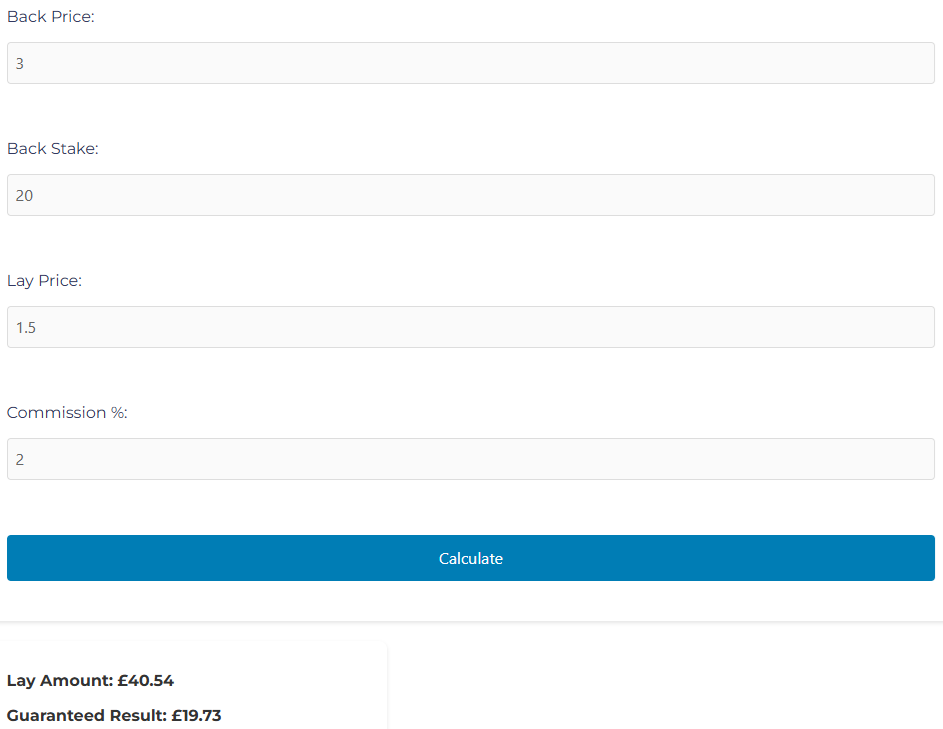
Here's how the calculation works:
Result
Bookmaker
Exchange
Profit
Team A Win
£40 Profit
-£20.27 Liability
£19.73
Team A don't win
-£20 Loss
£39.73 Profit
£19.73
No matter what the result, you profit £19.73. Even if the game is a draw, you're covered as that still means that Team A didn't win.
The Hedging Calculator is particularly useful when prices move quickly during live football. The Gambling Commission notes that in-play prices can change continuously as information about an event changes.
Tennis can be particularly interesting for hedge betting because the standard match-winner market has only two outcomes: one player wins or the other player wins.
For example, you might back Player A before a match starts. If Player A wins the first set and their odds shorten, you could potentially lay Player A at the new price to hedge the original position.
Alternatively, you could take an opposing position on Player B, depending on the market and betting platform being used.
Suppose you back Player A at 2.50 for £40.
Player A then wins the first set and their odds fall to 1.50.
You now have a position where the market considers Player A substantially more likely to win than it did before the match began.
You could potentially use the shorter price to hedge your original position. The precise stake required depends on whether you want to:
This is where a hedging calculator can be useful, as it removes much of the manual calculation involved.
Horse racing can also be used for hedge betting, particularly because prices can change significantly between the start of a race and different stages of the event.
A bettor might back a horse before the race and subsequently look to take an opposing position if the horse's price changes.
What the data says
Remote betting in Great Britain generated £2.6 billion in gross gambling yield in 2024–25. Football accounted for £1.3 billion of this total, while betting on horse racing generated £766.7 million, highlighting the substantial scale of these two sports betting markets.
Source: UK Gambling Commission, Industry Statistics Annual Report 2025
For example, a horse backed at relatively high odds could shorten considerably after making a strong start. If suitable opposing odds are available, this may create an opportunity to hedge the original position.
However, horse racing can be more complicated than two-outcome sports because multiple runners can win.
You therefore need to understand exactly what your opposing position covers. A hedge that protects against one outcome does not automatically cover every other runner in the race.
Liquidity is another important consideration. Even when a theoretical hedge exists, you may not be able to place the full stake at the price you want.
Cricket provides several different markets that may potentially be hedged, including match result, series markets, innings markets and player-related markets.
The length and structure of cricket matches can also produce significant changes in prices as the game develops.
For example, a team backed before a match could become much shorter after a strong batting performance. A bettor managing that position could then investigate whether an opposing position is available.
However, cricket markets can have different settlement rules depending on the competition and market selected, so it is important to check the specific market rules before placing either side of a hedge.
Golf is another sport where prices can change considerably during an event.
A player backed before a tournament might become a much shorter price after a strong opening round or particularly good performance.
A bettor could potentially use the change in price to reduce their exposure or secure a return.
Golf is particularly different from sports such as tennis because there are many potential winners. Hedging a single golfer therefore doesn't necessarily mean every other possible outcome has been covered.
If you're considering golf or another multi-runner sport, pay close attention to the market you're using and exactly what your hedge bet protects against.
Rugby can also be suitable for hedge betting, with markets available on match results, handicaps, totals and other outcomes.
The same principles apply as with other sports: you need an existing position, an opposing market or bet, and suitable odds for the hedge to make sense.
In a three-way match-result market, for example, you also need to consider the possibility of a draw.
For more complex markets, it can be useful to calculate the potential outcomes before placing the second bet rather than assuming that an opposing wager automatically creates a complete hedge.
Combat sports can provide potential hedge opportunities because prices can change substantially as a fight progresses.
A fighter backed before the event may become a significantly shorter price after gaining an advantage during the fight.
However, live combat-sports markets can be particularly fast-moving. Markets can also suspend frequently, meaning there may be a delay between identifying a potential hedge and being able to place it.
OddsMonkey expert insight
"In fast-moving markets, having a hedge plan before the event starts can matter more than reacting perfectly in the moment. Decide what price or exposure would trigger your hedge in advance, so a sudden swing doesn't encourage you to chase a market that has already moved."
James, OddsMonkey Hedge Betting Expert
This makes timing and execution particularly important when attempting to hedge in sports betting.
In principle, hedge betting can be considered across a wide range of sports, but not every market will provide a practical opportunity.
The main requirements are:
You should also consider whether prices are likely to move quickly. In-play betting is particularly fast-paced, with operators continuously adjusting prices as new information becomes available.
This means you should never assume that because you can calculate a hedge on paper, the required price will still be available when you try to place the bet.
Hedge betting often involves taking opposing positions.
For example, you might:
Back an outcome at one price.
Wait for the market to move.
Take an opposing position at a different price.
Calculate the combined result across the relevant outcomes.
A betting exchange can be particularly relevant because it allows customers to back and lay selections. The Gambling Commission describes a betting intermediary as a service that facilitates bets between parties, with betting exchanges falling within this category.
What the data says
The Gambling Commission's 2023 survey found that 6% of adults had bet on live football in the previous four weeks, while 4% had bet in-play on any event or sport. Live horse or dog racing accounted for a further 3%, highlighting the prevalence of live betting markets.
Source: UK Gambling Commission, Gambling Survey for Great Britain
Another option is to place opposing bets at different bookmakers. For example, you decide to bet £20 on a tennis player (A) to win a match at odds of 3.0. However, player B starts better than expected and the odds for player B drop to 3.5. Rather than risk losing, you could back player B to win at another bookmaker. This is how it might look:
Selection
Odds
Stake
Return
Profit
Bookie A (Player A)
3.0
£20
£60
£22.86
Bookie B (Player B)
3.5
£17.14
£59.99
£22.85
The above information can be calculated in seconds using the Dutching Calculator.
The key is to understand what each bet actually covers.
Working out a hedge manually can become complicated, particularly when you are dealing with different odds, stakes and exchange commission.
A Hedging Calculator can simplify this process.
You can enter details such as:
The calculator can then show the stake required for the opposing position and help you understand the resulting profit or loss.
For example, if you backed a selection at one price and its odds subsequently shortened, the calculator can help you determine how much to place on the opposing side rather than relying on manual calculations.
Want to see how much you need to hedge? Enter your back price, back stake, lay price and exchange commission into the Hedging Calculator to calculate the required hedge stake and potential outcome.
You can also use the OddsMatcher to help compare available odds and identify potential differences between bookmakers and exchanges.
For more calculations, the Dutching Calculator and Implied Probability Calculator can also be useful when assessing how different prices relate to potential outcomes.
There is no fixed amount you can make from hedge sports betting.
The potential outcome depends on factors such as your starting odds, stake, subsequent odds movement, available liquidity, commission and the way you structure the hedge.
For a more detailed look at potential returns, see our guide to How Much Can I Make Hedge Betting?
If you're new to hedge betting, it can help to start with simple, liquid markets rather than immediately attempting complicated in-play strategies.
Our guide to How to Start Hedge Betting provides a more detailed introduction for beginners.
You can also explore our Hedge Betting Strategies guide if you're looking beyond the basic mechanics.
You can potentially hedge bets across a wide range of sports, including football, tennis, horse racing, cricket, golf, rugby and combat sports. However, the sport itself is only part of the equation: the market structure, available opposing prices, liquidity, odds movement and timing determine whether a hedge is practical.
If you're assessing a specific position, use a Hedging Calculator to work through the numbers before placing the opposing bet.
You can potentially hedge bet on almost any sport where suitable markets, opposing bets and sufficient liquidity are available. Football, tennis, horse racing, basketball, cricket, golf, rugby, boxing and MMA are among the sports where hedge opportunities may arise.
There is no single best sport for hedge betting because the quality of an opportunity depends on the specific market rather than the sport alone. Liquidity, odds movement, the number of outcomes, available opposing prices, timing and commission can all affect whether a hedge is practical.
Tennis can be simpler to hedge because a standard match-winner market has two possible outcomes, whereas a football match-result market has three because of the draw. However, a particular football market can still provide a better hedge opportunity if the prices and liquidity are more favourable.
Yes, horse racing bets can potentially be hedged when the odds move and a suitable opposing position is available. However, races have multiple possible winners, so hedging one horse does not automatically cover every other outcome.
Yes, hedge opportunities can arise during live events when prices move, but in-play markets can change or suspend quickly. A calculated hedge is therefore only practical if the required opposing price and stake are still available when you attempt to place it.
No. A hedge can potentially be created using opposing bets at different bookmakers, while betting exchanges can also allow you to take opposing back and lay positions. The important consideration is whether the available markets and prices provide the position you are looking to create.

Unlock £29+ with our offer guides. Each guide will walk you through the back and lay bets needed to make your first matched betting profits.
Earn immediately. No payment details required
Start your FREE Trial
*DISCLAIMER: We’re legally required to state that there is no guarantee of specific results each month. The amount of money that you earn can vary dependant on the time and effort that you commit each month.
This website is strictly for over 18’s. If you do have any concerns about gambling please contact GambleAware
© Copyright 2011-2026 Terms of Use | Privacy Statement