
Learn how to hedge in betting with practical examples. Explore full, partial, in-play and exchange hedge betting strategies and calculate your hedge stake.
Quick answer
A hedge betting strategy involves placing an additional bet to reduce or offset the risk of an existing bet. You can use a full hedge to offset most of your exposure, a partial hedge to reduce potential losses while retaining some upside, or an in-play hedge to react to changing odds. If you use a betting exchange, the hedge stake depends on your original stake and odds, current lay odds and exchange commission.
Hedge betting can be a useful way to manage your exposure after placing a bet. Rather than simply accepting the original outcome of a wager, hedging involves placing another bet on an alternative outcome to reduce your potential loss or secure a more predictable result.
There isn't one single way to hedge a bet. Depending on the market, your original odds and your objective, you might completely hedge your position, reduce your potential loss with a partial hedge, or use an in-play hedge after the odds have changed.
In this guide, we'll explain the most popular hedge betting strategies, show you how to hedge in betting with practical examples, and explain how OddsMonkey's Hedging Calculator can help you work out the numbers.
Important: Hedging can reduce risk, but it does not automatically guarantee a profit. The result depends on the odds available, the stakes placed, commission and whether every possible outcome has been covered.
A hedge betting strategy is a way of reducing the risk attached to an existing betting position by placing an additional bet on an opposing outcome or otherwise offsetting part of the original exposure.
The objective isn't always to guarantee a profit. You might hedge to:
The strategy you choose depends on your original bet, the current odds, the available markets and how much risk you want to retain.
Hedge betting is related to matched betting and arbitrage betting, but the terms are not interchangeable. Matched betting generally uses bookmaker promotions and corresponding bets, while arbitrage betting aims to exploit price differences across outcomes. Hedging is broader: it describes using an additional bet to offset an existing position.
For a complete introduction to the concept, see our Hedge Betting guide.
There are several ways you can approach a hedge. The best strategy depends on your original bet, the available odds and what you want to achieve.
OddsMonkey expert insight
"The biggest mistake with hedging is treating the latest price movement as a signal to act. A better approach is to set your acceptable exposure first, then work backwards to the hedge stake. That keeps the decision based on risk rather than emotion."
James, OddsMonkey Hedge Betting Expert
A full hedge attempts to cover the opposing outcome sufficiently to create the same, or a closely matched, result regardless of which covered outcome wins.
This is one of the simplest forms of hedging to understand.
Suppose you place:
Later, the odds move and you decide you want to hedge the position.
If the available opposing price allows you to place a second bet that offsets the original exposure, you can calculate the appropriate hedge stake.
The exact amount will depend on the current odds and, if you're using a betting exchange, the commission charged.
This is where a hedging calculator becomes particularly useful because calculating the correct opposing stake manually can become complicated as odds change.
You don't always need to hedge the entire position.
A partial hedge involves placing a smaller additional bet to reduce your potential downside while retaining some exposure to the original bet.
For example, suppose you've backed a horse for £50 and it is now trading at shorter odds than when you placed your bet.
Rather than completely hedge the position, you could hedge part of it.
This means:
Partial hedging can therefore be useful when your priority is risk reduction rather than completely balancing the position.
A profit-locking hedge is designed to turn a favourable position into a predetermined profit, assuming the relevant outcomes are fully covered and the odds allow it.
For example, imagine you backed a horse at 5.00 with a £20 stake.
Your potential profit from the original bet is:
£20 × (5.00 - 1) = £80
The horse subsequently shortens significantly and you decide that you would rather secure a smaller return than leave the full £80 at risk.
You can then calculate a hedge against the horse's current price.
If the resulting figures show a positive return whichever covered outcome occurs, you have effectively converted an uncertain position into a more predictable one.
The important point is that the current odds matter. A hedge is not automatically profitable simply because the original selection has shortened.
Not every hedge is designed to make a profit.
Sometimes the objective is simply to reduce a potential loss.
For example, you might have backed a football team before kick-off but become less confident in your position after the match begins.
Rather than allowing the original bet to remain fully exposed, you could place a hedge on the opposing outcome.
The result might be:
Outcome
Original bet
Hedge bet
Overall result
Original selection wins
Profit
Loss
Smaller profit
Opposing selection wins
Loss
Profit
Smaller loss
This is a classic example of why hedging should be thought of as risk management, rather than simply another way of betting.
In-play hedging involves placing your hedge after the event has started.
This can create more opportunities because betting odds change as the event develops.
For example, a football team might start a match at odds of 3.50. After scoring, its odds could shorten substantially.
A bettor who backed the team before kick-off may then have an opportunity to hedge at the new price.
However, in-play betting also introduces additional risks.
Odds can move extremely quickly, markets can suspend and the price available when you decide to hedge may no longer be available when you attempt to place the bet.
For that reason, don't assume that a theoretical hedge calculation will always be executable at the price you see.
What the data says
Weekly in-play betting is significantly associated with higher gambling-risk scores. The Gambling Commission found that people who bet in-play weekly were more than three times as likely to have a PGSI score of 8 or more than those who gambled less frequently on the activity.
Source: UK Gambling Commission, Analysis of weekly activities
Betting exchanges can be particularly useful for hedging because they allow bettors to lay selections as well as back them.
A back bet is a wager that a selection will win or an outcome will occur.
A lay bet is effectively a wager that the selection will not win or the outcome will not occur.
This creates a natural way to hedge an existing back bet.
Suppose you back a horse for £50 at odds of 4.00.
Your potential profit is:
£50 × (4.00 - 1) = £150
If the horse subsequently trades at 2.50, you could potentially lay the horse.
The required lay stake depends on the current lay odds and your desired outcome. Exchange commission also needs to be included when calculating the final result.
OddsMonkey expert insight
"A calculated hedge is only as good as the price you can actually secure. On an exchange, check available liquidity as well as the headline odds, particularly in-play. A small difference between the expected and executed price can materially change the final outcome."
James, OddsMonkey Hedge Betting Expert
This is precisely the type of calculation that the OddsMonkey Hedging Calculator is designed to simplify. You enter your back price, back stake, lay price and commission, and the calculator works out the hedge (lay) amount.
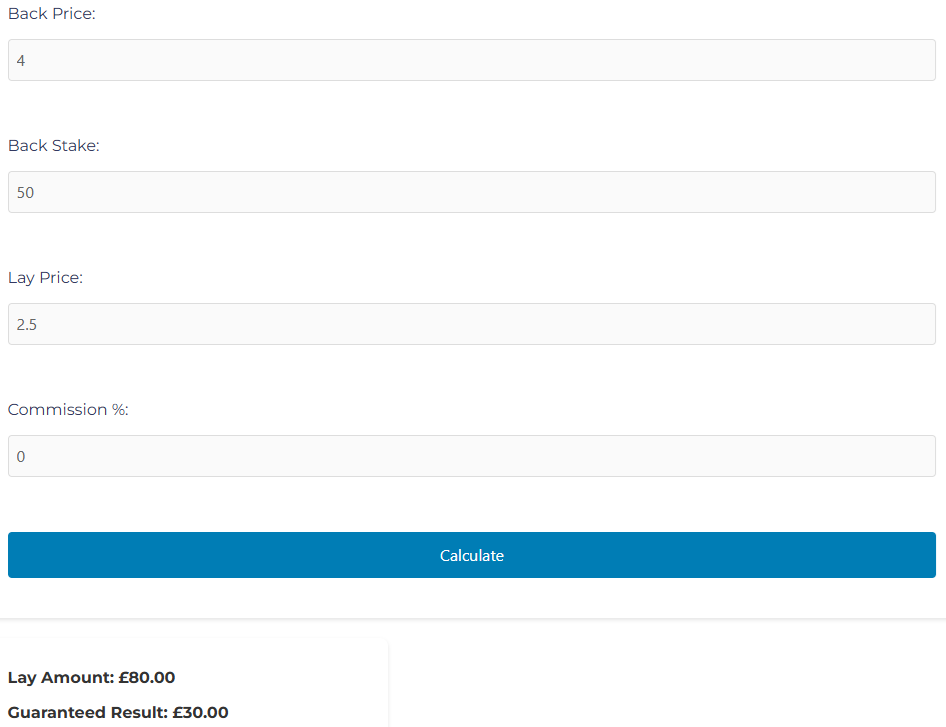
Using the above example, you would lay £80 (betting that your horse doesn't win). An £80 lay stake at odds of 2.5 will have a liability of £120.
This is the two possible outcomes from this bet:
Original bet
Hedge
Selection
Horse A
Lay Horse A
Stake
£50
£80
Odds
4.00
2.50
Liability
£50
£120
Commission
0%
2%
Result if horse wins
£30
£0
Result if horse loses
£0
£28.40
Try the OddsMonkey Hedging Calculator to calculate your hedge stake.
Some markets have more than two possible outcomes.
Football's traditional 1X2 market is a straightforward example because the possible results are:
Hedging only two of these outcomes does not automatically remove your exposure to the third.
Imagine you back a team to win a football match.
You then place another bet on the opposing team.
If the match finishes as a draw, neither of those bets may provide the result you intended.
This is why it's important to identify every possible outcome that matters before calling a position fully hedged.
For markets with multiple selections, strategies such as dutching can sometimes be relevant. OddsMonkey's Dutching Calculator can help calculate stakes across multiple selections.
However, dutching and hedging are not identical strategies, so the correct tool depends on the market and the position you're trying to create.
Goal
Strategy
What it does
Balance your position
Full hedge
Attempts to offset most or all exposure
Reduce potential loss
Partial hedge
Reduces downside while retaining some upside
Protect a profitable position
Profit-locking hedge
Attempts to secure a positive result
Limit a losing position
Loss-reduction hedge
Reduces the amount at risk
React to price movement
In-play hedge
Uses changing odds during an event
Hedge via exchange
Back-to-lay / lay hedge
Uses an exchange to offset a back bet
There is no single "best" hedge betting strategy. The appropriate approach depends on your objective, the available odds and the outcomes you need to cover.
If you're wondering how to hedge in betting, the process can be broken down into five steps.
Start with the bet you've already placed.
Record:
Don't place a second bet simply because the odds have moved.
First decide whether you want to:
Your objective determines the appropriate hedge.
Next, check the current price for the opposing selection.
If you're using a betting exchange, pay particular attention to the available lay price and exchange commission.
Remember that odds can move between calculating and placing a bet.
This is where the OddsMonkey Hedging Calculator can save time and reduce the risk of making a manual calculation error.
Enter your:
The calculator then calculates the amount required for the hedge.
Before confirming the second bet, check what happens if each relevant outcome occurs.
Ask:
This final check is particularly important for markets with three or more possible outcomes.
Let's look at a simplified example.
You place:
£100 back at odds of 3.00
If your selection wins, your total return is: £300
That represents a £200 profit before considering any subsequent hedge.
The selection then shortens to odds of 2.00 so you decide to hedge using an exchange.
When using a betting exchange to hedge bets, you can use the hedge calculator to calculate your hedge stake.
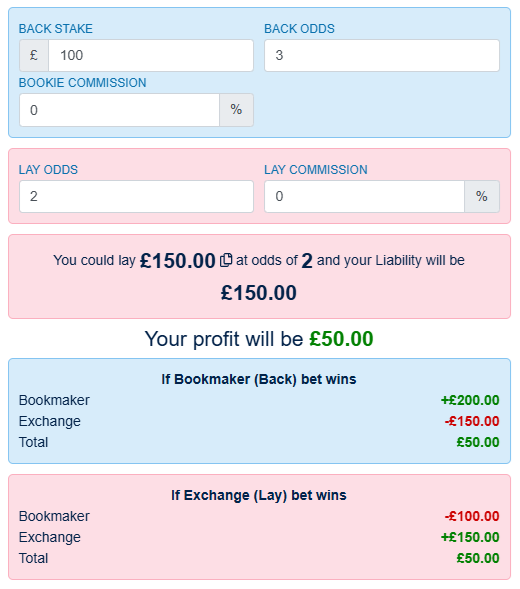
This gives you a calculated hedge stake and lets you assess the resulting position before placing the second bet.
That's one of the biggest advantages of using a calculator: you can see the numbers before committing additional money.
Football is particularly interesting for hedging because markets can contain several possible outcomes and prices can change dramatically during a match.
For example, consider a pre-match bet on a team to win.
If that team scores first, its odds may shorten. The bettor may then have an opportunity to hedge some of the original position.
However, a football match can still finish as a draw or the opposing team can come back to win.
For this reason, football hedge betting requires you to understand exactly which outcomes your hedge covers.
For more football-specific examples, see our guide to Football Hedge Betting.
Hedging can also be applied to certain roulette betting approaches by placing bets across different outcomes.
For example, a player might spread stakes across multiple outcomes to alter their exposure.
Read our dedicated Roulette Hedge Betting guide for a more detailed explanation.
Hedge betting and matched betting can look similar because both can involve placing bets on opposing outcomes.
However, they have different objectives.
Matched betting typically uses bookmaker promotions and a corresponding lay bet to convert qualifying offers or free bets into potential profit.
Hedge betting is a broader risk-management technique where an additional bet is used to offset some or all of an existing position.
Arbitrage betting minimises variance rather than maximize expected value. Instead of "win big or lose it all," you're smoothing out the outcome so you either guarantee a profit or limit your loss.
The distinction matters because a hedge isn't necessarily connected to a bookmaker promotion.
What the data says
The Gambling Commission found that 643,779 of 14,923,840 active customer accounts were commercially restricted in 2024, equivalent to 4.31%. Among restricted accounts, 62.17% were subject to a stake-factor restriction, limiting the maximum amount that could be bet.
Source: UK Gambling Commission, Commercial restrictions by betting operators
Hedge betting
Matched betting
Arbitrage betting
Primary purpose
Reduce exposure
Use bookmaker offers
Exploit price differences
Requires a promotion?
No
Usually
No
Can use exchanges?
Yes
Commonly
Sometimes
Existing bet required
Usually
Not necessarily
No
Profit guaranteed
No
Depends on qualifying conditions
Only where all outcomes and costs are correctly covered
Main calculation
Hedge stake
Lay stake/profit
Stakes across outcomes
If you're deciding which approach is right for you, read our detailed guide to Hedge Betting vs Matched Betting.
There is no fixed amount you can make from hedge betting.
Your result depends on factors including:
A full hedge may produce a smaller but more predictable outcome, while a partial hedge can leave more potential upside but also more exposure.
It's therefore better to think about hedge betting in terms of managing your risk and position rather than expecting a particular level of profit.
For more detail, see How Much Can I Make Hedge Betting?.
Even experienced bettors can make mistakes when calculating a hedge.
Before placing the second bet, know what you're trying to achieve.
A hedge designed to lock in profit is different from one designed simply to reduce a potential loss.
If you're using a betting exchange, commission affects your final return.
Make sure it is included in your calculation.
A hedge only produces the intended result if the relevant outcomes are covered and the stakes and odds have been calculated correctly.
A two-way hedge won't necessarily protect you from a third outcome.
Odds can move quickly, particularly during live betting.
Always check the current available price immediately before placing the hedge.
Hedging should not become an excuse to continually add stakes after an unsuccessful bet.
If you find yourself increasing your exposure simply because an original bet is going against you, step back and reassess the position.
The mathematics behind hedging can become complicated when you factor in different odds, stakes and exchange commission.
OddsMonkey provides several tools that can help.
The Hedging Calculator is the most directly relevant tool for this strategy.
It allows you to enter the back price, back stake, lay price and commission and calculates the required hedge amount.
Calculate your hedge with the OddsMonkey Hedging Calculator.
When you're comparing available prices, finding competitive odds can make a significant difference to the resulting hedge.
Odds comparison tools like the OddsMatcher can therefore complement the calculation stage.
If you're dealing with several selections rather than simply offsetting an existing position, the Dutching Calculator can help calculate how to distribute your stake across multiple selections.
If your objective is actually to use bookmaker promotions and betting exchanges to pursue matched-betting returns, the Matched Betting Calculator is the more appropriate tool. It calculates the lay stake, liability and resulting profit or qualifying loss.
Using the right calculator for the right strategy is important: a hedge calculation is not the same as a standard matched-bet calculation.
If you're new to hedging, start by understanding the mechanics before committing significant stakes.
A sensible process is:
Learn how back and lay bets work.
Understand the possible outcomes of your chosen market.
Decide what you want the hedge to achieve.
Compare the available odds.
Calculate the required hedge stake.
Check the result across every relevant outcome.
Only then decide whether the hedge is appropriate.
Our guide to How to Get Started with Hedge Betting provides a useful next step if you're new to the strategy.
The best hedge betting strategy depends on what you're trying to achieve.
The key is to calculate the position before placing the second bet. Odds, stakes, exchange commission and the number of possible outcomes all matter.
If you want to see exactly how much you need to stake to hedge an existing position, try the OddsMonkey Hedging Calculator.
Calculate your hedge, check the potential outcomes and make your next betting decision with the numbers in front of you.
Gambling involves risk. Never bet more than you can afford to lose. Odds and markets can change, and a calculated hedge does not guarantee a profit unless the relevant outcomes, stakes and prices produce that result.
The best hedge betting strategy depends on your objective and the odds available. A full hedge can balance your position more completely, while a partial hedge can reduce risk without giving up all of your potential upside.
Yes. A hedge is normally placed after the original bet to offset some or all of your exposure. You can hedge before an event starts or in-play, although in-play odds can move quickly and markets may be suspended.
To calculate a hedge, you need your original stake and odds, the current opposing odds and, where applicable, betting exchange commission. An OddsMonkey Hedging Calculator can calculate the required hedge stake and show the resulting position.
No. Hedging does not automatically guarantee a profit. A profitable hedge depends on the available odds, stakes, commission and whether all relevant outcomes have been covered.
No. Hedge betting is a broader risk-management technique used to offset an existing betting position, whereas matched betting generally uses bookmaker promotions and corresponding bets to target a potential return. The two can use similar back-and-lay mechanics but have different objectives.
Yes, but hedging only the opposing team may leave you exposed to the draw. In a three-way market such as football's 1X2, you need to consider home win, draw and away win when deciding whether your position is fully hedged.
Yes. Betting exchanges are particularly useful for hedging because they allow you to lay a selection against an existing back bet. Exchange commission should be included when calculating the required lay stake and potential result.
In-play hedging carries additional risks because prices can change rapidly and markets can be suspended. The odds used in a theoretical calculation may therefore no longer be available when you try to place the hedge.
Hedge betting is not generally prohibited as a betting strategy in Great Britain. However, gambling activities are regulated by the Gambling Commission, and you should use appropriately licensed operators. Individual bookmakers can also set their own terms and decide whether and on what terms they accept bets, so a betting strategy does not guarantee that a particular stake or price will always be available.

Unlock £29+ with our offer guides. Each guide will walk you through the back and lay bets needed to make your first matched betting profits.
Earn immediately. No payment details required
Start your FREE Trial
*DISCLAIMER: We’re legally required to state that there is no guarantee of specific results each month. The amount of money that you earn can vary dependant on the time and effort that you commit each month.
This website is strictly for over 18’s. If you do have any concerns about gambling please contact GambleAware
© Copyright 2011-2026 Terms of Use | Privacy Statement