
Two outcomes, no draw and a year-round calendar make tennis one of the simplest sports to arb. Here's how tennis arbs work, worked examples across bookmakers and exchanges, and the retirement rules that catch people out.
Quick answer
Tennis arbitrage betting is the practice of using different odds on the same tennis match to cover all possible outcomes at stakes calculated to produce a profit or minimise loss regardless of the winner.
Tennis can be an attractive sport for arbitrage betting because matches normally have two possible winners, making the mathematics relatively straightforward. Differences between the odds offered by bookmakers and betting exchanges can sometimes create opportunities to back both players at prices that produce a positive return regardless of who wins.
This is known as tennis arbitrage betting, or simply arbitrage tennis. The key is not predicting which player will win. Instead, the objective is to identify sufficiently large differences in prices, calculate the correct stakes and place all parts of the bet before the available odds change.
In this guide, we'll explain how tennis arbing works, show practical examples of the main types of tennis arbitrage bets and explain how OddsMonkey's tools can make the process easier.
Question
Answer
What is tennis arbitrage?
Using different prices on the same tennis event to construct a potential profit across all relevant outcomes
What is the basic arb formula?
1 ÷ odds A + 1 ÷ odds B < 1
Can you arb between bookmakers?
Yes
Can you arb using an exchange?
Yes, provided commission, liquidity and liability are included
Is tennis arbitrage risk-free?
No. Practical execution and settlement risks remain
Is in-play tennis arbing possible?
Yes, but price movement and market suspension make it harder
For a standard match-winner market, there are only two outcomes: Player A wins or Player B wins. Suppose one bookmaker offers 2.10 on Player A and another offers 2.10 on Player B. The implied probabilities are:
Because the combined implied probability is below 100%, an arbitrage opportunity exists mathematically.
The important point is that you're not trying to predict whether Player A or Player B is more likely to win. You're exploiting the difference between the prices available in the market.
Smarkets similarly describes odds arbitrage as exploiting price discrepancies so that the implied probability of the available prices can fall below 100%.
OddsMonkey expert insight
"The biggest mistake beginners make is treating an arb as a static mathematical calculation. In practice, the opportunity only exists while both prices remain available at usable stakes. Execution is part of the strategy, not something that happens after the calculation."
Find the best available price for each player.
Check that you're comparing exactly the same market.
Calculate whether the combined implied probability is below 100%.
Calculate the required stake on each outcome.
Place the bets as quickly as possible.
Check that both bets were accepted at the expected odds.
Record the result and actual profit.
For a two-way market, the basic arbitrage calculation is:
1 ÷ Odds Player A + 1 ÷ Odds Player B < 1
For example, 1 ÷ 2.10 + 1 ÷ 2.10 = 0.9524. Because 0.9524 (95%) is below 1 (100%), the prices create an arbitrage opportunity before considering factors such as exchange commission. This is one reason a tennis arbitrage calculator can be useful: you don't have to perform the calculations manually every time.
There isn't just one way to arb tennis. Opportunities can occur between multiple bookmakers, between a bookmaker and an exchange, or between different betting exchanges.
Method
What you do
Main calculation issue
Main risk
Bookmaker to bookmaker
Back each player at different bookmakers
Implied probability
Odds movement and rejections
Bookmaker to exchange
Back one side, lay the other
Commission and liability
Liquidity and matching
Exchange to exchange
Use back/lay prices across exchanges
Commission and liability
Suspension and price movement
This is the simplest form of arbitrage tennis. Imagine Bookmaker A offers 2.10 on Player A and Bookmaker B offers 2.10 on Player B, and you want to stake £100 in total. The stakes can be split approximately as £50 on Player A and £50 on Player B.
Outcome
Stake
Odds
Return
Player A wins
£50
2.10
£105
Player B wins
£50
2.10
£105
Profit either way
£5
Ignoring any other costs or restrictions, the £100 total stake produces a £5 profit whichever player wins. In real-world betting, however, the opportunity must be checked immediately before betting because odds can move and bookmakers may not accept the full stake.
A bookmaker-to-exchange arb uses a traditional bookmaker for one side and a betting exchange for the other. Here, you're backing Player A with the bookmaker while laying Player A on the exchange. The exchange introduces an additional calculation because commission may be charged on exchange winnings.
Example
Input
Value
Back stake at the bookmaker
£100
Back odds
2.15
Lay odds
2.00
Exchange commission
2%
Required lay stake
£108.59
Profit either way
£6.41
If the bookmaker selection wins: the bookmaker profit is £115.00 against an exchange liability of £108.59 — a profit of approximately £6.41.
If the selection loses: the lay winnings after 2% commission come to approximately £106.42, less the £100 back stake — again a profit of approximately £6.41.
In theory, you could give your brain a workout and calculate this manually. Alternatively, use the OddsMonkey Arbitrage Calculator to find the required lay stake in seconds.
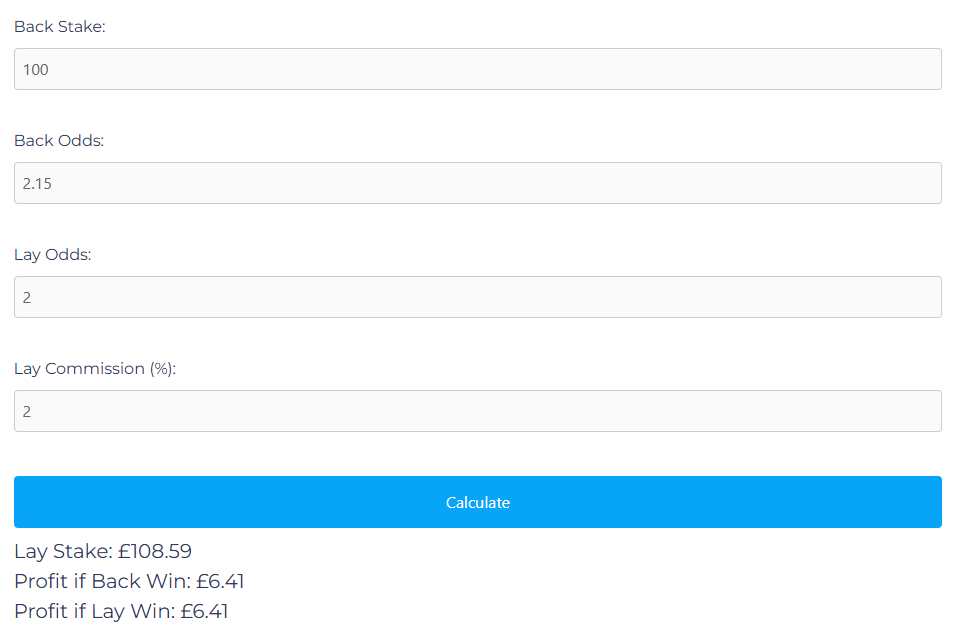
Never calculate an exchange arb using the lay odds alone. Commission, available liquidity and the actual amount matched all matter.
This type of arb can be particularly useful because exchanges provide a different source of pricing from traditional bookmakers. A betting exchange is essentially a marketplace where users can back or lay outcomes against other participants rather than simply accepting a bookmaker's fixed price.
Another possibility is to find different prices across two betting exchanges — for example, backing Player A at 2.20 on Exchange A and laying Player A at 1.95 on Exchange B. The higher back price and lower lay price can potentially create an arbitrage opportunity after exchange commissions are included.
This can be more complicated than bookmaker-to-bookmaker arbing because you need to consider:
An apparent arbitrage opportunity isn't necessarily a genuine arb if there isn't enough liquidity to place the required stakes.
Unlike football betting, a standard tennis match-winner market normally has only two players. That makes covering the outcomes relatively straightforward.
Tennis has a broad global event calendar, and major tournaments such as Wimbledon can generate extensive betting markets, including:
The more markets and operators you monitor, the more potential price discrepancies you may encounter.
What the data says
The scale of tennis creates a substantial pool of potential betting markets. The International Tennis Federation organises approximately 1,850 men's, women's and junior tournaments on the ITF World Tennis Tour each year, illustrating the breadth of events available across the tennis calendar.
Tennis odds can change quickly, particularly around the start of a match and during live play. That can create price differences between operators, but it also increases execution risk.
Bookmakers don't necessarily offer identical prices at the same moment. An arbitrage bettor is interested in finding the best available price for each outcome rather than simply choosing one bookmaker.
Pre-match arbitrage is generally easier to manage. You have more time to:
For someone learning tennis arbitrage betting, pre-match opportunities are usually the sensible place to start.
In-play tennis arbitrage is considerably more demanding. Prices can change following:
A price that creates an arb on your screen may no longer exist by the time you try to place the second bet. For this reason, a theoretical in-play arb isn't necessarily an executable arb.
Betting exchanges available to British bettors can be an important part of an arbitrage strategy because they allow you to back and lay outcomes. With a conventional bookmaker, backing Player A means betting that Player A wins. With an exchange, laying Player A means betting that Player A does not win.
However, exchange arbing requires you to understand liability. For example, laying £100 at 2.00 doesn't mean your maximum loss is necessarily £100 if you're using the standard exchange definition. The liability would be:
£100 × (2.00 − 1) = £100
At 3.00, the same £100 lay stake creates £200 of liability. That's why exchange-based tennis arbitrage needs an arbitrage calculator that accounts for lay liability and commission.
Finding opportunities manually across numerous betting sites can be time-consuming. A typical workflow is:
Compare tennis odds. Look across multiple bookmakers and exchanges for the same match.
Find the best price on each outcome. For example, Bookmaker A at 2.15 on Player A and Bookmaker B at 2.05 on Player B.
Check the arbitrage percentage. 1 ÷ 2.15 + 1 ÷ 2.05 = 0.9520, which is below 1 and indicates a theoretical arb.
Calculate the stakes. Distribute your total stake so the returns are equal, or as close as possible, across the outcomes.
Check the details. Confirm the tournament, players, market, match format, odds, stake limits, exchange liquidity, commission and settlement rules.
Place both sides. Speed matters. If one side is accepted but the other price disappears, you can be left with an exposed position rather than a completed arbitrage.
This is where an odds comparison and arbitrage tool such as the OddsMatcher can save significant manual work.
Tennis has a particular issue that arbitrage bettors need to consider: tennis retirement rules and withdrawals. Different operators and markets can have different settlement rules. For example, a bet may be void under one operator's rules but settled differently under another operator's rules if a player retires.
OddsMonkey expert insight
"Tennis creates a settlement risk that is easy to overlook because a match can end without either player winning in the conventional sense. A retirement, walkover or abandoned match can leave two apparently identical bets subject to completely different outcomes."
James, OddsMonkey Arbitrage and Matched Betting Expert
Never assume that identical-looking tennis markets have identical settlement rules. Before placing both sides of an arb, check the relevant bookmaker and exchange rules for:
A mathematically perfect arb can still fail to produce the expected result if the two sides are governed by different settlement conditions.
Potentially, but individual opportunities are generally based on relatively small price discrepancies. Your return depends on factors including:
It is therefore better to think of arbitrage as a process rather than expecting every tennis match to provide an opportunity. For a fuller discussion of potential returns, see our guide to how much you can make arbitrage betting.
Although the mathematics of a completed arb can produce a predetermined outcome, arbitrage betting is not risk-free in practice. The main risks include:
This is why disciplined processes and accurate calculators are so important. Our guide on whether it is ever safe to arb looks at these risks in more depth.
Tennis arbitrage and matched betting can look similar because both can involve multiple betting accounts and calculated stakes. The fundamental difference is the source of the opportunity: tennis arbitrage aims to exploit differences between prices on the same event, while matched betting typically uses bookmaker promotions and a corresponding qualifying bet or lay position to extract value from an offer.
If you're deciding which approach is more appropriate for you, read our guide to Arbitrage Betting vs Matched Betting. You can also learn how arbitrage fits into a wider matched betting approach in our guide to Is It Safe to Arb as Part of Your Matched Betting Strategy?
There are several ways experienced bettors may approach tennis arbing.
For more ideas, see our full guide to arbitrage betting strategies.
Finding and calculating tennis arbitrage opportunities manually can involve repeatedly checking different betting sites, comparing odds and calculating stake sizes. OddsMonkey's betting tools are designed to make the process more efficient by helping users identify opportunities and work out the appropriate stakes.
For someone looking to learn tennis arbitrage betting, the advantage isn't simply speed. A structured process can also reduce common mistakes such as:
Want to spend less time comparing tennis odds manually? Explore the OddsMonkey tools and see how they can help you find and calculate arbitrage opportunities across betting markets. Our tools include the OddsMatcher, Matched Betting Calculator, Arbitrage Calculator and Implied Probability Calculator.
If you're new to arbitrage tennis, don't try to master everything at once. A sensible starting process is:
Understand how arbitrage betting works.
Learn how implied probability is calculated.
Understand bookmaker back bets.
Learn how exchange lay bets and liability work.
Start with simple two-way pre-match tennis markets.
Learn how to use an arbitrage calculator.
Check bookmaker and exchange rules before betting.
Begin with stakes you can afford to lose.
Keep accurate records.
Gradually develop your process.
Before you place an arb bet, use a checklist like this:
Our how to get started arbitrage betting guide provides a broader introduction for beginners.
There isn't one universally "best" sport for arbing. Tennis can be attractive because standard match-winner markets are relatively simple to model, but football, basketball, horse racing and other sports can also be used for arbitrage betting. The most suitable sport depends on the number of markets, the number of bookmakers offering the sport, odds differences, liquidity, betting limits, speed of price movement and settlement rules.
For a wider comparison, see what sports you can place arbitrage bets on. If you're already familiar with football arbing, our dedicated football arbitrage betting guide explains how the strategy differs when a match has three primary 1X2 outcomes rather than two.
Tennis arbitrage betting is based on finding price differences that allow you to cover the possible outcomes of a match. The main types include bookmaker-to-bookmaker, bookmaker-to-exchange, exchange-to-exchange and in-play arbitrage — the last carrying additional execution risk.
The mathematics can be straightforward, but successful execution requires much more than finding two attractive odds. You need to consider stake calculations, commission, liquidity, market rules, odds movement, account restrictions and tennis-specific settlement rules. For UK bettors who want to explore arbitrage systematically, the most important first step is understanding the mechanics and building a disciplined process rather than simply chasing the biggest-looking price discrepancy.
Tennis arbitrage betting involves placing bets on the possible outcomes of a tennis match at different prices so that, where the opportunity remains available and all bets are successfully placed under compatible rules, the calculated outcome produces a positive return regardless of which player wins.
Tennis can be suitable for arbitrage because standard match-winner markets usually have two outcomes. However, an opportunity depends on the prices available, stake limits, liquidity, commission and settlement rules.
Yes. A bookmaker-to-bookmaker tennis arb occurs when the best available odds on the two players produce a combined implied probability below 100%.
Yes. A bookmaker's back price can potentially be combined with an exchange lay price. Exchange commission and lay liability must be included in the calculation.
"Arbitrage tennis" is another way of referring to tennis arbitrage betting, where different prices on the same tennis event are used to construct an arbitrage opportunity.
The mathematics of a completed arbitrage can be designed to produce a predetermined return, but the practical process carries risks. Odds can move, bets can be rejected or partially matched, exchange liquidity can be insufficient, and operators can have different settlement rules.
Yes, in-play tennis arbitrage opportunities can occur, but they are harder to execute because prices can change rapidly and markets may suspend around important points.
Betting exchanges generally charge commission according to their own pricing structures. Any commission must be included when calculating an exchange-based arbitrage opportunity.
Bookmakers can apply account restrictions under their terms and conditions. Anyone using arbitrage strategies should understand the terms of each operator and avoid assuming that an account will always remain unrestricted.
Check that the players, market, tournament and settlement conditions are identical; verify the current odds, stake limits and exchange liquidity; include commission; and make sure both sides can realistically be placed before committing funds.
Arbitrage betting still involves gambling and should only be undertaken with money you can afford to lose. A calculated arbitrage opportunity does not remove the practical risks associated with placing bets. If gambling is causing you concern, the Gambling Commission provides information about safer gambling and self-exclusion, and GAMSTOP allows people to self-exclude from online gambling operators licensed in Great Britain with one request.

Unlock £29+ with our offer guides. Each guide will walk you through the back and lay bets needed to make your first matched betting profits.
Earn immediately. No payment details required
Start your FREE Trial
*DISCLAIMER: We’re legally required to state that there is no guarantee of specific results each month. The amount of money that you earn can vary dependant on the time and effort that you commit each month.
This website is strictly for over 18’s. If you do have any concerns about gambling please contact GambleAware
© Copyright 2011-2026 Terms of Use | Privacy Statement