
Thousands of fixtures, dozens of bookmakers and a three-way match result. Here is how football arbs actually work — bookmaker, exchange and two-way markets — with worked examples and the risks to watch.
Quick answer
Football arbitrage betting is the practice of combining different football odds across bookmakers or betting exchanges so that the implied probability of all possible outcomes is below 100%. When all required bets are successfully placed at the quoted prices, the combined position can produce a theoretical profit regardless of the match result.
Football arbs can involve bookmaker-to-bookmaker, bookmaker-to-exchange or exchange-to-exchange prices. In practice, however, odds can move, bets can be rejected or limited, and exchanges may not have enough liquidity, so an apparent arb is not automatically a guaranteed realised profit.
Football is one of the most popular sports for arbitrage betting because there are thousands of matches, multiple betting markets and a wide range of bookmakers and betting exchanges offering different odds.
What the data says
The 2025/26 Premier League season consists of 380 matches across 33 weekends and five midweek match rounds. The volume of fixtures illustrates why football provides a substantial number of individual events for bettors to monitor when looking for differences in available prices.
Source: Premier League, 2025/26 dates
Football arbitrage betting, sometimes called arbitrage football, involves finding different prices on the same football outcome and placing bets across different betting platforms so that the combined odds can produce a theoretical profit regardless of the result.
For example, one bookmaker might offer 2.10 on a team to win, while another offers 4.20 on the draw and a third offers 4.00 on the opposition. If the combined implied probabilities are below 100%, an arbitrage opportunity may exist.
However, finding an arb is only part of the process. You also need to account for minimum and maximum stakes, betting limits, exchange commission, odds movement and the possibility that an advertised price disappears before all your bets are placed.
Football arbitrage betting is the practice of placing bets on different outcomes of the same event at different odds to create a positive theoretical profit when all bets are successfully placed at the required prices. The basic principle is simple:
Find different odds for the same football event.
Calculate whether those odds create an arbitrage opportunity.
Work out the correct stake for each outcome.
Place all the required bets.
The resulting returns should be higher than your total stakes, before applicable costs and subject to the bets being accepted at the quoted odds.
A simple way of identifying a three-way football arb is to add together the implied probabilities:
1 ÷ Home odds + 1 ÷ Draw odds + 1 ÷ Away odds
If the result is below 1 (or 100%), there may be an arbitrage opportunity.
Example
Imagine a Premier League match has the following prices:
Outcome
Odds
Implied probability
Team A to win
2.10
47.62%
Draw
4.20
23.81%
Team B to win
4.10
24.39%
Combined implied probability
95.82%
Because the combined implied probability is below 100%, this could represent a football arbitrage opportunity. The exact stakes would then be calculated so that the potential return is approximately the same whichever of the three outcomes occurs.
Want to check the maths quickly? Use the OddsMonkey Implied Probability Calculator to see whether a set of football prices could create an arbitrage opportunity.
Football arbs aren't limited to simply backing different teams with different bookmakers. Opportunities can involve bookmakers and betting exchanges in several different combinations depending on your arbitrage betting strategy.
This is one of the easiest types of football arbitrage betting to understand. You compare odds at multiple bookmakers and take the best available price for each possible outcome.
Example
Using the odds from our previous example, the implied probability is 95.82% — a positive arbing opportunity. If you wanted to invest £100, a dutching calculator could determine approximately how much to place on each outcome:
Outcome
Odds
Stake
Team A win
2.10
£49.70
Draw
4.20
£24.85
Team B win
4.10
£25.46
Total stake
£100.01
You could sit and work out the stakes if you had some time on your hands. Alternatively, enter your odds and total stake into the OddsMonkey Dutching Calculator to calculate how much to place on each selection. It takes seconds:
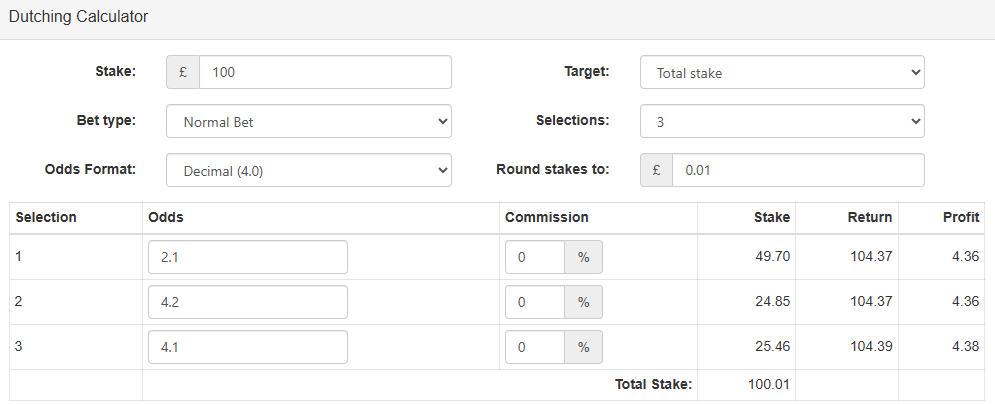
The important point is that you're not trying to predict which team will win. You're using price differences between bookmakers.
Bookmakers don't always price football matches identically. Their odds can differ because of different trading models, different assessments of betting activity, market movements, promotions or enhanced odds, different risk-management approaches, and delays in updating prices. These differences can occasionally create arbitrage opportunities.
A second approach is to combine a traditional bookmaker with a betting exchange. Instead of backing opposing outcomes at two bookmakers, you can back an outcome with a bookmaker and lay the same outcome on an exchange.
The key is finding a sufficiently large difference between the bookmaker's back price and the exchange's lay price after taking exchange commission into account.
Example
Input
Value
Bookmaker back odds
2.10
Exchange lay odds
1.95
Exchange commission
2%
Bookmaker back stake
£100
Required lay stake
£108.81
Profit either way
£6.63
If the bookmaker selection wins: the bookmaker profit is £110.00, less the exchange liability of £103.37 — a profit of approximately £6.63.
If the selection loses: the lay winnings after 2% commission come to approximately £106.63, less the £100 back stake — again a profit of approximately £6.63.
The calculation is more complicated than a standard three-way bookmaker arb because you have to consider:
You can ease the pain of calculations by using the OddsMonkey Arbitrage Calculator. Enter the stake, back and lay odds and commission, and you're good to go.
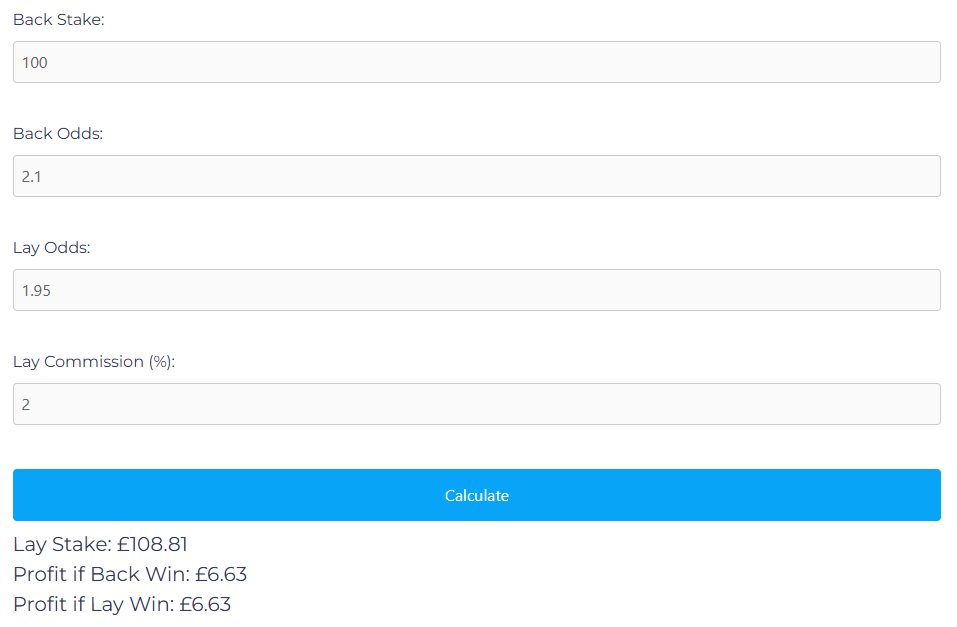
Betting exchanges allow customers to both back and lay selections. That creates another source of price differences that can be compared with bookmaker odds. For football bettors, this can considerably expand the number of potential prices available.
However, liquidity is critical. An exchange may display attractive lay odds, but there might not be enough money available at those odds to match the amount you want to stake. Learn more about this in our Liquidity Guide.
It's also possible to look for price differences between two betting exchanges. For example:
If the difference is large enough to cover commission on both exchanges, an arbitrage opportunity may exist. You could potentially back Team A at 2.10 on the Matchbook Exchange and lay Team A at 1.95 on the Smarkets Exchange. The correct lay stake would need to be calculated based on the respective commission rates and desired profit, and the principle is the same as a bookmaker-to-exchange arb.
This type of football arbitrage can be more complicated than bookmaker-to-bookmaker betting because you're dealing with:
It's therefore important to calculate the complete position before placing either bet.
Not every football arbitrage opportunity involves the traditional home/draw/away market. Two-way markets can sometimes be easier to calculate because there are only two possible outcomes. For example, consider over/under betting markets:
Outcome
Odds
Implied probability
Over 2.5 goals
2.10
47.62%
Under 2.5 goals
2.05
48.78%
Combined implied probability
96.40%
That is below 100%, meaning there is potentially an arbitrage opportunity. Other two-way betting markets that might include football arbing opportunities include:
The traditional football match-winner market is a three-way market: home win, draw and away win. This is one of the most recognisable forms of football arbitrage betting.
Outcome
Odds
Implied probability
Home
2.20
45.45%
Draw
3.90
25.64%
Away
4.00
25.00%
Combined implied probability
96.09%
Because the total is below 100%, the market could potentially contain an arb. The lower the combined percentage, the greater the theoretical margin available, although larger apparent margins may be harder to find and can disappear quickly.
Three-way football arb: 1 ÷ Home odds + 1 ÷ Draw odds + 1 ÷ Away odds
If the total is below 1 (100%), the prices may form an arbitrage opportunity.
Football handicap betting markets can provide another source of arbitrage opportunities. Different bookmakers may offer different prices on +1.5 goals, -1.5 goals, +0.5 goals and -0.5 goals.
Asian handicap markets can be particularly interesting because of their two-way structure and the way certain selections are settled. However, you need to understand exactly how the relevant handicap market settles before considering an opportunity. A superficially attractive pair of prices isn't necessarily an arb if the selections don't cover precisely opposite outcomes. Always check the market rules and settlement conditions before placing the bets. Our Handicap Betting article can explain more if you're interested.
Manually checking dozens of football matches across multiple bookmakers can be extremely time-consuming.
What the data says
The Gambling Commission reported that the number of bets and spins recorded across its online operator dataset reached 27.4 billion in October–December 2025, up 6% year on year. The figure was a new peak for the dataset, illustrating the scale of activity across Britain's online gambling market.
This is where specialist arbitrage betting software and odds comparison tools can help. A typical process is:
Scan the football markets. Look across multiple bookmakers and, where appropriate, betting exchanges for differences in prices.
Identify a potential arb. Check whether the combined implied probability is below 100%.
Confirm the exact market. Make sure the selections are genuinely equivalent and will be settled in a compatible way.
Check the available stakes. An arb isn't much use if a bookmaker will only accept £5 at the advertised odds when you need to place £100.
Calculate your stakes. Use an arbitrage calculator to determine how much to place on each outcome.
Place the bets quickly. Football odds can change rapidly, particularly around team news, goals and red cards.
Confirm every bet. Before assuming you've completed an arb, check that every required bet has actually been accepted at the intended odds and stake.
OddsMonkey expert insight
"The strongest-looking arb is not always the best one to take. A smaller margin with reliable limits and deep liquidity can be more valuable than a larger theoretical return that depends on one bookmaker accepting an unusually large stake. Execution quality matters as much as the percentage shown by the calculator."
Although arbitrage betting is based on mathematics rather than predicting football results, that doesn't mean every arb is completely risk-free in practice. The main risks include:
For these reasons, it's important to treat the theoretical arbitrage calculation and the practical execution of the bets as two separate things. Our guide on whether it is ever safe to arb goes into this in more depth.
Expert quote
"One overlooked issue is the order in which bets are placed. If the most fragile price is left until last, a single odds change can turn a calculated arb into an exposed position. Prioritising the least reliable price or lowest-liquidity leg can reduce the time your position remains unbalanced."
Football arbitrage betting and matched betting both use betting mathematics, but they work differently. With matched betting, you generally use bookmaker offers and a betting exchange to offset the outcome of a qualifying bet. With arbitrage betting, the objective is to identify price discrepancies between different betting platforms.
Factor
Football arbitrage
Matched betting
Primary objective
Exploit price discrepancies
Use offers while offsetting exposure
Requires multiple prices?
Usually
Yes
Exchange commonly used?
Often
Commonly
Depends on promotions?
No
Often
Main practical risks
Odds movement, limits, liquidity
Offer terms, qualifying calculations
Best page for more detail
If you're unsure which approach is right for you, our guide to arbitrage betting vs matched betting explains the differences in more detail.
Some bettors use arbitrage betting alongside matched betting because both approaches involve comparing prices and carefully calculating stakes. For example, someone already using matched betting may also monitor bookmaker and exchange prices for arbitrage opportunities.
However, the two strategies shouldn't be treated as identical. If you're considering combining them, it's important to understand the mechanics, risks and account implications of each approach first.
Read our guide on whether it is safe to arb as part of your matched betting strategy for more information.
There isn't a fixed amount you can make from football arbitrage betting. Your potential returns depend on factors including:
For example, a 2% theoretical arb on £100 represents a much smaller return than the same percentage on £1,000. However, you can't simply assume that you can scale every arb because bookmakers may restrict stakes or the required exchange liquidity may not exist. For a more detailed explanation, see our guide to how much you can make from arbitrage betting.
Football is particularly popular for arbitrage betting because of the volume of matches and markets available, but it's not the only sport where arbs can occur. Potential opportunities can also appear in:
Tennis can be particularly interesting because many markets are two-way, although liquidity and price movements still need to be considered. You can learn more in our guide to what sports you can place arbitrage bets on, or read the dedicated tennis arbitrage betting guide.
There isn't one single way to approach arbitrage football. Some bettors focus on:
The most important principle is to have a consistent process. Rather than simply looking for the biggest difference between two odds, check the entire betting position, including the stake limits, liquidity, commission and settlement rules.
For more ideas, see our complete guide to arbitrage betting strategies.
If you're completely new to arbitrage betting, start with the fundamentals before attempting to place complex positions. A sensible starting process is:
Understand how arbitrage calculations work.
Open accounts with suitable betting platforms.
Compare football odds.
Start with small stakes while you learn.
Check every market and settlement rule carefully.
Calculate your complete position before placing the first bet.
Keep accurate records of your bets and results with the Profit Tracker.
Our guide on how to get started with arbitrage betting provides a broader introduction to the process. Here's a checklist before you get started:
Finding football arbitrage opportunities manually can involve checking a large number of bookmakers, football leagues and betting markets.
OddsMonkey's betting tools are designed to make the process more efficient by helping users compare prices, calculate stakes and identify potential opportunities.
Football arbing problem
OddsMonkey solution
Calculating implied probability
Implied Probability Calculator
Balancing stakes
Dutching Calculator
Back/lay calculation
Arbitrage Calculator
Finding opportunities manually
OddsMatcher and arbitrage tools
Tracking results
Profit Tracker
The important thing is to use the tools as part of a disciplined process rather than assuming every displayed opportunity can automatically be converted into a profit. Always check the current odds, available stakes, exchange liquidity, commissions and the relevant bookmaker or exchange terms before placing a bet.
Football arbitrage betting involves combining different prices on the same football market to create a theoretical profit when all required bets are successfully placed. The main approaches include bookmaker-to-bookmaker, bookmaker-to-exchange and exchange-to-exchange arbs. Opportunities can also occur in two-way, three-way, goals and handicap markets.
Football arb type
How it works
Main consideration
Bookmaker to bookmaker
Back different outcomes at different bookmakers
Stake limits and odds movement
Bookmaker to exchange
Back with bookmaker, lay on exchange
Commission and exchange liquidity
Exchange to exchange
Back on one exchange, lay on another
Two commissions and liquidity
Two-way market
Cover two opposing outcomes
Check the market genuinely has two mutually exclusive outcomes
Three-way market
Cover home, draw and away
All three outcomes must be covered
The key calculation is only the starting point. Before placing an arb, check that the markets are genuinely equivalent, the odds are still available, the required stakes will be accepted, exchange liquidity is sufficient and any commission or other costs have been included.
For anyone learning football arbitrage, calculators can reduce staking errors and make it easier to assess whether a potential opportunity is worth pursuing. Start with small stakes while you learn the mechanics and keep accurate records of your positions.
Football arbitrage betting involves placing bets on different outcomes of a football event at different prices, usually across multiple bookmakers or betting exchanges, to create a theoretical profit regardless of the result.
Football can be well suited to arbitrage betting because there are many matches, bookmakers and betting markets available. However, the availability of profitable opportunities varies and odds can change quickly.
A football arbitrage opportunity is valid only when the prices cover mutually exclusive and collectively exhaustive outcomes of the same market, the combined implied probability is below 100%, and the required bets can actually be placed at those prices and stakes.
Yes. Betting exchanges can be used alongside bookmakers or other exchanges. For example, you could back a football selection at a bookmaker and lay it on an exchange if the prices create a sufficient margin after commission.
Yes. This is one of the simplest forms of football arbitrage. You identify the best available odds for each outcome across different bookmakers and calculate whether the combined implied probability is below 100%.
The mathematical principle behind an arb can produce a theoretical profit regardless of the outcome, but real-world risks remain. Odds can change, bets can be rejected or restricted, exchange liquidity can be insufficient and mistakes can leave a position partially uncovered.
There is no fixed minimum bankroll. However, your potential returns depend on your available stake and the size of the opportunities you can access. Starting with smaller stakes can help you understand the process before committing more money.
Bookmakers set their own terms and may apply stake restrictions or account limitations. Always check the current terms of the bookmaker you are using.

Unlock £29+ with our offer guides. Each guide will walk you through the back and lay bets needed to make your first matched betting profits.
Earn immediately. No payment details required
Start your FREE Trial
*DISCLAIMER: We’re legally required to state that there is no guarantee of specific results each month. The amount of money that you earn can vary dependant on the time and effort that you commit each month.
This website is strictly for over 18’s. If you do have any concerns about gambling please contact GambleAware
© Copyright 2011-2026 Terms of Use | Privacy Statement