
Learn how football hedge betting works, including back-to-lay examples, three-way Match Odds markets, in-play hedging and useful football betting calculators.
Quick answer
Football hedge betting involves placing another bet on a football outcome to reduce or potentially eliminate the risk associated with an existing position. For example, if you back a team before kick-off and its odds subsequently shorten, you could place a second bet at the new price to hedge some or all of your original position.
Whether you can lock in a profit depends on the odds, stakes, market and any exchange commission involved. Football also requires particular care because common markets such as Match Odds include three outcomes — home win, draw and away win — so backing and laying only one outcome does not necessarily cover every possible result.
Football hedge betting is just one variation of hedge betting and is the practice of placing a second bet against, or otherwise alongside, an existing football position to change the potential profit or loss across different outcomes.
The idea is simple: you already have a position on a football match, and you use another bet to alter your exposure.
For example, imagine you back Arsenal at 3.00 with £100 before a match. If Arsenal subsequently shortens to 2.00, you may have an opportunity to hedge that position.
The important point is that the second bet needs to be calculated carefully. Simply placing the same stake again will not necessarily produce an equal result across the outcomes.
This is where a Hedging Calculator can help. It takes inputs including the back price, back stake, lay price and commission to calculate the required hedge.
Football hedge betting can be used when the odds on a match change after you have placed your original bet.
A straightforward example is:
You back Team A at 3.00 for £100.
Team A starts strongly and its odds fall to 2.00.
You decide you want to reduce your exposure.
You place a second bet designed to hedge your original position.
The amount required for the second bet depends on the type of hedge you're making, the odds available and, where applicable, betting exchange commission.
If the odds subsequently move to 2.00, a hedge can potentially be placed against that position.
Rather than guessing the hedge stake, enter the original back price and stake, the new lay price and applicable commission into the OddsMonkey Hedging Calculator.
The calculator can then show the amount to lay and the resulting position which might look like this:
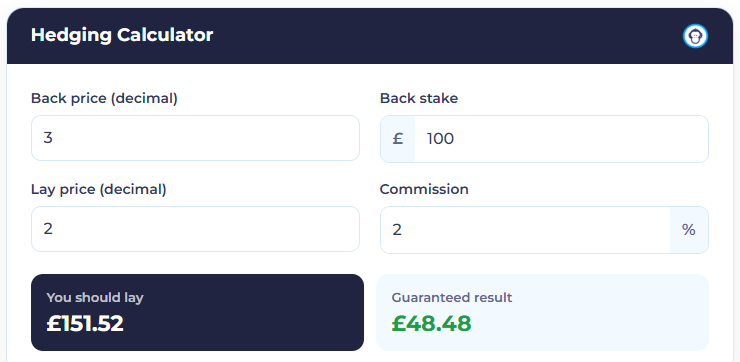
Provided Team A win or lose, the outcome will result in a profit.
Important: this example deliberately focuses on a two-outcome hedge. Football's standard Match Odds market has three possible outcomes — home win, draw or away win — so you need to understand exactly what your second bet covers before assuming that a position is fully hedged.
Yes. You can hedge a football bet by placing another bet that mitigates your exposure to the original position.
However, how you hedge depends on the market.
For example, you might:
A betting exchange can be particularly relevant when laying a selection, but you should always check the exchange's commission and market rules before calculating the final position.
A practical football hedging process looks like this:
Start by recording:
Don't start calculating the hedge until you know exactly what your original bet covers.
OddsMonkey expert insight
"A useful habit is to decide what you want the hedge to achieve before calculating the stake. Reducing your potential loss, equalising returns or securing a particular profit are different objectives, and each can produce a different hedge even when the original bet is identical."
James, OddsMonkey Hedge Betting Expert
The market may have moved significantly since your first bet.
A shorter price on your original selection can create a different hedging opportunity from a longer price.
For in-play betting, odds can change particularly quickly. The Gambling Commission notes that in-play prices are continuously amended according to information and liabilities in the market, while delays can also occur when bets are processed.
This is the stage where using a calculator can reduce mistakes.
The OddsMonkey Hedging Calculator requires the back price, back stake, lay price and commission, helping you determine the hedge stake rather than relying on mental arithmetic.
This is particularly important in football.
A standard Match Odds market has three outcomes:
If you have only backed and laid one team, you have not necessarily eliminated every possible result.
Once you've checked the calculation, place the second bet at the odds actually available.
Don't assume that the displayed odds will remain unchanged, particularly when betting in-play.
The way a football bet can be hedged depends on the market. Some markets have two possible outcomes, while others contain several selections and require a more detailed calculation.
Football market
Can it be hedged?
Main consideration
Match odds
Yes
Home win, draw and away win must be considered
Over/Under goals
Yes
Check the exact goal line and market rules
Both teams to score
Yes
Two possible outcomes, subject to available prices
Correct score
Potentially
Multiple outcomes make the hedge more complex
Half-Time result
Yes
The hedge applies to the specific half-time market
Player markets
Potentially
Check liquidity, suspension and settlement rules
The important point is not simply whether a market can be hedged, but whether the available prices and market rules allow you to create the position you want.
One of the clearest examples of football hedging involves backing a team and subsequently laying that same team.
Imagine:
Your potential return if Liverpool wins is £350, including your original stake.
Liverpool are playing well and their odds fall to 2.00 which provides a hedging opportunity. You could potentially lay Liverpool at the shorter odds.
OddsMonkey expert insight
"A shortening price doesn't automatically make a hedge worthwhile. The useful comparison is between the position you hold now and the position you would have after hedging, including commission and the amount of capital tied up, rather than focusing on the odds movement alone."
James, OddsMonkey Hedge Betting Expert
The correct lay stake depends on the desired outcome and exchange commission. Rather than estimating it, you can enter the figures into the Hedging Calculator.
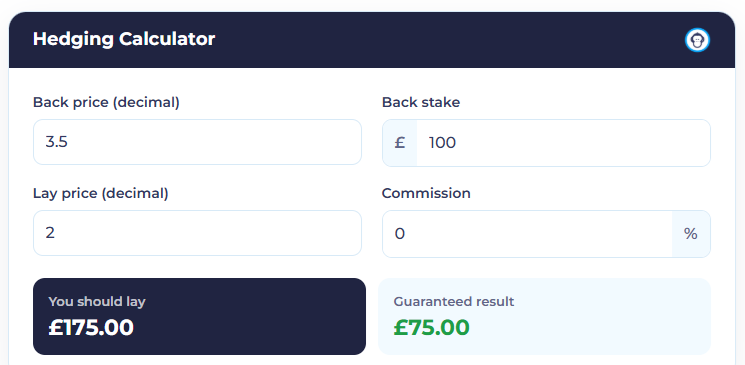
As you can see, the Hedge Calculator tells you how much to lay. A lay bet against Liverpool wins if Liverpool do not win, which includes both a draw and an opposition victory.
Result
Bookmaker
Exchange
Profit
Liverpool Win
+£250
-£175
+£75
Liverpool Win or Draw
-£100
+£175
+£75
This illustrates an important principle of football hedging: you're not simply betting on who will win. You're managing the position created by your original bet as the available odds change.
Football looks straightforward because there are only two teams, but the standard Match Odds market actually has three possible results.
That makes football hedging more complicated than a simple two-way market.
For example, if you back Manchester United to win:
Laying Manchester United would cover you if Manchester were to draw or lose. However, if you choose to place opposing back bets with other bookies, then you need to take the draw into account. It really depends on your hedge betting strategy.
This is why you should always look at the complete market rather than assuming that placing an opposing bet automatically creates a guaranteed result.
Yes, football bets can be hedged in-play, provided the relevant market is available and the operator or exchange permits the required bets.
However, in-play football hedging introduces additional considerations.
Football odds can move rapidly after events such as:
What the data says
The Gambling Commission describes in-play betting as fast-paced and notes that prices can be amended continuously. It also highlights delays in bet processing and the importance of real-time information.
That means an in-play hedge can be harder to execute at the price you originally expected.
Practical takeaway: calculate your hedge before placing it, check the price immediately before confirming the bet, and don't assume an in-play market will remain available.
Football hedging can also overlap with matched betting, but the objective is different.
Matched betting typically uses bookmaker promotions and a betting exchange to turn qualifying offers into a potential profit after accounting for the free bet and qualifying stake.
Hedging is broader. You don't necessarily need a promotional offer — you may simply want to change the risk profile of an existing football bet.
If you're deciding which approach is more suitable, our guide to Hedge Betting vs Matched Betting explains the distinction in more detail.
Calculating football hedges manually can become complicated, particularly when exchange commission and different odds are involved.
OddsMonkey's tools can help with different parts of the process.
The Hedging Calculator is the most directly relevant tool for football hedge betting.
It allows you to enter:
and calculate the appropriate hedge position.
The OddsMatcher can help when you're comparing available bookmaker and exchange odds.
For a football hedge, the price you can actually obtain matters just as much as the theoretical calculation.
The Dutching Calculator can be useful where you're looking at multiple selections rather than a straightforward back-and-lay hedge.
Dutching involves distributing a stake across selections, making it relevant to certain multi-outcome football strategies.
The Implied Probability Calculator can also help you understand what a particular football price represents in probability terms before deciding how you want to structure a position.
The key is to use the right tool for the position you're actually trying to create, rather than treating every football betting strategy as the same type of hedge.
Football hedging is relatively straightforward once you understand the mechanics, but there are several common mistakes to avoid.
A home win, draw and away win are separate outcomes. Make sure you understand exactly which outcomes your bets cover.
If your hedge involves a betting exchange, commission can affect the final result. A calculation that ignores commission may not match the actual outcome.
This is especially relevant to in-play football. Prices can change rapidly and the bet may not be matched at the price you expected.
The amount you need to hedge is generally determined by the odds and your original position, not simply by placing the same amount on the opposite side.
A hedge can reduce risk without necessarily creating a guaranteed profit. Whether you can lock in a positive return depends on the prices and positions involved.
Football hedge betting is not identified by the Gambling Commission as a separate category of prohibited betting. The relevant issue is the betting activity being provided and whether the operator or betting exchange is appropriately licensed for consumers in Great Britain.
The Gambling Commission states that most gambling facilities provided to consumers in Great Britain require an operating licence, while online betting exchanges operate under the relevant betting intermediary licensing framework.
For more detail on the legal position, see our guide to Is Hedge Betting Legal?.
There is no fixed amount you can make from football hedge betting. Any potential profit depends on the original odds, hedge odds, stakes, commission and the specific position being created.
For a broader explanation of the factors that affect potential returns, see our guide to How Much Can I Make With Hedge Betting?.
Yes, you can hedge a football bet after placing it by adding another bet. The hedge stake and potential outcome depend on the odds available, the market and any exchange commission.
Yes, you can hedge football bets in-play when the relevant market and betting options are available. However, football odds can change quickly after goals, red cards and other match events, so the price may change before your hedge is placed.
It depends on the bets you use. A back-and-lay position on the same football selection can account for the selection winning or losing, but using opposing back bets in a standard Match Odds market requires you to consider all three outcomes: home win, draw and away win.
No, a betting exchange is not always required to hedge a football position. However, exchanges can provide the option to lay a selection, which is particularly useful for certain back-and-lay hedging strategies.
No. Hedging can reduce your exposure or change the potential result of an existing position, but it does not automatically create a profit. The outcome depends on the original odds, hedge odds, stakes, market and any applicable commission.

Unlock £29+ with our offer guides. Each guide will walk you through the back and lay bets needed to make your first matched betting profits.
Earn immediately. No payment details required
Start your FREE Trial
*DISCLAIMER: We’re legally required to state that there is no guarantee of specific results each month. The amount of money that you earn can vary dependant on the time and effort that you commit each month.
This website is strictly for over 18’s. If you do have any concerns about gambling please contact GambleAware
© Copyright 2011-2026 Terms of Use | Privacy Statement