
Hedge betting means placing an additional bet to reduce or offset the risk of an existing one. Here is how hedging works, worked examples, how it compares with matched and arbitrage betting, and how to calculate your hedge.
Quick answer
Hedge betting is placing an additional bet to reduce or offset the risk of an existing bet. Depending on the odds and stakes available, a hedge can reduce a potential loss, protect some profit or equalise returns across outcomes. Hedging does not automatically guarantee a profit.
Hedge betting at a glance
What it means
What is hedge betting?
Placing an additional bet to reduce or offset the risk of an existing bet.
Why hedge a bet?
To reduce potential losses, protect some profit, reduce exposure or balance potential returns.
How does it work?
You place an initial bet, then use a second bet on the same or an opposing outcome to change your overall position.
Can hedge betting guarantee a profit?
No. The result depends on the available odds, stakes, market outcomes, commission, liquidity and execution.
Where can you hedge?
Depending on the market, you may hedge with another bookmaker or use a betting exchange to lay a selection.
What affects the hedge stake?
Your original stake and odds, hedge odds, number of outcomes, exchange commission and the result you want to achieve.
What tools can help?
A Hedging Calculator can help calculate a hedge stake, while other betting calculators can help compare prices and potential outcomes.
Hedge betting is commonly used by sports bettors who want to change their exposure after placing an initial wager. Rather than leaving the original bet to run entirely on its own, a bettor places a second bet designed to offset some or all of the potential result of the first.
For example, imagine you back a football team at 3.00 and that team subsequently shortens to 1.80. You could place a second bet against your original position to reduce your exposure or potentially secure a profit.
This is different from matched betting, where opposing bets are deliberately structured around sportsbook promotions to generate a potential profit. It is also different from arbitrage betting, where bettors look to combine available prices across bookmakers or betting exchanges to create a positive return across all covered outcomes.
In this guide, we'll explain what hedge betting is, how hedge betting works, the different types of hedge bets, how to calculate a hedge bet and when hedging may make sense.
Hedge betting means placing an additional wager that offsets some or all of the risk created by an existing bet.
The simplest example is backing one side of a market and subsequently betting on the opposing side. If the second wager is large enough, it can reduce the potential loss from the original bet or, where the odds allow it, create a profit regardless of the result.
However, hedging does not automatically guarantee a profit.
The outcome depends on:
This distinction is important because hedge betting is fundamentally a risk-management technique, rather than a guarantee of profit.
Hedge betting normally involves two stages.
You first place a wager based on your original view or strategy.
For example:
You could simply allow the bet to run.
Alternatively, if the market subsequently moves in your favour, you might decide to hedge.
Suppose Arsenal's odds subsequently fall to 1.60.
You could place a bet on the opposing outcome, such as Arsenal not winning, depending on the market and betting platform being used.
The purpose of the second bet is to change your overall exposure.
The amount you need to stake depends on what you are trying to achieve. You might want to:
This is why there isn't one universal hedge-bet calculation.
Suppose you place:
£100 on Team A at odds of 3.00.
Your potential return is £300, giving you a potential £200 profit.
Team A then performs well and its odds fall to 1.80 and the odds for Team B drift out to 5.0.
You could now hedge by backing Team B at another bookie at odds of 5.0 or you could lay Team A at a betting exchange at odds of 1.80.
If you choose to back Team B at another bookie, you could use the Dutching Calculator to work out the correct hedge stake.
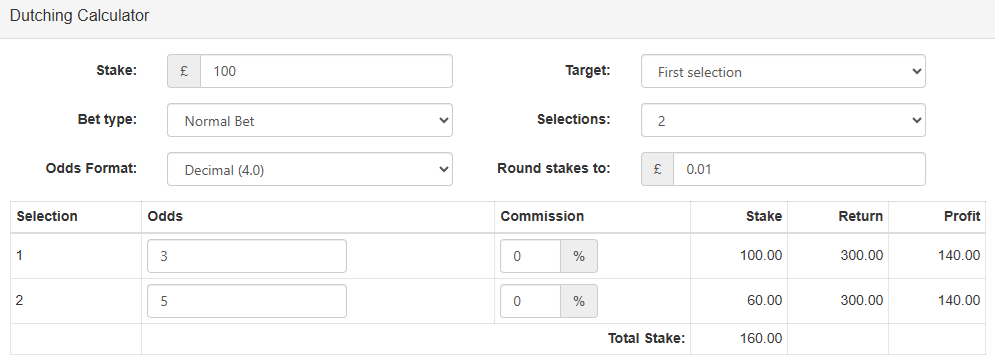
As you can see from the calculator, a back stake of £60 on Team B at odds of 5.0 will return a profit of £140 after deducting your stake of £100 on Team A and the £60 stake on Team B.
The other option is to lay Team A at a betting exchange at odds of 1.80. This time, you would use the Hedging Calculator to determine your hedge stake.
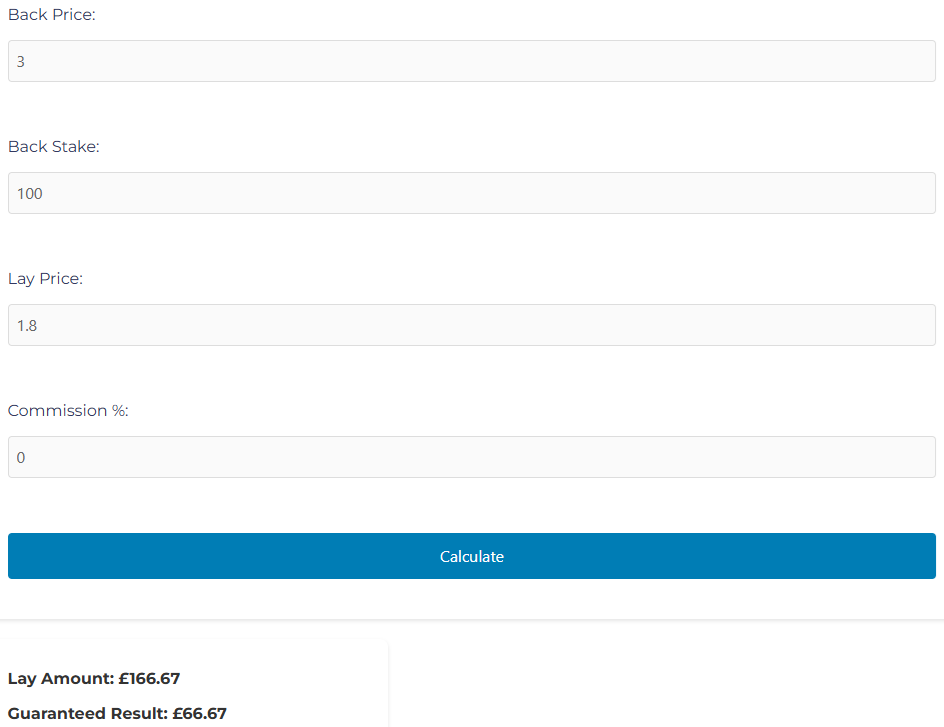
Using this strategy, you would lay £166.67 against Team A winning. Taking into account the exchange liability of £133.34, you can lock in a profit of £66.66.
By backing Team B at another bookie, a drawn match is not covered. To cover a draw, you would need to place a three-way hedge bet. By laying Team A, you do cover off the draw.
The precise hedge stake depends on the odds available and whether your objective is to equalise the potential outcomes, protect your original stake or lock in a specific profit.
This is where a betting calculator can make the process considerably easier.
Rather than manually working through multiple scenarios, you can enter your existing stake and the available odds to calculate the potential hedge position.
Important: a hedge is only as good as the prices and liquidity available when you place it. Odds can move between identifying an opportunity and placing the second bet.
Hedge betting isn't limited to one particular type of strategy. The most appropriate hedge betting strategy depends on the market and what you're trying to achieve.
This is the most straightforward form of hedging.
You place an initial bet and then bet on the opposing outcome to reduce your exposure.
For example:
In a market with a draw, however, backing only Team B would not cover every possible outcome.
That's an important distinction when comparing hedge betting with arbitrage or matched betting.
A partial hedge doesn't attempt to completely eliminate your exposure.
Instead, you place a smaller second bet to reduce your potential loss while retaining some potential upside.
This can be useful when you want to protect part of an existing position without completely giving up the possibility of a larger return.
A full hedge is designed to offset the original position as completely as possible.
Depending on the market and prices available, the bettor may attempt to create approximately equal returns across the relevant outcomes.
The result isn't necessarily a guaranteed profit. Commission, price movement and the structure of the market can all affect the final position.
A bettor can also hedge after an event has started.
For example, a team might score early in a football match, causing its odds to shorten. The bettor could then decide to hedge the original position at the new price.
In-play hedging can be more complicated because odds can move rapidly and a desired price may disappear before the second bet is placed.
Betting exchanges provide another way to hedge.
Rather than simply backing the opposing selection with another bookmaker, a bettor can potentially lay their original selection on an exchange. This strategy is more aligned to matched betting.
For example:
The lay bet can offset some or all of the original exposure.
However, exchange commission and available liquidity need to be incorporated into the calculation.
OddsMonkey expert insight
"On an exchange, the headline price can give a false sense of security if there isn't enough money available at that price. A hedge may need to be matched in stages, and a partially matched position can leave you carrying more exposure than your calculation assumes."
Hedge betting, matched betting and arbitrage betting can look similar because they all involve using opposing positions to manage risk.
Hedge betting is also closely related to arbitrage betting, but the two strategies aren't identical.
Arbitrage betting involves combining prices from different bookmakers or betting exchanges where the implied probabilities create a theoretical positive return across the covered outcomes.
Hedging, meanwhile, generally starts with an existing position and uses another bet to alter or reduce the risk attached to it.
The key difference is why the bets are being placed.
Feature
Hedge Betting
Matched Betting
Arbitrage Betting
Primary purpose
Manage existing exposure
Convert sportsbook promotions
Exploit price discrepancies
Promotions required?
No
Usually
No
Opposing positions
Often
Yes
Yes
Starts with an existing bet?
Usually
Not necessarily
No
Guaranteed outcome?
Not necessarily
Can be structured around known promotional returns
Potentially if all conditions are met
Main risk
Price movement/execution
Errors, restrictions, offer terms
Price movement, limits, liquidity
If you're specifically interested in matched betting, our hedge betting vs matched betting guide goes into the differences in greater detail.
Hedging can provide several potential advantages.
Benefit of hedge betting
How hedging can help
Reduce potential losses
Hedging can reduce your exposure to an unfavourable result by placing an additional bet that offsets some or all of the original position.
Protect an existing profit
If a selection's odds have moved in your favour, a hedge can potentially protect some of the value created by that movement.
Increase flexibility
Hedging allows you to change your betting position as circumstances or market prices change, rather than leaving the original bet untouched until the event finishes.
Manage bankroll risk
Reducing your exposure can help you control how much of your bankroll remains committed to a particular outcome.
However, hedging isn't free. Placing a second bet can reduce your maximum potential return, and poor execution can potentially turn a profitable position into a loss.
Hedge betting can reduce risk, but it doesn't remove every risk.
Risk of hedge betting
What you need to consider
Odds can change
The price available when you identify a hedge may no longer be available when you try to place the second bet, potentially changing the amount you need to stake or the resulting return.
Markets can move quickly
Prices can change rapidly, particularly with in-play betting, making it harder to place a hedge at the price you originally calculated.
Your hedge may be imperfect
If you cannot place the required stake or obtain the calculated price, the hedge may not fully offset your original position, leaving you with some remaining exposure.
Commission can affect returns
When using a betting exchange, commission on winnings can affect the final result and should be included when calculating a hedge.
Bookmaker restrictions can apply
Bookmakers may impose stake limits, account restrictions or other terms that prevent you from placing the required hedge at the intended stake or odds.
Data insight
The Gambling Commission found that 643,779 of 14,923,840 active customer accounts — 4.31% — were subject to some form of commercial restriction. This illustrates why bettors cannot assume that a planned hedge will always be available at the required stake or price.
Source: UK Gambling Commission, Commercial restrictions by betting operators
For these reasons, don't assume that placing a second bet automatically creates a risk-free position.
The correct hedge stake depends on the odds and the outcome you're trying to achieve.
For a simple two-outcome market, you can compare the potential returns from the original bet with the amount required on the opposing outcome.
For example, if you have already placed a £100 bet and want to equalise your potential returns, the hedge stake will depend on the available opposing odds.
This becomes considerably more complicated when:
This is where OddsMonkey's betting calculators can help you work through the numbers rather than relying on manual calculations.
Where appropriate, use the relevant OddsMonkey OddsMatcher, Dutching Calculator, Implied Probability Calculator and other betting calculators to compare prices and understand how different stakes affect your potential position.
The calculator should support your decision-making, rather than replacing the need to check the actual market and bookmaker terms.
There is no single situation where you should always hedge.
A bettor might consider hedging when:
The important question isn't simply "Can I hedge this bet?"
It is: "What am I trying to achieve by hedging, and does the available price make that worthwhile?"
OddsMonkey expert insight
"A shorter price on your original selection isn't, by itself, a reason to hedge. The useful question is whether the new price changes the balance between your potential return and the risk you're still carrying. Hedging too quickly can simply sacrifice value without meaningfully improving your position."
Hedge betting can potentially be used across many different sports and markets.
Football is particularly relevant because of its extensive range of pre-match and in-play markets.
Other possibilities include:
However, the suitability of a sport depends on the specific market.
Data insight
Gambling Commission data covering the largest online operators recorded 6,226,358 active accounts in real-event betting in March 2026, alongside 319,313,395 real-event bets. The figures illustrate the scale of the online betting environment in which bettors may adjust positions as markets develop.
Source: UK Gambling Commission, Business data on gambling to March 2026
A two-outcome tennis match can be relatively straightforward to hedge, whereas a football match-result market has three possible outcomes because of the draw.
For a deeper look at the options, read our which sports can I place hedge bets on? guide.
If you're new to hedging, start with simple markets and make sure you understand the mathematics before committing significant funds.
A sensible process is:
Understand the original bet and its potential outcomes.
Identify what you want the hedge to achieve.
Compare available prices.
Calculate the required hedge stake.
Check limits and exchange liquidity.
Account for any commission or additional costs.
Confirm both bets before placing them.
Recalculate if the available odds change.
Our how to get started with hedge betting guide can take you through the process in more detail.
There is no fixed amount you can make from hedge betting.
Your potential return depends on factors such as:
More importantly, hedging is primarily a risk-management strategy rather than a guaranteed income method.
If you're interested in the earning potential, see our dedicated how much can I make with hedge betting? guide.
Hedge betting itself is not inherently illegal in Great Britain and bettors should use licensed gambling operators to understand the rules that apply to the bookmaker, betting exchange and specific market they are using.
The legality of a particular betting activity can depend on how and where it is conducted, so always check the current terms and relevant UK gambling regulations.
For a more detailed explanation, see our is hedge betting legal? guide.
Hedging isn't limited to sports.
The principle can also be applied to certain roulette strategies, where a bettor attempts to cover different outcomes using multiple bets.
However, players should be aware that roulette hedging will not remove the house edge that bookies and casinos have.
For more information, see our dedicated roulette hedge betting guide.
Calculating hedge positions manually can become complicated, particularly when odds change or multiple outcomes are involved.
OddsMonkey provides a range of betting tools and calculators that can help bettors compare odds, calculate stakes and assess potential betting positions.
Depending on the strategy you're using, relevant tools can include:
The important point is that software doesn't eliminate betting risk.
It can make calculations and price comparison faster, but you should still check the market, available odds, maximum stakes, exchange liquidity, commission and settlement rules before placing a bet.
Want to spend less time comparing odds and calculating stakes? Explore the OddsMonkey betting tools and see how they can help you assess potential hedge betting opportunities more efficiently.
Hedge betting is a strategy for changing or reducing your exposure to an existing bet by placing an additional wager.
It can potentially be used to reduce losses, protect profits or equalise potential returns, but hedging doesn't automatically guarantee a profit.
The key things to remember are:
Ultimately, hedge betting is about managing exposure rather than simply chasing bigger profits. Used appropriately, it can give bettors greater control over their positions and allow them to respond when market prices change.
18+. Gambling involves risk. Hedge betting does not guarantee profit and can result in losses. Always check current bookmaker and betting exchange terms before placing a bet. Bettors should never chase losses and can use Gamble Aware for guidance.
The main purpose of hedge betting is to reduce or change your exposure after placing an initial bet. Depending on the odds and your objective, a hedge can reduce a potential loss, protect some profit or balance your potential returns.
No. Hedging involves placing an additional bet to offset an existing position, while cashing out closes or partially closes a bet through the bookmaker's cash-out facility. Both can reduce exposure, but they work differently and the costs or returns can vary.
No. Hedge betting does not automatically guarantee a profit. The final result depends on factors such as the original and hedge odds, stakes, market outcomes, commission, liquidity and whether the hedge can be placed at the required price.
Yes, where the bookmaker or betting exchange offers suitable in-play markets. However, in-play hedging can be more difficult because odds may change rapidly and the price or liquidity you need may disappear before you can place the hedge.
Yes. A hedge can potentially be placed with a different bookmaker offering a suitable opposing price. The key consideration is whether the available odds, stake limits and market rules allow you to achieve the level of risk reduction you want.
Hedging describes the broader objective of reducing or offsetting an existing betting position. Laying a selection on a betting exchange is one way of achieving that objective, because you're effectively betting against the selection rather than backing it.
It can be, provided you understand how the original and hedge bets interact before placing them. Beginners should generally start with simple markets, calculate the potential outcomes in advance and avoid relying on a hedge being available at a particular future price.
Commission may apply when you use a betting exchange to hedge, and this can affect the final result. Any calculation should account for the exchange's applicable commission rather than assuming the displayed odds represent your final net return.
Yes, but hedging a three-way market such as a football match result requires more care because there are three possible outcomes: home win, draw and away win. Hedging only one opposing selection may leave you exposed to the third outcome.

Unlock £29+ with our offer guides. Each guide will walk you through the back and lay bets needed to make your first matched betting profits.
Earn immediately. No payment details required
Start your FREE Trial
*DISCLAIMER: We’re legally required to state that there is no guarantee of specific results each month. The amount of money that you earn can vary dependant on the time and effort that you commit each month.
This website is strictly for over 18’s. If you do have any concerns about gambling please contact GambleAware
© Copyright 2011-2026 Terms of Use | Privacy Statement