
Learn how to start hedge betting in Great Britain with our beginner's guide. Discover how hedging works, calculate your hedge stake and understand the risks before you place a bet.
Quick answer
To start hedge betting, choose a suitable betting market, place your initial bet and then assess the available opposing odds. If you decide to hedge, calculate the second stake based on your original bet, current odds and any exchange commission, then check the result across every relevant outcome before placing the hedge. A hedge can reduce your exposure but does not guarantee a profit.
Hedge betting can be useful when you want to reduce your exposure to a particular outcome without simply accepting the original bet's result. However, hedging doesn't automatically mean a guaranteed profit: the outcome depends on the market, odds, stakes, commission and which selections you cover.
Question
Short Answer
What is hedging?
Placing an additional bet to change or reduce exposure
How do I start?
Choose a market, place an initial bet, assess the opposing odds and calculate the hedge
Do I need an exchange?
No, although exchanges can be useful because they allow back and lay bets
Does hedging guarantee profit?
No. A hedge can reduce risk while still producing a loss
Can I hedge in-play?
Yes, where the market remains available, but odds can move rapidly
What do I need to calculate?
The original stake, odds, current hedge odds and any applicable commission
If you're new to the concept, this hedge betting guide explains how to start hedge betting step by step, with examples and practical tips for getting your calculations right.
Hedge betting involves placing an additional bet designed to reduce your exposure to the original wager.
For example, imagine you back Manchester United at odds of 2.50. As the match progresses, the odds on the opposing outcome may change. You could place another bet on the other side of the market to offset some or all of your potential loss.
The purpose of the second bet is to hedge your original position.
Depending on the odds and market, a hedge can be used to:
The important point is that hedging is about managing your position, rather than simply predicting which team, player or horse will win.
What the data says
In the Gambling Survey for Great Britain 2025, 8% of adults reported betting on sports and racing online or via an app in the previous four weeks. This shows that online sports and racing markets form a meaningful part of current UK betting activity.
If you're completely new to the concept, start with our main Hedge Betting guide to understand the fundamentals before moving on to the practical steps below.
If you're wondering how to start hedge betting, the process can be broken down into five straightforward steps. Hedge betting is a strategy but the execution methods can differ depending on whether you are backing an opposing bet or laying your original bet at a betting exchange.
Start by choosing an event and market where you understand the available outcomes.
Football is a common example, but hedge betting can be applied across many different sports and betting markets.
For example, you might consider:
However, don't assume every market is suitable for a simple two-way hedge.
OddsMonkey expert insight
"The quality of a hedge is often determined before the first bet is placed. Markets with clear, well-defined outcomes and sufficient liquidity give you more control when you need to adjust your position; an attractive price is less useful if you cannot secure the second side."
James, OddsMonkey Hedge Betting Expert
A football match involving Home Win, Draw and Away Win, for example, has three possible match-result outcomes. Betting on just two of them does not cover the entire market.
This is one reason it's important to understand exactly what your hedge does before placing the second bet.
For more ideas, see our guide to What Sports Can I Place Hedge Bets On?.
Once you've identified a suitable market, place your initial bet.
Suppose you back a tennis player:
If your selection wins, the £50 bet returns £100, including your original stake.
But rather than simply waiting for the result, you might decide to hedge later if the circumstances or available odds change.
This is where hedge betting differs from simply placing two random bets.
The second wager is specifically intended to alter the risk profile of the original position.
Next, look at the available odds for the opposing selection.
This is important because your hedge stake depends on the odds available when you place the second bet.
For example, imagine your original £50 bet was placed at 2.00 and the opposing selection is now available at 2.20.
The calculation required to determine your hedge stake isn't something you should guess.
OddsMonkey's Hedging Calculator lets you enter your back price, back stake, lay price and commission to calculate the appropriate hedge amount.
Give the FREE OddsMonkey Hedging Calculator a try.
This is the mathematical part of the process.
You need to consider:
For example, suppose you have:
Bet
Odds
Stake
Original back bet
2.20
£50
Opposing hedge
2.0
£55
Rather than manually working out the second stake, enter the figures into the OddsMonkey Hedging Calculator.
The calculator is designed to work out the amount required for the contrasting bet and show the resulting position.
By inputting the above figures into the Hedging Calculator, the calculation will look like this:
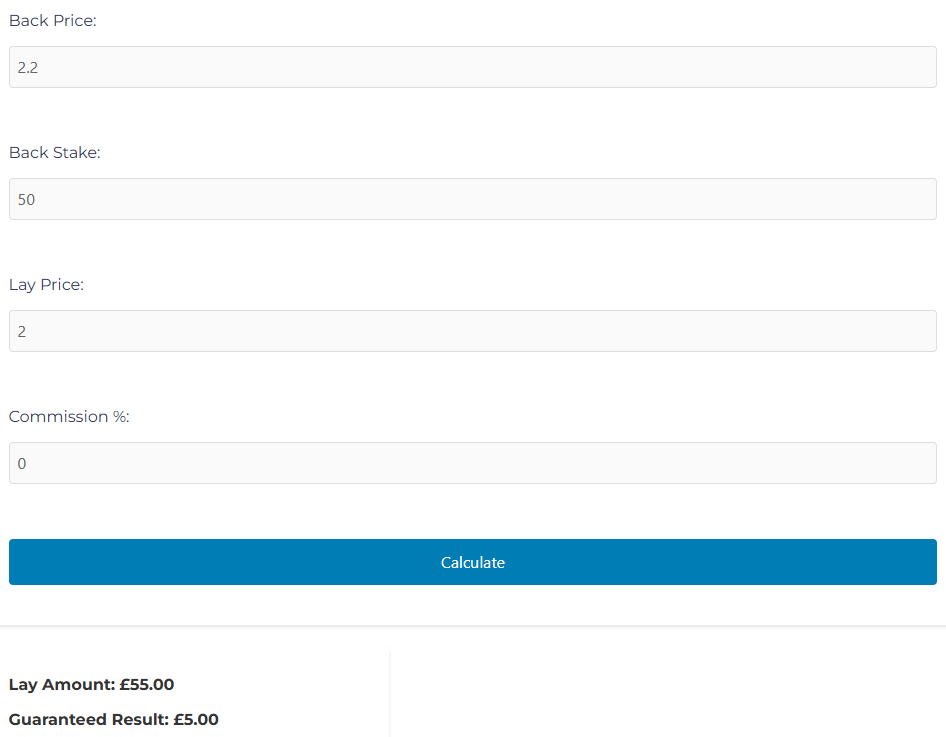
This is particularly useful because small mistakes in the stake calculation can materially change the outcome.
Here's how the maths for the outcomes works:
Outcome
Back bet wins
Lay bet wins
Profit
Bookmaker wins
£60
-£55
£5
Lay wins
-£50
£55
£5
Before placing the hedge, work out what happens if each outcome occurs. Check the total amount staked, potential returns, exchange commission and resulting profit or loss so you know exactly what position the second bet creates.
If the market has three or more possible outcomes, make sure you understand which outcomes your hedge actually covers.
Let's look at a simplified example.
Imagine you place:
£100 on Team A at odds of 2.00
Your potential return is:
£100 × 2.00 = £200
Now suppose you decide to hedge by backing Team B at odds of 2.00.
If you place another £100 on Team B:
In this simplified example, you've effectively created a break-even position.
That illustrates an important point about hedge betting:
A hedge can reduce your risk, but it doesn't automatically create a profit.
To potentially lock in a profit, the relationship between the original odds, hedge odds and stakes needs to produce a positive overall result.
Real-world betting also introduces factors such as commission, changing odds and market liquidity, so calculations should be checked before placing either side.
Betting exchanges can be particularly useful for hedging because they allow bettors to back or lay selections, depending on the market and exchange.
A lay bet is effectively a wager against a selection winning.
For example, you could initially back a horse with a bookmaker and later lay that horse on a betting exchange.
The combination can be used to change your exposure to the original bet.
However, exchange commission needs to be included in your calculations.
That's why a calculator can be useful: rather than treating the hedge as a simple calculation based solely on the displayed odds, you can account for the relevant inputs before placing the second bet.
If you're interested in the relationship between these approaches, read our guide to Hedge Betting vs Matched Betting.
One of the biggest practical considerations when learning how to start hedge betting is that odds aren't fixed.
Suppose you originally back a selection at 3.00.
Later, the opposing selection might be available at significantly different odds.
That changes the amount required for your hedge.
This means you shouldn't calculate your hedge stake and then assume the same figure will remain correct indefinitely.
Instead:
Check the current odds.
Enter the current figures into your calculator.
Check the calculated hedge stake.
Confirm the odds haven't changed.
Place the hedge if it still achieves your intended outcome.
This is particularly important when betting in-play, where prices can move quickly.
OddsMonkey expert insight
"A calculated hedge is only a snapshot of the market. Between checking the price and getting the second bet matched, the odds can move or available liquidity can disappear, so experienced bettors treat the displayed hedge figure as conditional rather than guaranteed."
James, OddsMonkey Hedge Betting Expert
There isn't one universal way to hedge a bet. Your approach will depend on why you're hedging in the first place.
You might hedge because your original position is moving against you and you want to reduce your downside.
This doesn't necessarily turn the position into a profitable one, but it can reduce the amount you stand to lose.
You might also hedge after your original selection has moved into a stronger position.
For example, a tennis player you backed pre-match may win the first set and see their odds shorten substantially.
You could then consider whether hedging makes sense based on the new odds and the amount you're prepared to risk.
Another approach is to calculate a hedge designed to produce a similar outcome across the covered selections.
The exact result depends on the odds and stakes.
For more approaches, see our dedicated Hedge Betting Strategies guide.
The mathematics behind a hedge can become complicated surprisingly quickly.
That's where the OddsMonkey Hedging Calculator can help.
The tool allows you to enter:
It then calculates the amount you should lay and the resulting position.
A calculator can help you:
OddsMonkey also provides a broader range of betting calculators, including matched betting, arbitrage, dutching and other betting tools.
Hedge betting and matched betting can look similar because both can involve placing bets on opposing sides of an outcome.
But they're not the same strategy.
Hedge betting generally involves placing an additional bet to reduce or manage the risk of an existing position.
Matched betting typically uses bookmaker promotions and a betting exchange to exploit the difference between back and lay bets.
If you're deciding which approach is right for you, read Hedge Betting vs Matched Betting.
If you're new to hedging, keep the process simple.
Don't begin by risking a large amount while you're still learning how the calculations work.
Before placing a hedge, ask:
"What happens to my overall position if each possible outcome occurs?"
If you can't answer that question, don't place the second bet yet.
A small change in odds can alter your required hedge stake.
If you're using a betting exchange, make sure the relevant commission is reflected in your calculation.
A hedge can reduce risk without creating a profitable position.
The OddsMonkey Hedging Calculator can handle the stake calculation and help you understand the resulting position.
Tracking your bets can help you understand whether your approach is actually working over time rather than judging it on a handful of individual bets.
Beginners can make several avoidable mistakes.
If there are three or more possible outcomes, betting against just one doesn't necessarily cover the entire market.
Always check that you're using the current price rather than the odds from your original bet.
Exchange commission can change the final calculation.
Don't place the second bet first and work out what it means afterwards.
Calculate the position beforehand.
Hedge betting shouldn't be used as a way of trying to recover previous gambling losses.
If you find yourself increasing stakes because you've lost money, stop and reassess your betting.
What the data says
The Gambling Commission's 2025 survey found that 2.4% of participants had a Problem Gambling Severity Index (PGSI) score of 8 or more, the level classified as indicating a higher risk of gambling-related harm. Hedging therefore should not be presented as removing the risks associated with gambling.
Before placing a hedge, ask yourself:
If you've answered all of these questions, you're in a much better position to understand the bet you're about to place.
Learning how to start hedge betting doesn't require complicated mathematics, but understanding the numbers is essential.
Before placing your first hedge, make sure you understand all the possible outcomes, the current odds, the amount of your original stake and any commission that applies. Most importantly, calculate the resulting position before placing the second bet so you know what you could win or lose in every covered outcome.
The basic process is:
Choose a market → place your initial bet → monitor the position → check the opposing odds → calculate your hedge → review every possible outcome → place the hedge if it achieves your objective.
The OddsMonkey Hedging Calculator can take care of the stake calculation, helping you spend less time working through the maths and more time understanding the position you're taking.
If you're new to the strategy, start with the main Hedge Betting guide, then explore the related guides on strategies, sports, potential returns and legality.
And remember: hedge betting can reduce exposure, but it cannot guarantee a profit. Always understand the risks before placing a bet and only gamble what you can afford to lose.
Start by choosing a market you understand, placing your initial bet and monitoring the available opposing odds. If you decide to hedge, calculate the required second stake using the current odds, your original stake and any exchange commission before placing it.
No, not necessarily. A hedge can involve different types of bets, but betting exchanges are particularly useful because they allow you to lay a selection as well as back one, making it easier to take an opposing position.
Check your original stake and odds, the current opposing odds, all possible outcomes and any applicable exchange commission. You should also calculate the resulting position for each outcome so you understand exactly what you could win or lose.
Yes, provided the market remains available and your bookmaker or exchange allows the relevant bet. However, in-play odds can change quickly, so you should always check the current price and recalculate your hedge stake immediately before placing the second bet.
No. Hedging involves placing another bet to change your exposure to the original position, whereas cashing out is a feature offered by some bookmakers or exchanges that settles a bet before the event finishes. They can have similar objectives, but they work differently.
You can, but covering only one opposing outcome may leave other outcomes exposed. For example, a standard football match-result market has three outcomes—home win, draw and away win—so you need to understand which outcomes your hedge actually covers.
Your required hedge stake depends on factors including your original stake, original odds, current opposing odds and any exchange commission. Using a hedging calculator can help you calculate the appropriate amount rather than relying on manual calculations.
One of the most common mistakes is placing the hedge without first checking what happens across every relevant outcome. Other mistakes include using outdated odds, forgetting exchange commission or assuming that hedging automatically creates a guaranteed profit.
Yes, hedge betting is generally legal in the UK when you place bets through gambling operators that are authorised to offer betting in Great Britain. The Gambling Commission regulates betting operators under the Gambling Act 2005, including bookmakers and betting exchanges.

Unlock £29+ with our offer guides. Each guide will walk you through the back and lay bets needed to make your first matched betting profits.
Earn immediately. No payment details required
Start your FREE Trial
*DISCLAIMER: We’re legally required to state that there is no guarantee of specific results each month. The amount of money that you earn can vary dependant on the time and effort that you commit each month.
This website is strictly for over 18’s. If you do have any concerns about gambling please contact GambleAware
© Copyright 2011-2026 Terms of Use | Privacy Statement