
Learn how a football dutching strategy works, how to split stakes across outcomes, calculate implied probability and assess potential dutching opportunities.
Quick answer
A football dutching strategy involves backing two or more mutually exclusive outcomes and dividing your total stake between them according to the available odds. In a 1X2 football market, for example, you could back the home win, draw and away win with stakes calculated to target a similar gross return. Dutching does not guarantee a profit, and the result depends on the odds, outcomes covered, stake availability and bookmaker rules.
Element
What it means
Selections
Two or more mutually exclusive football outcomes
Odds
The prices available for each selection
Stake
Your total amount divided according to the odds
Key calculation
Combined implied probability
Potentially favourable position
Combined implied probability below 100%, before practical factors
Main risks
Odds movement, stake limits, market rules and uncovered outcomes
The aim is to distribute your stakes so that the potential return is similar across the selections you have backed. Whether the strategy produces a profit, breaks even or results in a loss depends on the odds available and which outcomes you cover.
The OddsMonkey Dutching Calculator can calculate the required stake for each selection, while tools such as the Implied Probability Calculator can help assess the combined probability represented by the available odds.
Important: Dutching does not guarantee a profit. If the combined implied probability of your selected odds is above 100%, covering all the outcomes will normally result in a loss before any other factors are considered.
Football dutching is a form of dutch betting where you back multiple outcomes in the same football match rather than choosing just one selection.
In a traditional 1X2 football market, there are three possible match-result outcomes:
Outcome
What it means
Home win
The home team wins
Draw
The match finishes level
Away win
The away team wins
A football dutching strategy can involve backing two of these outcomes or all three.
For example, you might back:
Instead of placing £100 on one result, you could split the £100 between the three selections. The exact stakes depend on the odds and the return you are targeting.
If you're new to the concept, see our full guide to What Is Dutch Betting? before moving on to the football-specific examples below.
Choose two or more mutually exclusive football outcomes, find the available odds, calculate their combined implied probability and enter the selections into a dutching calculator. The calculator can then distribute your total stake between the selections to target a broadly similar gross return.
Choose the football market you want to dutch.
Identify the outcomes you want to cover.
Find the best available odds for those selections.
Check the combined implied probability.
Enter your selections and total stake into a dutching calculator.
Review the calculated stakes and potential returns.
Check the bookmaker's rules before placing the bets.
The important calculation is the combined implied probability.
For decimal odds, implied probability can be calculated as:
Implied probability = 1 ÷ decimal odds × 100
For multiple selections, add the implied probabilities together.
For example:
Selection
Decimal odds
Implied probability
Home win
2.50
40.00%
Draw
3.50
28.57%
Away win
4.00
25.00%
Combined
93.57%
A combined implied probability below 100% can indicate a potentially favourable dutching position based on the quoted prices. It does not guarantee a profit, because the available stake, price changes, bookmaker restrictions and settlement rules can affect the final outcome.
What the data says
A study of nearly 100,000 football matches across 17 European leagues found that betting odds outperformed methods based on points or goals when predicting match winners and expected goals, highlighting the information contained in market prices.
You can use the OddsMonkey Implied Probability Calculator to make this calculation easier.
Let's look at a simple three-way football dutching example.
Suppose you have found the following prices across different bookmakers:
Outcome
Odds
Home win
2.50
Draw
3.50
Away win
4.00
You want to stake £100 in total.
Using the dutching calculation, the £100 could be divided approximately as follows:
Selection
Odds
Approx. stake
Approx. return
Home win
2.50
£42.75
£106.88
Draw
3.50
£30.54
£106.89
Away win
4.00
£26.72
£106.88
Total
£100.01
The small difference from £100 is caused by rounding the calculated stakes.
If the home team wins, the £42.75 stake at 2.50 produces approximately £106.88 in returns. If the match is drawn, the £30.54 stake at 3.50 produces approximately £106.89. If the away team wins, the £26.72 stake at 4.00 produces approximately £106.88.
The underlying principle is that the stakes are adjusted to target a broadly equal gross return.
However, this example should not be interpreted as a guaranteed profit. The actual outcome depends on the prices available, the stakes accepted, bookmaker terms and whether every relevant outcome has genuinely been covered.
You don't need to work out every stake manually.
Enter the football selections, odds and total stake into the OddsMonkey Dutching Calculator and it can calculate how the stake should be distributed.
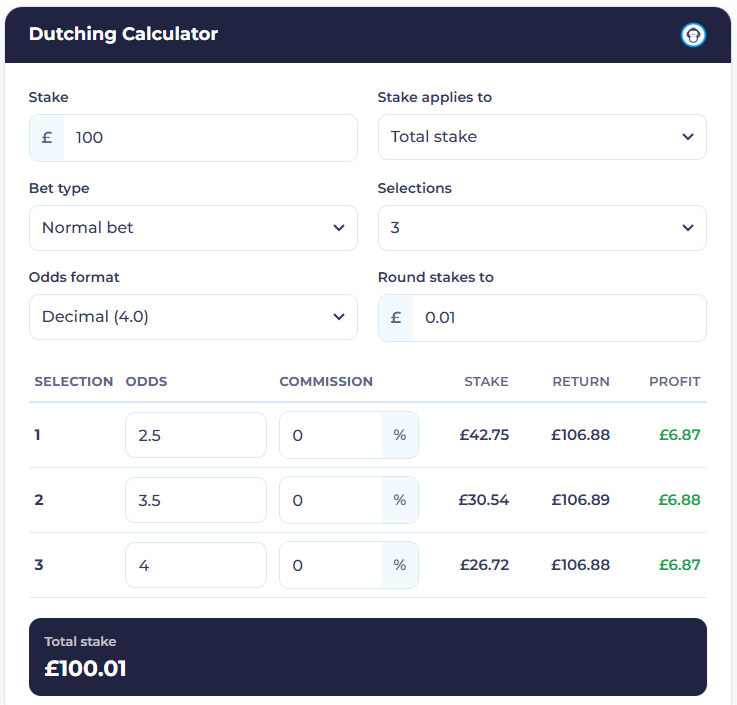
This can reduce the risk of arithmetic mistakes when working with several selections.
Want to check your own football dutching calculation? Enter your selections, odds and total stake into the OddsMonkey Dutching Calculator to see how the stake can be distributed across your selections.
Football dutching can potentially produce a profitable position when the available odds and stake allocation create a favourable combined price.
However, dutching football is not automatically profitable simply because you cover multiple outcomes.
Consider these situations:
Combined implied probability
General position
Below 100%
Potentially profitable before other costs and practical considerations
100%
Approximately break-even before other costs
Above 100%
Normally a loss if all outcomes are covered
This is why finding suitable odds is central to a football dutching strategy.
What the data says
Research using 84,230 European professional soccer matches found that bets in the lowest probability decile had an average loss of 17%, compared with just 2% for bets in the highest probability decile, demonstrating that betting prices do not all carry the same expected return.
The opportunity can disappear if odds change before all bets are placed, if a bookmaker changes the market, or if you cannot get the required stake at the advertised price.
For a broader discussion of potential returns and the factors that affect them, see How Much Can I Make With Dutching?
Football offers several markets that can potentially be used for dutching, but the mathematics become more complicated as the number of outcomes increases.
The classic example is:
This is often the easiest market to understand because there are three mutually exclusive outcomes.
Some football markets have only two possible outcomes after the market is defined.
For example, you could potentially dutch two selections in a market where the outcomes are mutually exclusive.
The important point is to understand exactly what constitutes a winning outcome before calculating your stakes.
Markets involving goals can also have multiple mutually exclusive selections, although the number of outcomes and settlement rules can make the calculations more complicated.
For newer bettors, a straightforward 1X2 example is usually easier to understand before moving into more complex markets.
A key difference is how the total stake is distributed.
Imagine you have £100 and think the home team has a strong chance of winning.
With a conventional bet, you could place the full £100 on the home team.
With dutching, you could instead distribute some or all of the £100 across multiple outcomes.
Approach
Number of selections
How stake is allocated
What happens if an unbacked outcome wins?
Single bet
1
Entire stake on one selection
Entire stake is lost
Football dutching
2+
Stake calculated across selections
The covered outcomes can produce a return; an uncovered outcome loses the relevant stake
Three-way dutching
3
Stake calculated across home/draw/away
One of three covered outcomes should win, subject to correct market selection
Dutching therefore changes the relationship between selection coverage, stake size and potential return.
It does not make the underlying football result more predictable.
Football dutching and matched betting can overlap, but they are not the same strategy.
Football dutching
Matched betting
Backs multiple outcomes
Usually combines a bookmaker back bet with a lay bet
Can be completed using bookmaker bets
Commonly involves a betting exchange
Stakes are adjusted between selections
Back and lay stakes are calculated to offset different outcomes
Can be used outside promotional offers
Often focuses on converting bookmaker promotions
Profit depends on the odds and selections covered
The objective is generally to use qualifying offers and calculated bets to reduce exposure
If you're deciding which approach is more relevant to your betting activity, see Dutching vs Matched Betting: What's the Difference?
Calculating several football stakes manually can become unnecessarily complicated, particularly when the odds are different across three selections.
The OddsMonkey Dutching Calculator is designed to calculate how a total stake should be distributed across multiple selections.
For a football dutching bet, you can use it to:
The calculator can be particularly useful when the odds are changing or when you're comparing several potential football dutching opportunities.
Expert insight from James, OddsMonkey dutch betting expert
“A calculated dutching position is only as good as the prices you can actually secure. Experienced bettors tend to treat the calculation as a live snapshot: check the available prices immediately before placing the bets, then recalculate if one selection moves materially rather than relying on an earlier figure.”
Implied Probability Calculator
The Implied Probability Calculator converts decimal odds into implied probabilities and assesses the combined probability of your selected football outcomes.
OddsMatcher
The OddsMatcher can help you compare available bookmaker prices and identify relevant odds before calculating your dutching stakes.
Profit Tracker
If you're using dutching as part of a wider betting strategy, keeping track of stakes and results can help you monitor your actual results rather than relying on individual successful bets.
If you're new to dutching football, keep the process straightforward.
Start with a simple market such as the football match result.
Decide whether you are covering two outcomes or all three 1X2 outcomes.
Look across the bookmakers available to you and record the best prices.
Use the Implied Probability Calculator to calculate the combined implied probability.
Enter the odds and total stake into the Dutching Calculator.
Confirm:
Use your records or Profit Tracker to monitor the actual result over time.
This process is deliberately simple. More advanced approaches can be explored in our guide to Dutching Bet Strategies.
Even when the mathematics are correct, practical mistakes can affect the outcome.
It doesn't.
Dutching distributes your stakes across selected outcomes. Whether those stakes produce a profit depends on the odds and the market.
Football odds can move quickly. A calculation based on 2.50, for example, is no longer valid if the bookmaker changes the price before you place the bet.
In a standard football 1X2 market, the draw is a distinct outcome.
If you back the home and away teams but don't cover the draw, a drawn match does not produce the intended three-way dutching result.
If your selections have different odds, simply dividing £100 into three equal £33.33 stakes will not normally produce equal returns.
The whole point of dutching is to adjust the stakes according to the odds.
Bookmakers can apply different rules to football markets, including rules around void bets, postponed matches, abandoned matches and other settlement circumstances.
Check the relevant bookmaker's terms before placing a bet.
It is possible to encounter dutching opportunities in football markets while a match is in play, but this introduces additional considerations.
In-play betting means placing bets while the football match is taking place. The Gambling Commission notes that in-play betting is commonly conducted through online bookmakers and betting exchanges.
Prices can move rapidly during a match, which means the odds used in a dutching calculation may no longer be available by the time you attempt to place every selection.
For this reason, anyone considering in-play dutching should understand that the practical execution can be more complicated than calculating a pre-match example.
There isn't a single set of football selections that will always make a good dutching opportunity.
Instead, consider:
Factor
Why it matters
Available odds
The prices determine the implied probability
Number of selections
More selections can mean more bets to place
Stake limits
You need sufficient available stake at the required prices
Odds movement
A price can change before all bets are placed
Market rules
Settlement conditions can differ
Bookmaker availability
You may need accounts with multiple bookmakers
Commission
Relevant when an exchange is involved
Record keeping
Helps you assess actual results over time
The Dutch Matcher and Dutching Calculator can make the numerical side easier, but they don't remove the need to check the underlying bet.
Expert insight from James, OddsMonkey dutch betting expert
“The strongest dutching opportunities are not necessarily those with the highest individual odds. What matters is how the prices work together within the same market definition, including settlement rules. A slightly lower price can sometimes be more useful if it gives you a cleaner, genuinely comparable set of outcomes.”
No. Football dutching is not risk-free.
Even when the mathematics indicate a potentially favourable position, there can be practical risks.
For example:
If you're using multiple bookmakers, always check the terms and conditions that apply to the specific market.
The Gambling Commission advises consumers to check that gambling businesses are appropriately licensed and to understand the terms and conditions of the gambling products they use.
A football dutching strategy is essentially about splitting a total stake between multiple football outcomes according to their odds.
The key points are:
If you want to learn the fundamentals first, start with What Is Dutch Betting? Then explore How To Get Started With Dutching for a step-by-step introduction to the process.
A football dutching strategy involves backing two or more mutually exclusive outcomes of a football market and splitting your total stake between them according to the available odds. The aim is generally to create a similar potential gross return across the selections rather than staking the same amount on each outcome.
First, calculate the implied probability of each selection and add them together, then use the total stake and odds to calculate how much to place on each outcome. A dutching calculator can automate the stake allocation and help reduce calculation errors.
Football dutching can potentially be profitable when the combined implied probability of the selected odds is below 100%, but this does not guarantee a profit. Odds movement, stake limits, bookmaker rules and whether all relevant outcomes are correctly covered can affect the final result.
Yes. In a standard 1X2 market, you can dutch the home win, draw and away win. Because the three outcomes are mutually exclusive, one of the covered selections should win, although this does not by itself guarantee a profit.
The 1X2 match-result market is a straightforward starting point because it has three clearly defined outcomes: home win, draw and away win. Other two-outcome and goals markets can also be considered, but their settlement rules and number of outcomes can make the calculations more complicated.
Yes. Football dutching can involve finding different prices for your selected outcomes across multiple bookmakers, then calculating how to distribute your total stake between them. You should check that the required stake is available and that the relevant market and settlement rules match before placing the bets.
No. Football dutching is not risk-free, even when the calculated position appears favourable. Odds can change, stakes may be unavailable, markets can be suspended and bookmaker settlement rules can affect the outcome.
Football dutching involves backing multiple outcomes and adjusting the stakes according to the odds, whereas matched betting commonly combines a bookmaker back bet with a lay bet at a betting exchange. The two approaches can overlap, but they have different mechanics and objectives.

Unlock £29+ with our offer guides. Each guide will walk you through the back and lay bets needed to make your first matched betting profits.
Earn immediately. No payment details required
Start your FREE Trial
*DISCLAIMER: We’re legally required to state that there is no guarantee of specific results each month. The amount of money that you earn can vary dependant on the time and effort that you commit each month.
This website is strictly for over 18’s. If you do have any concerns about gambling please contact GambleAware
© Copyright 2011-2026 Terms of Use | Privacy Statement