
Follow our step-by-step guide to choosing selections, calculating stakes, checking odds and placing your first dutch, with worked examples and a simple checklist for beginners.
Quick answer
To get started with dutching, choose two or more outcomes from the same event, check the available odds, decide how much you want to stake and use a dutching calculator to divide the stake between your selections. Review the calculated stakes and potential returns before placing each bet.
Remember that dutching does not guarantee a profit: if an outcome outside your selections wins, your stakes can be lost.
To start dutching, you need an event with two or more selections you want to back, the current odds for those selections, a total amount you are prepared to stake and a way to calculate how that stake should be divided. You should also understand which outcomes your bets cover and check the market's settlement rules before placing your bets.
A dutching calculator can calculate the individual stakes for you, particularly when selections have different odds or exchange commission applies.
This guide to dutching explains how the process works, walks through a simple example and shows how OddsMonkey's tools can make the calculations easier.
Dutching involves backing multiple selections in the same event rather than backing just one.
For example, imagine a football match where you believe either Team A or Team B could win, but you don't want to put your entire stake on one team.
You could back both selections at different odds.
The amount placed on each selection is adjusted according to its odds. A selection with lower odds generally requires a larger stake than a selection with higher odds if you're trying to create a similar potential return.
Here's a simplified example:
Selection
Decimal odds
Example stake
Potential returns
Team A
2.00
£30
£60
Team B
3.00
£20
£60
Total
£50
£60
In this simplified example, £50 is divided between two selections, with either selected team producing a £60 return (£10 profit) if successful.
However, the calculation becomes more complicated when you have more selections, different odds, exchange commission or a specific target return.
That's where a calculator can help.
If you want to understand the terminology and theory before trying the method yourself, start with our What Is Dutch Betting? guide.
The main formula for calculating dutching bets is:
Stake on selection = Total stake × (1 / odds for selection) ÷ sum of (1 / odds for all selections)
Here’s how the calculation works for the above example:
The first thing to do is work out the implied probability, which involves dividing 1 by the odds:
Now we can calculate the stakes required:
As you can see, it’s a little fiddly and is so much easier to let the Dutching Calculator do the work for you.
Before placing your first dutch, make sure you have:
Once you have these details, you can calculate the individual stakes and check the figures before placing the bets.
The easiest way to approach the dutching betting method is to break it down into a repeatable process.
Start by selecting a sporting event with multiple possible outcomes.
Expert insight from James, OddsMonkey dutch betting expert
“A useful starting point is to judge the market before thinking about the stake. Look for clear, well-defined outcomes and check how the market is settled, because a technically correct dutch can still produce an unexpected result if the underlying market rules are misunderstood.”
Dutching can be used across different sports and markets, but the most important consideration is whether the selections you want to back are suitable for the particular dutch you're constructing.
For example, you might look at:
You don't necessarily need to cover every possible outcome. A dutch can involve selected outcomes only, meaning there remains a possibility that an outcome you haven't backed wins.
For more information about choosing markets, see our guide to What Sports Can I Use for Dutching?
Next, decide which outcomes you want to include.
Suppose you're looking at a football market and select:
The draw isn't included.
That means your dutch covers two possible outcomes, but not all three results in the 1X2 market.
This is an important point for beginners: a dutch is only covering the selections you've included.
If the draw wins, neither of your bets wins.
Beginner's tip: Always check exactly which outcomes your bets cover before placing them. Don't assume that backing several selections means you've covered the entire event.
Once you've selected your outcomes, check the odds available for each one.
Odds can change, so don't rely on calculations made using old prices.
If you're dutching Team A, Team B and the draw, you'll need to enter the current odds into your calculator before placing the bets.
This is particularly important if you're placing several bets manually because even a relatively small odds movement can alter the required stakes.
Before calculating your individual bets, decide on your total stake.
For example, you might decide that you want to allocate £100 to the dutch.
The £100 isn't necessarily placed equally across your selections.
Instead, the dutching calculation determines how the £100 should be divided based on the odds.
This is one of the main differences between simply placing the same amount on every selection and using a structured dutching approach.
This is where the OddsMonkey Dutching Calculator can save you from doing the calculations manually.
The calculator allows you to enter relevant details such as your total stake, number of selections, odds and, where applicable, exchange commission. It then calculates the individual stakes, potential returns and profit.
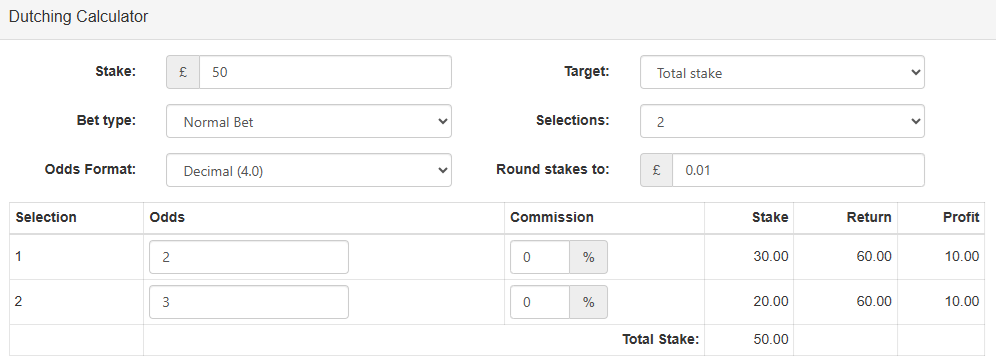
For a beginner, the process is essentially:
Total stake → Add selections → Enter odds → Add commission if applicable → Calculate → Check stakes
The calculator can be particularly useful when the odds aren't identical or you're working with several selections.
Don't immediately place the bets after getting your calculation.
Take a moment to check:
If the odds have moved, recalculate before placing the bets.
Once you've checked everything, place the individual bets using the calculated stakes.
Try to avoid unnecessary delays between bets, particularly where prices are moving quickly.
If one price changes significantly before you've placed all the bets, stop and recalculate rather than assuming the original figures still apply.
After the event, check the result and record what happened.
Keeping a record can help you understand how the dutching betting method works in practice and identify errors in your process.
If you're using dutching alongside other betting strategies, a Profit Tracker can also help you keep track of your overall betting activity and results.
Let's look at a simplified example.
Suppose you're considering three selections with a total stake of £100:
Selection
Decimal odds
Selection A
2.50
Selection B
4.00
Selection C
5.00
Rather than simply placing £33.33 on each selection, you use a dutching calculation to determine how the £100 should be distributed. The calculation takes the odds of each selection into account.
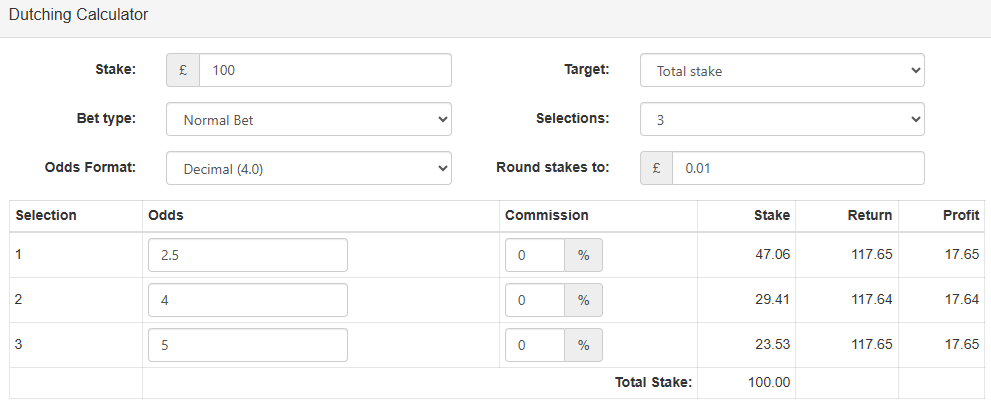
The lower-priced selection requires a different stake from the higher-priced selections because each stake has a different potential return.
The exact figures will depend on the calculation, whether you're betting with a bookmaker or exchange, and any applicable commission.
Doing a two-selection calculation manually may be manageable.
But imagine trying to calculate the correct stakes for five selections while also accounting for exchange commission and changing odds.
That's where a calculator becomes useful.
It reduces the amount of manual arithmetic involved and gives you a clear set of stakes to work from.
Where you place your bets can affect how you calculate the dutch.
What the data says
The Gambling Commission’s 2025 data request covered almost 15 million active customer accounts at some of Great Britain’s largest online real-event betting providers. Of these, 4.31% were reported as having some form of commercial restriction, showing that account availability can be a practical consideration when betting online.
Source: Gambling Commission, Commercial restrictions by betting operators
Factor
Bookmaker
Betting exchange
Bet type
Back bet
Back or lay bet
Exchange commission
Usually not applicable in the same way
May apply
Odds
Bookmaker’s available price
Exchange market price
Stake calculation
Based on available odds
May need to account for commission
Liquidity
Not generally displayed as exchange liquidity
Can affect whether a bet can be matched
Calculator input
Odds and stake
Odds, stake and applicable commission
If you're using a betting exchange, make sure you understand how commission affects the potential return before calculating your stakes.
OddsMonkey's Dutching Calculator includes a commission field for this purpose.
For someone looking to start dutching, the most useful tools are those that help with finding prices, calculating stakes and checking potential outcomes.
What the data says
The Gambling Commission’s latest Gambling Survey for Great Britain found that 10% of adults reported betting in the four weeks covered by its January–May 2026 survey. Overall, 39% reported participating in online gambling, falling to 16% when people who only played lottery draws were excluded.
Source: Gambling Commission, Statistics on gambling participation 2026
The Dutching Calculator is the most directly relevant tool when you're constructing a dutch.
It can calculate how the total stake should be distributed between your selections based on the odds and target parameters you enter.
OddsMatcher can help you compare available betting odds so you can identify suitable prices before building your dutch.
Once you've identified the selections and prices you want to use, you can then take those figures into the Dutching Calculator.
An Implied Probability Calculator can help you convert decimal odds into their implied probability.
This can be useful when assessing how individual prices compare and understanding what the odds represent.
If you're using dutching regularly, a Profit Tracker can help you maintain a record of your bets and results rather than relying on memory.
Getting started with dutching doesn't need to be complicated, but there are several mistakes beginners should watch out for.
Make sure the selections you've entered into your calculator are the same selections you're actually betting on.
A single incorrect selection can invalidate the calculation.
Odds can change between calculating your stakes and placing your bets. If a price changes, recalculate.
If you're using a betting exchange, make sure the relevant commission is included in your calculation.
Otherwise, your expected return may not match the actual figure.
Backing several selections isn't necessarily the same as covering every possible outcome.
If you're backing two teams in a three-way football market, for example, the draw remains outside your dutch.
Rounding individual stakes can mean the final amount staked differs slightly from your original target.
Check the total before confirming the bets.
Dutching is a method of distributing stakes across multiple selections. It isn't automatically profitable.
If a selection outside your dutch wins, the bets you've placed can lose.
The underlying odds and market determine whether a particular dutch is potentially profitable.
The basic principle remains similar across sports, but the markets and practical considerations can vary.
Expert insight from James, OddsMonkey dutch betting expert
“The mechanics of dutching may look identical across sports, but the real differences often appear at settlement. Before placing a bet, check how the market handles situations such as abandoned matches, retirements, non-runners or other unusual outcomes, rather than assuming every sport follows the same rules.”
Sport
Example dutching opportunity
Key consideration
Football
Backing selected match outcomes
Check whether the draw is covered
Horse racing
Backing multiple runners
Field size, non-runners and market changes
Tennis
Backing selected outcomes/markets
Match format and retirement rules
Other sports
Multiple selected outcomes
Check settlement rules before betting
There’s plenty of sports you can use for dutching. The mechanics are the same but these are the specialist guides for each sport:
Once you've understood the basic process, there are more specialised areas of dutching that you may want to explore.
For example, dutching extra-place races can involve a different approach to ordinary horse-racing markets because of the additional place terms involved.
This isn't something you need to understand before learning the basic dutching process.
Similarly, our Dutching Bet Strategies guide covers different approaches you can consider once you've mastered the mechanics.
Before placing your first dutch, run through this checklist:
This gives beginners a straightforward process to follow without needing to perform complicated calculations themselves.
Getting started with dutching is mainly about following a consistent process: choose your market and selections, check the current odds, decide your total stake, calculate the individual stakes and check the figures before placing your bets.
A dutching calculator can make the stake calculation easier, while tools such as OddsMatcher can help you find and compare available prices.
Remember that dutching does not guarantee a profit. Your result depends on the selections, odds, stakes and outcome of the market, so only bet with money you can afford to lose and check the relevant bookmaker or exchange rules before placing a bet.
Remember that dutching doesn't remove the underlying risks of gambling. Only stake money you can afford to lose, and always check the relevant bookmaker and exchange terms before placing a bet. Gambling advertising and promotions in Great Britain are subject to UK advertising and social-responsibility requirements, including rules around misleading marketing and significant promotional terms.
18+. Gambling involves risk. Dutching does not guarantee profit and can result in losses. Always check current bookmaker and betting exchange terms before placing a bet. Bettors should never chase losses and can use Gamble Aware for guidance.
Yes. Dutching can be approached by beginners by starting with a small number of selections and using a calculator to work out the individual stakes. The main things to understand are which outcomes you're covering, the odds available and how much you're prepared to stake.
You need at least two selections to create a dutch. You can include more selections, but adding selections does not automatically make a bet profitable or mean every possible outcome of an event is covered.
Yes. A dutch can include only the selections you choose rather than every possible outcome in the market. For example, backing two teams in a three-way football market leaves the draw outside your dutch.
Check that your selections and odds are correct, your total stake is within your budget and any applicable exchange commission has been included. You should also confirm that the odds have not changed since you calculated the individual stakes.
Yes. Dutching can involve bookmaker bets or betting exchanges, although the calculation can differ where exchange commission applies. Always check the specific market, odds and settlement rules before placing your bets.
No. Dutching is a way of distributing a total stake across multiple selections; it does not guarantee a profit. If an outcome outside your selected bets wins, the stakes on your selections can be lost, and the underlying odds determine whether a particular dutch is potentially profitable.

Unlock £29+ with our offer guides. Each guide will walk you through the back and lay bets needed to make your first matched betting profits.
Earn immediately. No payment details required
Start your FREE Trial
*DISCLAIMER: We’re legally required to state that there is no guarantee of specific results each month. The amount of money that you earn can vary dependant on the time and effort that you commit each month.
This website is strictly for over 18’s. If you do have any concerns about gambling please contact GambleAware
© Copyright 2011-2026 Terms of Use | Privacy Statement