
Learn how potential dutching returns are calculated, what affects your profits and why dutching isn't risk-free, with worked examples and practical tips.
Quick answer
How much you can make with dutching depends on the odds available, your total stake, the number of selections you back and how frequently you find suitable opportunities. A single dutch bet may produce a relatively small percentage return, while repeated opportunities can add up over time. However, dutching is not risk-free, and there is no guaranteed level of profit.
Is dutching profitable? It can be, when the combined implied probability of the selected outcomes is below 100% and you can successfully place all required bets at the quoted odds.
Is dutching risk-free? No. Odds can move, bets can be rejected, stakes can be restricted and calculation or selection errors can leave you exposed.
How much can you make? There is no fixed amount. Your potential return depends on your available stake, the theoretical margin, bookmaker limits and how often suitable opportunities arise.
Question
Short answer
Is dutching profitable?
It can be, when the combined implied probability of the selected outcomes is below 100% and the required bets can be placed successfully.
Is dutching risk-free?
No. Odds movement, rejected bets, stake restrictions and calculation errors can create practical risk.
Does dutching guarantee a profit?
No. A theoretical margin depends on the quoted odds remaining available and all bets being placed correctly.
How much can you make?
There is no fixed amount. Returns depend on stake size, available margin, opportunities and betting limits.
Can you make £100 a day?
There is no reliable daily income level; achieving £100 depends on the margin and amount of successfully placed stakes.
If you want to understand the technique itself first, start with our guide to what is dutch betting.
Dutching can be profitable when the combined implied probabilities of your selected outcomes are below 100%.
The basic idea is straightforward: rather than putting your entire stake on one outcome, you distribute it between two or more selections.
For example, imagine a tennis match with these available decimal odds:
Selection
Odds
Player A
2.20
Player B
2.20
The implied probability of each selection is:
Because the combined implied probability is below 100%, there is theoretically a margin available. If you need help with the calculations, try out the OddsMonkey Implied Probability Calculator.
If you wanted to stake £100 in total, you could split the stake equally:
Selection
Odds
Stake
Return
Player A
2.20
£50
£110
Player B
2.20
£50
£110
Total
£100
£110
Whichever of the two selections wins, the gross return is £110 against a £100 total stake with a theoretical profit of £10.
However, finding a theoretical profit does not mean that £10 is guaranteed in practice. You need to make sure the prices are still available, the bookmakers accept the required stakes and the bets have identical settlement conditions.
A dutch bet is theoretically profitable when the combined implied probability of all the outcomes you are backing is below 100%. The available prices determine the theoretical margin, while your total stake determines the potential monetary return.
However, a theoretical margin is not the same as realised profit. The prices must remain available, the required stakes must be accepted and all parts of the dutch must be placed correctly for the calculated result to be achieved.
There isn't a fixed amount you can make from dutching.
Your potential return depends on several factors:
For that reason, it is better to think about dutching in terms of percentage return per opportunity and available bankroll, rather than expecting a particular monthly income.
Suppose you have £500 available and find dutching opportunities producing different theoretical returns.
Theoretical return
£100 total stake
£500 total stake
1%
£1
£5
2%
£2
£10
3%
£3
£15
5%
£5
£25
These are simplified examples before considering any practical costs, rounding, rejected stakes or changes in odds.
They also illustrate why volume and bankroll matter. A small percentage edge on a small stake produces a small monetary return.
There is no reliable daily income figure for dutching.
To make £100 from a 2% theoretical return, for example, you would need £5,000 of successfully placed total stakes at that return level:
£5,000 × 2% = £100
But that does not mean you should expect to find £5,000 of suitable dutching opportunities every day.
The number of opportunities available will vary, and the amount you can actually stake depends on bookmaker limits, available odds, market liquidity and your bankroll.
What the data says
Gambling Commission data for January–March 2026 found online real-event betting yield increased 1% year-on-year, while the number of bets fell 8% and average monthly active accounts fell 5%.
This is why claims that dutching can produce a fixed daily or monthly income should be treated cautiously.
Rather than asking, “How much will I make every month?”, consider three questions:
The first question is whether the prices actually create a profitable opportunity.
A theoretical £50 profit is irrelevant if a bookmaker will only accept £10 of the required stake.
A profitable calculation is only useful if you can actually place the required bets at the quoted prices.
This makes dutching more about finding and executing suitable price combinations than predicting a particular sports result.
Expert insight from James, OddsMonkey dutch betting expert
“An individual dutch can look excellent on paper but tell you very little about long-term performance. The useful measure is how consistently your calculated edge survives real-world execution, including price changes, rejected stakes and the occasional opportunity that cannot be completed as planned.”
No. Dutching is not risk-free.
There is an important distinction between outcome risk and practical betting risk.
If you successfully back all relevant outcomes at the required odds and the calculations are correct, the mathematics can be structured so that the return is equalised across those outcomes.
But the real-world process can still involve risk.
Risk
What it means
Odds movement
A price can change before you place every bet
Stake restrictions
A bookmaker may not accept the stake required
Bet rejection
One bookmaker may reject or amend your bet
Incorrect selection
You could accidentally leave an outcome uncovered
Settlement rules
Different bookmakers may apply different rules
Market changes
A market can be suspended or removed
Account restrictions
Betting accounts may be restricted or closed
Calculation errors
Incorrect odds, stakes or selections can change the result
The biggest practical issue is that all parts of the dutch need to be placed successfully at the assumed prices.
If one price disappears after you have already placed another bet, you may be left with an unwanted position.
That's why calculating the stakes accurately and checking the prices immediately before placing your bets is important.
No. A genuine mathematical dutch can be constructed to produce a theoretical profit across the covered outcomes. But that calculation assumes that:
If any of these assumptions changes, the expected result can change too.
This is also why “risk-free” isn't an appropriate way to describe dutching overall.
The better description is that dutching can be used to reduce or potentially eliminate outcome risk within a correctly calculated set of bets, while practical betting risks remain.
Working out the correct stakes manually can become complicated when you have several selections.
That's where a dutching calculator can help. A calculator can help you:
For example, suppose you have three selections:
Selection
Odds
A
4.00
B
5.00
C
8.00
Instead of manually working out how much to stake on each selection, you can use the calculator to distribute your total stake according to the odds.
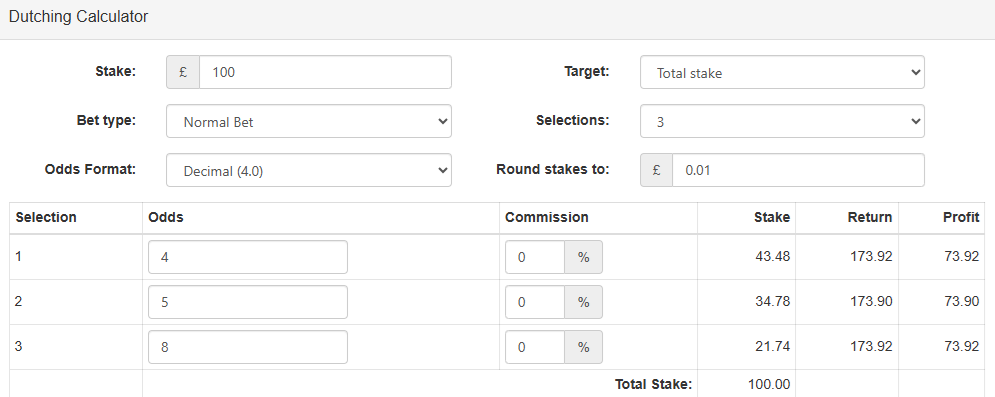
This is particularly useful when the prices are different because simply dividing your bankroll equally would not produce equal returns.
The calculator should be treated as a tool for checking the mathematics rather than a guarantee that the calculated opportunity will remain available.
Odds are one of the most important factors in determining whether a dutch is profitable.
Consider two simplified two-selection examples.
Selection
Odds
A
2.00
B
2.00
Implied probabilities: 50% + 50% = 100%
There is no theoretical margin before considering other factors.
Selection
Odds
A
2.20
B
2.20
Implied probabilities: 45.45% + 45.45% = 90.91%
That leaves a theoretical margin.
The difference demonstrates why finding the right prices is central to profitable dutching. The OddsMatcher is the ideal tool to find real-time up-to-date odds.
What the data says
Research on soccer and tennis betting found average losses varied substantially by implied probability: from 17% to 2% for soccer and from 23% to 3% for tennis.
Source: University College Dublin / Scottish Journal of Political Economy
Potentially, yes — but it also means more money is being committed.
If an opportunity has a theoretical 3% return:
Total stake
Theoretical return
£50
£1.50
£100
£3
£250
£7.50
£500
£15
£1,000
£30
The percentages remain the same, but the monetary amount changes with the stake.
This is why increasing your stake simply to chase a larger monetary profit isn't necessarily appropriate. Your available bankroll, bookmaker limits and ability to execute the entire dutch all matter.
Dutching isn't restricted to one sport. It can potentially be used wherever you can find suitable prices across the outcomes you want to cover.
Some sports will have a two-outcome market while others might have three-way or more markets to consider.
In order to cover all outcomes of a football match, you'll need to dutch the home win, away win and draw.
Let's see how that works and the theoretical profit opportunity in an example of a hypothetical Premier League match.
Selection
Odds
Example stake
Approx. return
Arsenal Win
2.00
£26.32
£52.64
Brentford Win
5.00
£10.53
£52.65
Draw
4.00
£13.16
£52.64
Total
£50.01
As you can see, by splitting a stake of £50 across the three possible outcomes, you will end up with a profit of approximately £2.63.
For more football-specific examples, see our football dutching strategy guide.
Tennis dutching is a little different in that there will always be one winner.
Here's a theoretical example for a tennis match at Wimbledon.
Selection
Odds
Example stake
Profit
Jannik Sinner
2.00
£66.67
£33.33
Ben Shelton
4.00
£33.34
£33.35
Total
£100.01
This time, the stake is £100 and there's a potential profit of approximately £33.34 no matter which player wins the match.
Our tennis dutching strategy guide goes into more detail on using the technique for tennis. Alternatively, take a look at the what sports you can use for dutching guide for a broader picture.
There are several practical steps that can make dutching more manageable.
A small difference in odds can affect whether a theoretical dutch exists at all.
Don't guess your stakes. Use the calculator to establish the required amount for each selection.
Prices can move quickly. Recheck the odds immediately before confirming the bets.
You may need balances across multiple bookmaker accounts to place all parts of the dutch.
Recording your bets helps you understand your actual returns rather than relying on individual successful bets.
Expert insight from James, OddsMonkey dutch betting expert
“Tracking the result of every dutch is more useful when you record the price you found, the price you actually secured and the stake you managed to place. That shows whether your theoretical edge is being preserved during execution, rather than simply measuring how many bets happened to win.”
A calculator can tell you what should happen if the inputs remain valid. It cannot guarantee that the bets will be accepted or that you will achieve a particular monthly return.
The process of dutching isn't totally rigid. You can explore the different approaches in our dutching betting strategies guide.
It can be, but there is no fixed profit figure and no guarantee of returns.
A profitable dutch exists mathematically when the available prices and your stake distribution create a positive margin across the outcomes you're covering.
Your actual results will depend on:
The most useful way to approach dutching is therefore to focus on the quality of individual opportunities and disciplined execution, rather than expecting a predetermined monthly income.
There is no fixed amount you can make from dutching because returns depend on your bankroll, available odds, stake limits and how often you find suitable opportunities. It is more useful to consider the potential percentage return per opportunity rather than expect a set daily or monthly income.
Dutching can produce a theoretical profit when the combined implied probability of the selected outcomes is below 100%. However, whether you make money in practice depends on being able to place all parts of the bet at the required odds and stakes.
It is possible to calculate a £100 theoretical return from dutching, but that does not mean you can reliably make £100 every day. For example, a 2% return would require £5,000 of successfully placed stakes to produce £100, while suitable opportunities and bookmaker limits will vary.
Your potential profit is affected by the size of your stake, the percentage edge available, bookmaker stake limits, the odds you can obtain and how frequently suitable opportunities arise. Prices can also change before all bets are placed, which can reduce or remove the calculated margin.
Yes. Although a correctly calculated dutch can equalise the return across the covered outcomes, practical risks remain. Odds can move, bets can be rejected, stakes can be restricted or an outcome can be entered incorrectly, potentially leaving you with a loss.

Unlock £29+ with our offer guides. Each guide will walk you through the back and lay bets needed to make your first matched betting profits.
Earn immediately. No payment details required
Start your FREE Trial
*DISCLAIMER: We’re legally required to state that there is no guarantee of specific results each month. The amount of money that you earn can vary dependant on the time and effort that you commit each month.
This website is strictly for over 18’s. If you do have any concerns about gambling please contact GambleAware
© Copyright 2011-2026 Terms of Use | Privacy Statement