
Dutching means splitting one stake across two or more selections in the same event, weighted by their odds, so that whichever selected outcome wins the return is broadly the same. Here’s how dutch betting works, worked examples, how to calculate your stakes and how it compares with matched betting.
Quick answer
Dutching is a betting strategy where you place bets on two or more selections in the same event, splitting your total stake between them according to their odds. The aim is to create a more balanced return if one of your selected outcomes wins.
Dutching can be used across sports including football, horse racing and tennis. The amount placed on each selection depends on the odds, your total stake and the return you are targeting.
For example, if you want to back three horses in the same race, rather than putting your entire stake on one horse, you can use dutching to distribute your stake across all three. A dutching calculator can work out the individual stakes for you.
Dutching does not automatically guarantee a profit. Whether a dutched bet is profitable depends on the odds, the selections chosen, the total implied probability and any applicable commission or betting costs.
Dutching, also known as dutch betting, is a method of betting on multiple selections in the same market.
Instead of choosing one outcome and placing your entire stake on it, you divide your overall stake between two or more selections.
The stakes do not necessarily need to be equal. In fact, with traditional dutching, the amount placed on each selection is normally adjusted according to the odds.
The objective is to create a similar potential return from each winning selection.
For example, imagine a football match where you want to back two possible outcomes:
Selection
Decimal odds
Stake
Team A
2.50
£60
Team B
3.00
£50
Total
£110
If Team A wins, the £60 stake at 2.50 returns £150, less your original stake (£60), less the stake on Team B (£50), producing £40 profit.
If Team B wins, the £50 stake at 3.00 returns £150, less your original stake (£50), less the stake on Team A (£60), producing £40 profit.
This illustrates the basic principle behind dutching: split the stake between multiple outcomes to target a broadly equal return.
In practice, the mathematics becomes more complicated as you add selections, change the target return or introduce betting exchange commission. That’s why a dutching calculator can be useful before placing the bets.
Dutching betting works by calculating how much of your total stake should be allocated to each selection.
The calculation takes the odds for each selection and distributes the stake accordingly.
Generally, a selection with shorter odds requires a larger stake than a selection with longer odds if the objective is to produce an equal return.
Suppose you have £100 to stake on three selections:
You could simply place £33.33 on each, but that would not produce the same return if each selection won.
A dutching calculation instead adjusts the stakes according to the odds.
The resulting stakes are designed so that, if one of the three selected outcomes wins, the gross return is approximately the same, subject to rounding and any applicable commission.
This is one of the main reasons people use a Dutching Calculator rather than attempting the calculations manually.
Consider two selections:
A £50 bet at 2.00 returns £100.
To achieve the same £100 return at 4.00, you only need to stake £25.
So, when dutching, the lower-priced selection generally receives more of the overall stake while the higher-priced selection receives less.
Working out dutching stakes manually can become difficult when you have several selections or are using different odds.
The OddsMonkey Dutching Calculator can calculate the stakes required for each selection based on the information you enter.
You can enter details such as:
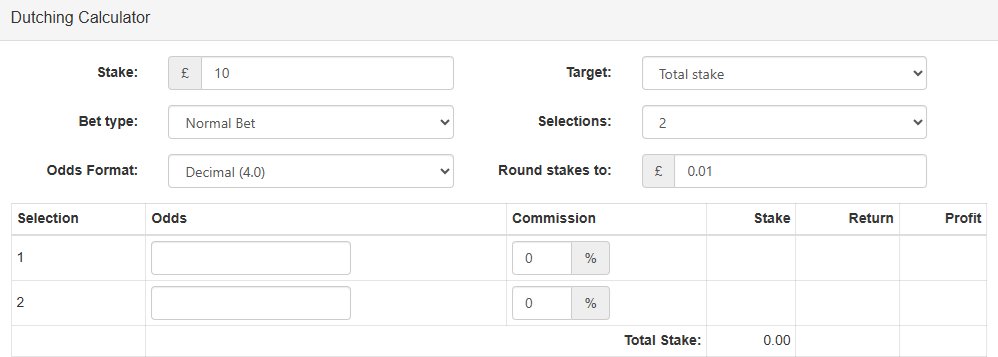
The calculator then shows the stake for each selection alongside the potential return and profit.
This can help reduce calculation errors and lets you work out your stakes before placing the individual bets.
For anyone regularly using dutching strategies as part of a wider betting approach, the calculator is particularly useful because changing one price can affect the stakes required across all the selections.
Let’s look at a simplified example.
Suppose you have £100 available and want to dutch three selections for an upcoming Premier League match between Manchester City and Bournemouth:
Selection
Odds
Example stake
Manchester City
2.00
£52.63
Draw
4.00
£26.32
Bournemouth
5.00
£21.05
Total
£100
A real calculation would depend on your exact target and whether you want to use all of your available £100.
The important point is that the stakes are weighted towards the shorter-priced selection rather than divided equally.
If Man City win, the £52.63 stake at 2.00 produces a £105.26 return.
If the game is a draw, the £26.32 stake at 4.00 produces a £105.28 return.
If Bournemouth win, the £21.05 stake at 5.00 produces a £105.25 return.
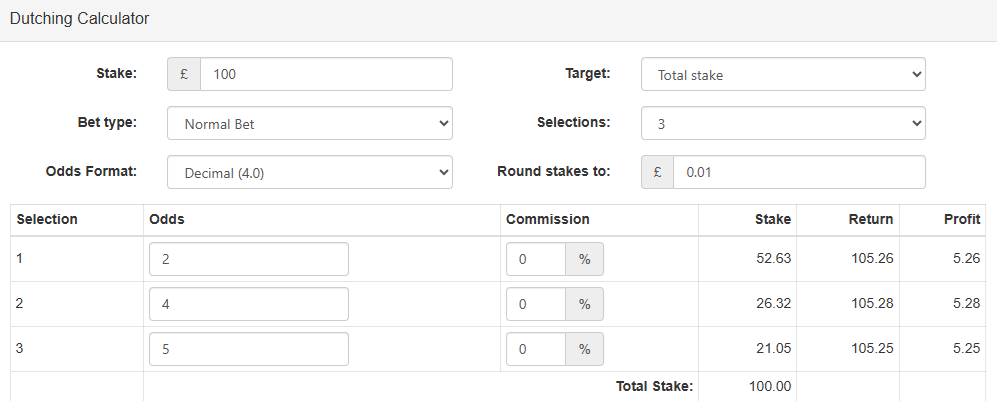
If one of the three selected match-result outcomes wins and the bets are placed at these prices, the gross return would be approximately £105.26, giving a profit of around £5.26 before any applicable costs.
This demonstrates how dutching can be used to target a similar gross return across multiple outcomes.
Important: a dutched bet can still lose. If an outcome outside your selected runners or teams wins, your stakes on the selected outcomes are lost.
With a conventional bet, you typically select one outcome and stake your money on it.
With dutching, you select multiple outcomes and divide your overall stake between them.
For example:
£100 on Team A at 2.00.
If Team A wins, the return is £200. If Team A loses, the £100 stake is lost.
£100 divided between Selections A, B and C according to their odds.
If one of your selected teams wins, your stake allocation is designed to provide a similar return regardless of which selected outcome wins.
The trade-off is that because your money is spread across several outcomes, the return from a successful selection may be lower than putting the entire £100 on that selection individually.
Dutching is not limited to one type of sport.
It can potentially be used whenever a market contains multiple mutually exclusive outcomes and the available odds make the strategy appropriate.
Common examples include:
The most suitable approach depends on the market and the number of selections available.
Expert insight from James, OddsMonkey dutch betting expert
“Good dutching starts with the market, not the calculator. Before working out the stakes, check that the selections genuinely cover the outcomes you intend to target and that the market rules treat those outcomes consistently. A neat calculation cannot fix a poor market choice.”
Take a more in-depth look in our What Sports Can I Use For Dutching guide.
Football is one of the most straightforward areas in which to understand dutching because many markets contain multiple possible outcomes.
Consider a three-way match-result market:
A bettor could potentially select two or three of those outcomes and divide their stake between them.
What the data says
The Gambling Survey for Great Britain found that betting on sports and racing online was among the three most common gambling activities for people aged 18–34 and for male participants in 2025.
Source: Gambling Commission, Gambling Survey for Great Britain Annual Report 2025
If betting on football is your thing, get more info in the Football Dutching Strategy article.
Horse racing is another common application of dutching because a race can contain several runners that a bettor believes have attractive odds.
Horse racing also has additional considerations such as:
These factors can affect the final result of a dutched position.
What the data says
In 2025, 7.2% of horse declarations in Britain resulted in non-runners, with 6,696 non-runners recorded overall. This shows why non-runners are a practical consideration when using dutching strategies on horse racing markets.
Source: British Horseracing Authority (BHA), 2025 Annual Data Pack
See our guide to Horse Racing Dutching Strategies for more information.
Tennis provides another interesting example because matches normally have two principal outcomes: Player A wins or Player B wins.
Suppose:
A bettor could potentially back both players, but whether this produces a profitable dutching opportunity depends on the combined prices and any costs involved.
Get more information about the dutching potential in the Tennis Dutching Strategy guide.
There is no fixed amount you can make from dutching.
Potential returns depend on factors including:
A dutching strategy can sometimes be structured around a target return, but that should not be confused with a guaranteed profit.
Because there are many variables involved in betting, it’s difficult to put specific figures on returns. We have more information on this in the How Much Can I Make With Dutching guide.
Dutching is mostly performed using bookmakers, but you can use betting exchanges or a combination of betting platforms, depending on the strategy.
When a betting exchange is involved, commission needs to be factored into the calculation.
For example, a £100 return before commission is not necessarily the same as a £100 net return after exchange commission.
This is why it is important to check the calculation using the correct commission rate before placing the bets.
The OddsMonkey Dutching Calculator can account for commission when the relevant information is entered.
A betting exchange is different from a traditional bookmaker because customers can bet against each other rather than simply betting against the operator. The Gambling Commission describes a betting intermediary as a business that brings two or more betting parties together without taking liability for their bets.
Dutching and matched betting can look similar because both involve carefully calculating stakes across multiple bets.
However, they have different purposes.
Dutching
Matched betting
Usually involves backing multiple selections
Typically involves using qualifying bets and free bets/promotions
Stakes are distributed across selected outcomes
Stakes are calculated to offset outcomes
Can be used independently of bookmaker promotions
Usually built around bookmaker offers
Focuses on multiple selections within a market
Focuses on exploiting promotional value
Can be used across many sports
Commonly uses sportsbook promotions
Dutching can form part of a broader matched betting approach in certain circumstances, but the two concepts should not be treated as interchangeable.
If you are deciding which approach is more suitable for your goals, learn more about the mechanics in the Dutching vs Matched Betting article.
The mathematics behind dutching can become complicated quickly, particularly when several selections, different odds formats or exchange commission are involved.
OddsMonkey provides tools that can help bettors calculate and assess different betting positions.
The Dutching Calculator is the most directly relevant tool for this strategy. It calculates the stake required on each selection and can show the resulting return and profit based on the information entered.
OddsMatcher can help users compare available odds and identify betting opportunities across bookmakers and exchanges.
For dutching, having accurate and current prices is important because a change in one selection’s odds can affect the entire calculation.
Expert insight from James, OddsMonkey dutch betting expert
“A dutching calculation is only as reliable as the prices used to create it. When several selections are involved, a small change to one price can alter the required stakes across the whole position, so treating the original calculation as fixed can create a different risk profile from the one you intended.”
The Implied Probability Calculator can help translate decimal odds into their implied probability.
This is useful when assessing how the prices of multiple selections combine and whether a particular set of odds appears mathematically attractive.
The Matched Betting Calculator is designed for matched betting calculations rather than standard dutching, but can be useful when dutching is being considered alongside a wider matched betting strategy.
Using the appropriate calculator for the task can make the process easier to understand and reduce avoidable calculation mistakes.
Give the free Dutching Calculator a try today to see what it’s all about.
Dutching can look simple on the surface, but there are several mistakes that can affect the result.
Simply splitting £100 into £50 and £50 does not necessarily produce an equal return when the selections have different odds.
The stakes should be calculated based on the prices.
If you are using an exchange, commission can reduce your net return.
Make sure the calculation uses the correct commission rate.
Dutching can be used to cover multiple outcomes, but it does not automatically create a profitable bet.
If an unselected outcome wins, you can lose your entire stake.
Betting prices can change.
If you calculate your stakes using one price and place the bet after the odds have moved, the resulting return may differ from your original calculation.
This is particularly relevant to horse racing.
If a selected horse becomes a non-runner, the rules governing the market and any applicable deductions can affect the final outcome.
Increasing the number or size of your bets simply to target a larger return also increases your exposure.
It is important to understand the potential loss before placing the bets.
Dutch betting, or dutching, is a way of distributing a total stake across multiple selections in the same market. The stakes are normally weighted according to the available odds so that the selected outcomes can produce a broadly similar return.
Dutching does not guarantee a profit. The result depends on the prices available, the selections covered, your total stake, market rules and any applicable betting or exchange costs.
If you want to explore the strategy further, see our guides to how to get started with dutching, dutching betting strategies and sport-specific dutching for football, horse racing and tennis. When you are ready to calculate your stakes, the OddsMonkey Dutching Calculator can do the calculations for you.
18+. Gambling involves risk. Dutching does not guarantee profit and can result in losses. Always check current bookmaker and betting exchange terms before placing a bet. Bettors should never chase losses and can use Gamble Aware for guidance.
Dutching means placing bets on multiple outcomes in the same market while distributing your total stake between them. The stakes are usually adjusted according to the odds so that the potential return is more evenly balanced between the selected outcomes.
Yes. Dutch betting and dutching are commonly used to describe the same basic betting technique: splitting a stake across multiple selections in a market.
No. Dutching does not automatically guarantee a profit. If an outcome that you have not selected wins, your stakes on the selected outcomes can be lost. The available odds and any applicable commission also affect whether a particular dutching position is profitable.
You can calculate a dutch bet by entering your total stake and the odds for each selection into a dutching calculator. The calculator can then determine how much to stake on each outcome based on your chosen target.
Yes. Horse racing is one of the sports where dutching can be used. You can select multiple runners and distribute your stake between them according to their odds.
Yes. Dutching can be used on football markets containing multiple possible outcomes. For example, a bettor could potentially select two or more match-result outcomes and calculate how to distribute their stake between them.
No. Dutching involves distributing a stake across multiple selections, whereas matched betting generally uses bookmaker promotions and calculated bets to offset outcomes. The two strategies can sometimes be used alongside each other, but they have different purposes.
There is no fixed amount. Potential returns depend on your stake, the odds, the number of selections and the outcome of the event. Dutching should not be presented as a guaranteed way to make money.

Unlock £29+ with our offer guides. Each guide will walk you through the back and lay bets needed to make your first matched betting profits.
Earn immediately. No payment details required
Start your FREE Trial
*DISCLAIMER: We’re legally required to state that there is no guarantee of specific results each month. The amount of money that you earn can vary dependant on the time and effort that you commit each month.
This website is strictly for over 18’s. If you do have any concerns about gambling please contact GambleAware
© Copyright 2011-2026 Terms of Use | Privacy Statement