
A dutching betting strategy splits one stake across two or more selections in the same market, weighted by their odds. Here are the main dutching strategies for football, tennis and horse racing, with worked stake calculations and tips for comparing odds.
Quick answer
A dutching betting strategy involves backing two or more selections in the same market and dividing your total stake between them according to their odds. The aim is to make the gross return similar whichever selected outcome wins. There is no single best dutching strategy: the most suitable approach depends on the market, available prices and which outcomes you choose to cover. Dutching does not guarantee a profit, because an outcome outside your selected bets can still result in a loss.
Dutching does not guarantee profit. A dutch can still lose if an outcome outside your selected bets wins.
Dutching is a betting strategy that involves backing multiple selections in the same market and dividing your total stake between them. The aim is usually to create a similar return whichever of your selected outcomes wins, rather than relying on one selection alone.
The key to a successful dutching betting strategy is not simply backing several selections. The odds available, the number of outcomes covered and the way your stake is divided all affect the result.
In this guide, we explain how dutching strategies work, show practical examples and look at some of the approaches bettors can use across football, tennis and horse racing.
If you are completely new to the concept, start with our guide to What is Dutch Betting?, which explains the fundamentals before moving on to specific dutching betting strategies.
A dutching betting strategy involves backing two or more selections in the same market and dividing a total stake between them according to their odds. The aim is to make the gross return similar whichever selected outcome wins. Dutching does not guarantee profit because any outcome outside your selected bets can still result in a losing bet.
Rather than staking the same amount on each selection, you adjust the stakes according to the odds. Shorter-priced selections receive a larger stake, while higher-priced selections receive a smaller stake.
This means that, when one of your selections wins, the gross return can be approximately equal across the selections.
For example, imagine two tennis players are available at:
You have a total betting budget of £100.
A simple dutch could split the stake as follows:
Selection
Decimal odds
Stake
Gross return
Player A
2.00
£66.67
£133.34
Player B
4.00
£33.33
£133.32
Total
£100
£133.33
If either selected player wins, the gross return is approximately £133.33.
That would leave a potential profit of around £33.33, before considering any applicable restrictions, deductions or other costs.
The important point is that this result comes from the prices available, not simply from backing multiple selections.
The mathematics behind dutching is relatively straightforward.
You first identify the selections you want to back and their decimal odds. You then calculate the implied probability of each selection:
Implied probability = 1 ÷ decimal odds
For a selection priced at 2.00:
1 ÷ 2.00 = 50%
For a selection priced at 4.00:
1 ÷ 4.00 = 25%
The combined implied probability is therefore:
50% + 25% = 75%
If your selected outcomes are mutually exclusive and cover every possible result, a combined implied probability below 100% indicates a theoretical arbitrage position. If you do not cover every possible outcome, dutching can still equalise returns across your selected bets, but it does not remove the risk of losing the entire stake.
However, this distinction is important: dutching itself does not create value simply because you have spread your stake across several selections. If the prices are poor, dutching can simply spread your money across multiple bets without creating a profitable position.
This is why checking the combined implied probability and available prices is an important part of any dutching betting strategy.
Our Implied Probability Calculator can make this calculation quicker when comparing prices.
There is no single best dutching strategy for every market. Different approaches suit different types of events and betting opportunities.
Expert insight from James, OddsMonkey dutch betting expert
“The number of selections you include should reflect how much of the market you genuinely want to cover, not simply how many outcomes you can afford to back. Adding another selection changes the calculation and can reduce the advantage if its price is unattractive.”
Strategy
Typical use
Main benefit
Main limitation
Two-selection dutching
Two-outcome markets
Simple staking calculation
One losing outcome can lose the whole stake
Three-way dutching
Football 1X2
Covers home/draw/away
Requires attractive prices across all three
Horse racing dutching
Multiple runners
Spreads stake across selected runners
Other runners remain uncovered
Cross-bookmaker dutching
Different bookmaker prices
Can improve combined prices
Odds/availability can change
Extra-place dutching
Selected horse racing promotions
Can work alongside specific promotions
Promotion terms affect settlement
Here are several strategies worth understanding.
A two-selection dutch is one of the simplest ways to understand the strategy.
It can be used when you believe two outcomes have a realistic chance of winning but do not want to put your entire stake on just one.
For example, suppose a tennis match has:
With a £100 total stake, you could use a dutching calculator to determine the appropriate split rather than simply staking £50 on each player.
The resulting stakes would be approximately:
Selection
Odds
Approx stake
Player A
2.20
£47.62
Player B
2.00
£52.38
Total
£100
Each winning selection would produce approximately the same gross return.
However, the combined implied probability here is:
1 ÷ 2.20 + 1 ÷ 2.00 = 95.45%
That leaves a mathematical margin before considering other factors.
For more detail on applying the strategy specifically to tennis, see our Tennis Dutching Strategy guide.
Dutching is not limited to two-outcome markets.
A classic example is a football match where the possible results are:
Suppose the odds are:
The combined implied probability is approximately:
35.71% + 29.41% + 32.26% = 97.38%
Because the combined percentage is below 100%, these particular prices produce a theoretical margin if all three outcomes are covered.
With a £100 total stake, the approximate dutched stakes would be:
Outcome
Odds
Approx stake
Home
2.80
£36.67
Draw
3.40
£30.20
Away
3.10
£33.13
Total
£100
Whichever result occurs, the gross return would be approximately £102.69, giving a potential profit of around £2.69.
This is a useful example of why small differences between bookmakers' prices can matter when constructing a dutch.
For football-specific examples, see our Football Dutching Strategy guide.
Horse racing is a market where dutching can be applied to multiple runners in the same race.
For example, imagine you have identified three horses at:
You could enter those prices into a Dutching Calculator and determine how much to stake on each horse from your chosen total stake. Here’s how that would look using the Dutching Calculator:
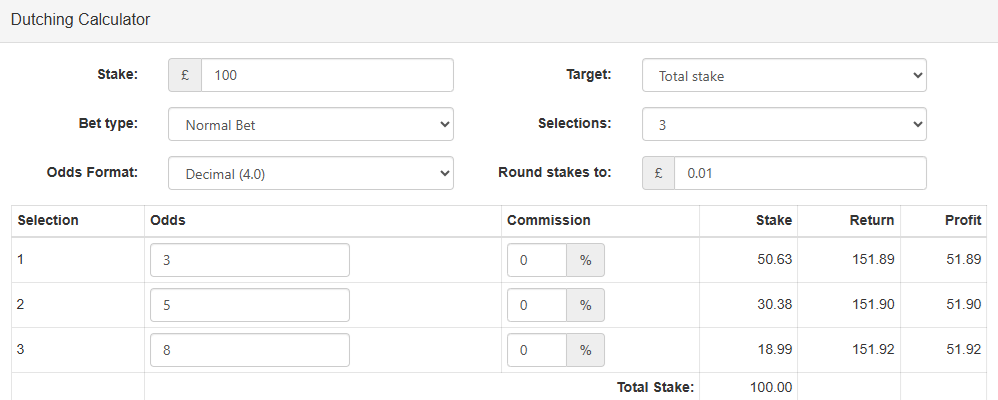
The shorter-priced horse receives the larger proportion of the stake, while the longer-priced horse receives less.
However, there is an important consideration with horse racing: you are not automatically covering every possible winner.
If your three selected horses are the only runners you back and another horse wins, your entire dutched stake could be lost.
That makes selection particularly important. The strategy is therefore not simply about calculating stakes; it is also about deciding which runners to include and whether the available prices justify the position.
For a more detailed look at this market, see our Horse Racing Dutching Strategy guide.
One application of dutching is comparing prices across different bookmakers.
Bookmakers can offer different odds on the same event. If you can combine sufficiently attractive prices across selections, the overall calculation may become more favourable.
What the data says
Research examining competing bookmakers found 545 arbitrage portfolios in soccer betting markets, with around 50% requiring a bet on the favourite at the bookmaker offering the relevant price. The study shows why differences between bookmakers’ prices can matter when constructing multi-selection positions.
Source: The European Journal of Finance
For example, imagine a football match where you find:
Instead of simply looking at the individual prices, you can calculate the combined implied probability:
1 ÷ 2.90 + 1 ÷ 3.50 + 1 ÷ 3.20
The result tells you whether the combined prices potentially create a favourable mathematical position.
This is where tools become particularly useful. Manually checking multiple bookmakers, calculating implied probabilities and working out individual stakes can quickly become time-consuming.
The OddsMatcher can help identify differences between available bookmaker prices.
Another useful approach is to decide your total stake first and then work backwards to the individual bets.
For example, suppose you have decided that you are comfortable using £50 on a particular dutch.
Rather than deciding to stake £25 on each of two selections, enter your total stake and the available odds into the Dutching Calculator.
This allows the stake to be distributed according to the prices.
That matters because equal stakes do not normally produce equal returns.
For example:
The returns are very different.
A dutched stake would instead allocate more money to the 2.00 selection and less to the 4.00 selection to bring the returns closer together.
Extra-place promotions can create another potential application for dutching, particularly in horse racing.
The basic concept is to identify several runners that you want to back and then calculate the stakes across those selections.
However, extra-place betting comes with additional terms and conditions that can affect how the bet settles, including qualifying criteria, enhanced places and applicable bookmaker rules.
This means you should check the individual promotion before placing bets rather than assuming that a standard dutching calculation applies.
For a more detailed explanation, see our guide to Dutching Extra Place Races.
Let's put the process together.
Imagine you are looking at a two-outcome event with:
You decide to use a total stake of £100.
The £100 stake can be divided according to those implied probabilities.
That gives approximately:
The returns are approximately equal. Your potential gross return is therefore around £136.36, compared with a £100 total stake.
The potential profit is approximately £36.36 if either selected outcome wins.
A calculator removes the need to perform these calculations manually and also makes it easier to compare different combinations of selections and prices.
Don't want to work out each stake manually? Enter your selections, odds and total stake into the Dutching Calculator to see how the stake can be distributed and what the potential gross return would be.
Calculating a dutch is only one part of the process. You also need to find prices that make the strategy worthwhile.
Expert insight from James, OddsMonkey dutch betting expert
“A small mathematical edge can disappear quickly when odds move, so the price should be checked immediately before staking. A potentially favourable dutching position depends on the prices available at the time you place the bets.”
A practical process is:
Choose the market.
Compare available odds using the OddsMatcher.
Check the combined probability with the Implied Probability Calculator.
Calculate your stakes with the Dutching Calculator.
Check the final position.
Our What Sports Can I Use For Dutching? guide can help you identify potential betting markets.
One of the biggest mistakes beginners make is assuming that dutching means putting the same amount on every selection.
It doesn't.
Consider two horses priced at 2.00 and 6.00.
If you stake £25 on each:
The returns are completely different.
With dutching, the stakes are adjusted so that the potential gross return is approximately equal.
This makes dutching a staking strategy, rather than simply a method of choosing several selections.
Dutching and arbitrage betting are closely related, but they are not necessarily identical.
Dutching involves spreading your stake across multiple selections. Arbitrage betting generally involves finding prices across different bookmakers or markets that cover the relevant outcomes at favourable combined odds.
Dutching
Arbitrage betting
Main purpose
Distribute stake across selections
Exploit price discrepancies
Must cover every outcome?
No
Normally yes
Can use one bookmaker?
Yes
Often involves multiple prices/operators
Below 100% combined probability required?
No
Yes, for a conventional back-only arbitrage
Main risk
Selected outcome loses
Practical execution, terms or odds movement can undermine the theoretical position
Dutching and matched betting use different principles.
With matched betting, the traditional approach involves using bookmaker promotions and placing corresponding back and lay bets to convert qualifying offers into a potential return.
Dutching instead involves backing multiple selections and dividing your stake between them.
The two approaches can therefore require different calculations, tools and betting decisions.
If you're deciding which approach fits your objectives, our Dutching vs Matched Betting guide provides a more detailed comparison.
If you are new to dutching, it makes sense to start with the basic process rather than immediately trying complex strategies.
A simple workflow is:
Choose a market → compare odds → select your outcomes → check implied probability → calculate stakes → check the final position → place bets if appropriate.
What the data says
The Gambling Survey for Great Britain found that betting on sports and racing online was among the three most common gambling activities for people aged 18–34 and for male participants in 2025.
Source: Gambling Commission, Gambling Survey for Great Britain Annual Report 2025
If you want a step-by-step introduction, see our guide to How to Get Started With Dutching.
A good dutching betting strategy starts with the numbers.
Rather than simply backing several selections, compare the available odds, calculate the combined implied probability and work out how your stake should be distributed.
The Dutching Calculator can handle the staking calculation, while the OddsMatcher, Dutch Matcher and Implied Probability Calculator can help you find and assess potential opportunities.
Most importantly, remember that dutching is a staking technique rather than a guarantee of profit. The quality of the prices you obtain, the selections you choose and the outcomes you cover all matter.
For the fundamentals, start with What is Dutch Betting?, then explore the more specific dutching guides for football, tennis, horse racing and other markets.
Dutching is a form of gambling and does not guarantee a profit. Only bet with money you can afford to lose, check the terms and settlement rules before placing bets, and avoid increasing your stakes to try to recover previous losses.
Bookmakers can also apply commercial restrictions or refuse bets, so prices shown when you calculate a dutch may not always remain available when you try to place the bets.
18+. Gambling involves risk. Dutching does not guarantee profit and can result in losses. Always check current bookmaker and betting exchange terms before placing a bet. Bettors should never chase losses and can use Gamble Aware for guidance.
There is no single best dutching betting strategy for every market. The most suitable approach depends on the available odds, number of selections, market structure and whether the combined implied probability creates a favourable mathematical position.
No. Dutching does not guarantee a profit because your selected outcomes may not cover every possible result, and available prices can change. Even when the combined implied probability is below 100%, you should check the market, selections and final calculations before placing bets.
Compare the odds for your selected outcomes and calculate their combined implied probability. A figure below 100% can indicate a potentially favourable mathematical position, but you should also consider whether you are covering all relevant outcomes and whether the prices and betting conditions remain available.
Neither approach is inherently better; it depends on the market and prices available. Two-selection dutching is relatively straightforward, while three-way dutching can be useful in markets such as football where you want to cover home win, draw and away win.
Yes. Comparing prices across bookmakers can be useful because different operators may offer different odds on the same event. Combining sufficiently attractive prices can improve the overall mathematical position, although availability, limits and bookmaker terms should also be checked.
Yes, dutching can be used in horse racing by backing several runners in the same race and adjusting the stakes according to their odds. However, you are not automatically covering every runner, so your selections remain an important part of the strategy.
A Dutching Calculator can work out how to divide your total stake between selected outcomes according to their odds and show the potential gross return. An Implied Probability Calculator can also help assess the combined probability of your selections, while OddsMatcher can help compare bookmaker prices.
Yes, dutching can be applied to some extra-place races, but promotional terms can affect how the bets settle. Always check the individual promotion's qualifying criteria, enhanced places and bookmaker rules rather than assuming a standard dutching calculation applies.

Unlock £29+ with our offer guides. Each guide will walk you through the back and lay bets needed to make your first matched betting profits.
Earn immediately. No payment details required
Start your FREE Trial
*DISCLAIMER: We’re legally required to state that there is no guarantee of specific results each month. The amount of money that you earn can vary dependant on the time and effort that you commit each month.
This website is strictly for over 18’s. If you do have any concerns about gambling please contact GambleAware
© Copyright 2011-2026 Terms of Use | Privacy Statement