
Learn how horse racing dutching works, how to split your stake, whether it can be profitable and why it isn't risk-free, with examples and calculations.
Quick answer
A horse racing dutching strategy involves backing two or more horses in the same race and dividing a total stake between them according to their odds. The aim is to create a similar gross return if one of your selected horses wins.
However, dutching does not automatically cover the whole race or guarantee a profit. If an unselected horse wins, the bets on your selected runners can all lose.
Term
Meaning
Dutching
Splitting a total stake across two or more selections
Equalised return
Stakes are calculated so selected winners produce a similar gross return
Full-outcome dutch
Stakes cover all relevant outcomes
Selective horse racing dutch
Only chosen runners are backed, so unselected runners remain a risk
Is dutching profitable? It can be, but there is no automatic profit. Profit depends on the odds available, the selections you choose, your total stake and whether your combined implied probability creates a positive outcome.
Is dutching risk-free? No. Even when the maths shows a potential profit across your selected horses, any horse you haven't backed can win, odds can change and mistakes when placing the bets can create a loss.
For horse racing, the OddsMonkey Dutching Calculator can do the stake calculations for you, helping you see the potential return and profit before placing your bets.
Horse racing dutching is a betting strategy where you back multiple horses in the same race rather than choosing just one winner.
Instead of staking the same amount on every horse, your total stake is divided according to the odds. More money is placed on the shorter-priced selections and less on the bigger-priced selections.
The objective is to make the potential return similar if one of your chosen horses wins.
What the data says
A 2026 Oxford Economic Papers study analysed approximately 60,000 British horse races and found an average of 10.5 runners per race, with fields ranging from 1 to 40 runners. The finding illustrates how widely race structures can vary when deciding how many selections to include.
For example, imagine a four-runner market with these decimal odds:
Horse
Odds
Example stake
Horse A
4.00
£35.51
Horse B
5.00
£28.41
Horse C
7.00
£20.29
Horse D
9.00
£15.78
Total
£99.99
Using these stakes, each horse produces a gross return of approximately £142.04 if it wins.
That means the theoretical profit is around £42.05, regardless of which of the four backed horses wins.
However, there is an important catch: the calculation only covers the horses you have backed. If another horse wins, all four bets lose.
This is why dutching should not be described as a guaranteed or risk-free horse racing strategy.
If you are new to the concept, start with our guide to What is Dutch Betting? before looking at the more advanced horse racing applications.
The basic process is:
Choose a horse race and identify the selections you want to back.
Check the available odds for each selection.
Decide how much you want to stake overall.
Enter the selections and odds into a dutching calculator.
Follow the suggested stakes for each horse.
Check the potential return and profit before placing the bets.
Place the bets at the relevant bookmakers.
Record the outcome and your actual profit.
The mathematics can become increasingly complicated as you add more horses, particularly when the odds are different at different bookmakers.
That's where a calculator becomes useful.
The OddsMonkey Dutching Calculator lets you enter your total stake, selections and odds and calculates the suggested stake for each selection, along with the potential return and profit.
Using our above example, this is what the calculator would look like after inputting your stake, number of selections and odds:
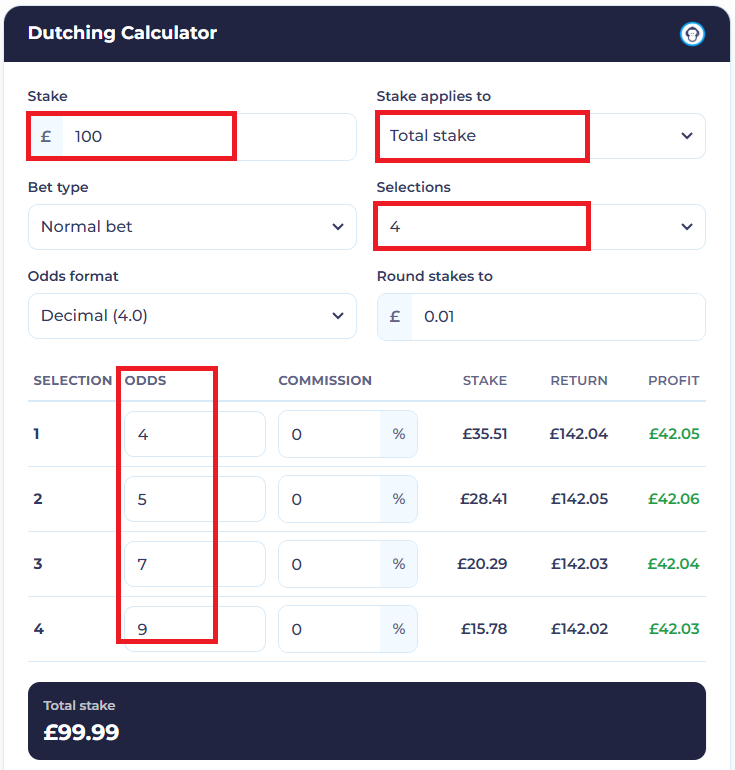
This is particularly useful for horse racing because a race can have several possible winners, meaning manually calculating the correct stake for every horse can quickly become difficult.
The OddsMonkey Dutching Calculator can calculate how your total stake could be divided between your chosen horses and show the potential return and profit based on the odds you enter.
Use the Dutching Calculator to check your figures before placing your bets.
Tip: Check all the odds immediately before placing your bets. If one price changes, the original calculation may no longer produce the expected result.
Horse racing dutching can be profitable, but there is no automatic profit. The potential result depends on the odds available, the selections you choose, your total stake and which horse ultimately wins.
For decimal odds, the implied probability of a selection can be calculated as:
Implied probability = 1 ÷ decimal odds
You can then add the implied probabilities of your selected horses to understand how much of the market your prices represent.
Using the earlier example:
Horse
Odds
Implied probability
Horse A
4.00
25%
Horse B
5.00
20%
Horse C
7.00
14.29%
Horse D
9.00
11.11%
Total
70.40%
The combined implied probability is approximately 70.40%.
That leaves a theoretical margin before other considerations, which is why the example can produce a positive return if one of the four selected horses wins.
But this shouldn't be interpreted as saying that every horse racing dutch will be profitable.
A dutch can lose if:
For more information on potential profitability, see How Much Can I Make With Dutching?
No. Horse racing dutching is not risk-free.
This distinction is particularly important because dutching can sometimes produce a calculation showing the same potential profit whichever of your selected horses wins.
That does not mean the overall bet is risk-free.
For example, suppose you dutch four horses in a six-runner race.
If one of your four horses wins, the calculation may show an equalised return.
But if either of the two horses you didn't back wins, your entire dutched stake could be lost.
Race outcome
Result
Backed horse A wins
Potential calculated return
Backed horse B wins
Potential calculated return
Backed horse C wins
Potential calculated return
Backed horse D wins
Potential calculated return
Unbacked horse E wins
All dutched bets lose
Unbacked horse F wins
All dutched bets lose
So there is an important difference between equalising the return across your selected outcomes and covering every possible outcome.
Traditional matched betting can use a back bet and a lay bet to cover opposing outcomes. Dutching instead involves backing multiple outcomes, usually with different bookmakers, without necessarily using a betting exchange.
For that reason, you should never assume that a dutching calculator showing a positive figure means you have eliminated all risk.
Let's look at a more detailed example.
Imagine a race where you believe four horses have the best chance of winning, and you find these prices:
Selection
Odds
Horse A
4.00
Horse B
5.00
Horse C
7.00
Horse D
9.00
You have a £100 total betting budget.
The Dutching Calculator distributes the £100 as follows:
Selection
Odds
Stake
Gross return if winner
Horse A
4.00
£35.51
£142.04
Horse B
5.00
£28.41
£142.05
Horse C
7.00
£20.29
£142.03
Horse D
9.00
£15.78
£142.02
Total
£99.99
The tiny difference comes from rounding the stakes.
If Horse B wins, for example:
£28.41 × 5.00 = £142.05
With approximately £100 staked overall, that gives a potential profit of about £42.05.
The same principle applies if Horse A, C or D wins. However, if any other horse in the race wins, your bet loses.
Dutching can be useful when you have identified multiple selections that you want to back but don't want to place the same stake on each horse.
It can also be useful where bookmaker prices differ enough to create a favourable dutching calculation.
For example:
Rather than simply putting £25 on each horse, dutching allocates the £100 according to the available odds.
The result is a more consistent potential return across your selected horses.
This is one reason dutching can be particularly interesting in horse racing, where there are often many runners and prices can vary between bookmakers.
Expert insight from James, OddsMonkey dutch betting expert
“The biggest mistake is treating the dutching calculation as the strategy itself. The calculation only tells you how to distribute your stake; the real edge, if there is one, comes from the quality of the prices and your assessment of which runners deserve to be included.”
However, a larger field also creates a greater challenge: you have to decide how many horses to include in your dutch.
Adding more runners can increase your coverage, but it can also increase the amount of money you need to stake and reduce the potential return.
There is no universally correct number.
It depends on the race, available prices, your selections and the potential outcome you are trying to achieve.
What the data says
The British Horseracing Authority reported that average field sizes in 2025 were 8.90 runners on the Flat and 7.84 over Jumps. That highlights why the number of selections matters when building a dutch: several potential winners may remain outside your chosen selections.
Number of selections
Potential advantage
Potential drawback
2
Simple calculations and fewer bets
More winning outcomes remain uncovered
3
Good balance between coverage and simplicity
Still leaves unbacked runners
4
Greater coverage
More bets and more capital required
5+
Covers a larger proportion of the field
Stakes and complexity increase
The important point is that more selections do not automatically mean a better dutch.
Expert insight from James, OddsMonkey dutch betting expert
“Field size alone shouldn't determine how many runners you dutch. A compact field with closely matched prices can behave very differently from a large handicap with uncertain chances, so the number of selections should follow the strength of the available prices rather than an arbitrary target.”
You need to consider the odds available for each selection and whether adding another horse improves the overall calculation.
The OddsMonkey Dutching Calculator can help you test different combinations before placing the bets.
There is no fixed formula for choosing the right number of horses to include in a dutch. A stronger approach is to consider the available prices, the runners you want to back and the amount of risk you are prepared to accept.
Before placing a horse racing dutch, consider:
The key point is that more selections do not automatically make a dutch better. Adding runners increases coverage, but it can also increase the total stake required and reduce the potential return.
Dutching and each-way betting are different strategies.
An each-way bet combines a win bet with a place bet, while dutching involves backing multiple selections in the same market. The mathematics and bookmaker terms are different.
Feature
Dutching
Each-way betting
Multiple horses backed
Yes
Can be
Stake split between selections
Yes
Not necessarily
Uses win and place portions
No
Yes
Depends on place terms
No
Yes
Can use bookmaker prices
Yes
Yes
Can be used with extra-place offers
Potentially
Yes
If you're specifically interested in extra-place opportunities, see our guide to dutching extra place races.
Dutching is related to matched betting, but the mechanics are different.
Horse racing dutching
Traditional matched betting
Main principle
Back multiple selections
Back and lay the same selection
Betting exchange required
No
Usually
Multiple bookmakers
Often useful
Can be
Multiple outcomes covered
Selected outcomes
Back/lay combination
Exchange commission
Not applicable when no exchange is used
Can apply
Main calculation
Split stake across selections
Calculate back and lay stakes
For a more detailed comparison, see dutching vs matched betting.
Horse racing dutching involves more calculations than simply choosing a horse and placing a bet.
OddsMonkey provides several tools that can make the process easier.
The Dutching Calculator calculates how your total stake should be divided between your selections and shows the potential return and profit.
Try the OddsMonkey Dutching Calculator →
The OddsMatcher compares prices from 100+ bookmakers and five betting exchanges, helping users identify available odds and potential matched betting opportunities.
Once you've completed your bets, the Profit Tracker can help you record your results and compare expected profits with actual results. It can also break results down by sport and tool.
Track your betting results with Profit Tracker.
If you're trying horse racing dutching for the first time, keep the process straightforward.
Start with a race and market where you understand the available selections and bookmaker terms.
Look for the best available prices on your chosen horses.
Small changes in odds can affect the overall dutching calculation, so use current prices rather than relying on an old calculation.
Only use an amount you can afford to lose.
For example, if your total budget is £50, enter £50 into the Dutching Calculator rather than deciding on the stake for each horse manually.
Add each horse and its current odds to the calculator.
Look at:
If you proceed, make sure every bet is placed at the correct odds and for the correct amount.
Use Profit Tracker to keep an accurate record of your actual results rather than relying on memory.
This approach doesn't remove the inherent risks of betting, but it can reduce avoidable mathematical and record-keeping errors.
Dutching can make the mathematics of multiple bets easier to manage, but it doesn't remove betting risk.
The main risks include:
This is the biggest difference between dutching and a strategy that genuinely covers every outcome.
If a horse outside your dutch wins, the bets on your selected horses can all lose.
Horse racing also has risks that are specific to the sport. If a horse is withdrawn after you have placed a bet, the bookmaker's rules may result in a Rule 4 deduction or another adjustment to the market.
This can affect the return you originally calculated, so check the bookmaker's rules for withdrawals, non-runners and deductions before placing a dutch. Don't assume that the return shown by a calculator will remain unchanged if the race changes after your bets have been placed.
Horse racing odds can move quickly.
If your calculation was based on 5.00 and the price changes to 4.50 before you place the bet, your original calculation may no longer be accurate.
A bookmaker may not accept the stake calculated for a particular horse.
You may then have to recalculate the entire dutch.
Placing several bets creates more opportunities to:
Promotions and betting rules can vary between bookmakers.
Always check the terms of the individual bookmaker before relying on a particular price or offer.
Not necessarily. Dutching changes how you distribute your stake; it doesn't tell you which horse will win.
If you are highly confident in one selection, a straightforward back bet may have a different risk and reward profile.
Dutching becomes more interesting when you want exposure to multiple selections and the available odds produce a favourable calculation.
The decision should therefore be based on the numbers and your own betting strategy rather than assuming that dutching is automatically superior.
Before placing a dutch, check:
Most importantly, don't confuse an equalised potential return across several selected horses with a risk-free bet.
A horse racing dutching strategy can be a useful way to spread a stake across several horses rather than relying on a single selection.
The mathematics can create an equalised potential return across your chosen horses, but that shouldn't be confused with guaranteed or risk-free betting.
If you're interested in trying the strategy, start by comparing the available odds, decide how much you're prepared to stake and use the OddsMonkey Dutching Calculator to work out the numbers before placing anything.
For a broader introduction, read What is Dutch Betting?, then explore our guides to dutching bet strategies and how to get started with dutching.
18+ | Gamble responsibly. Gambling involves risk. Never bet more than you can afford to lose. If gambling is causing you concern, free and confidential support is available in Great Britain through GambleAware.
Yes. You can dutch two or more horses in the same race, with the total stake divided according to the odds available for each selection. Adding more horses can increase the number of outcomes covered, but it also increases the total number of bets and the capital required.
If a horse outside your selections wins, the bets on your dutched horses will normally all lose. This is one of the key risks of horse racing dutching and means that an equalised return across your selections does not make the overall strategy risk-free.
No. You can use different bookmakers if they offer better prices on your selected horses. However, you should check that each bookmaker accepts the required stake and that the odds have not changed before placing all of the bets.
You can apply dutching principles to horse racing markets, but each-way betting has separate win and place components and bookmaker terms. If you are considering an each-way or extra-place opportunity, make sure you calculate the potential returns using the specific place terms rather than treating it as a standard dutch.
It can be, provided you understand that dutching does not remove the risk of losing your stake. Beginners should start with straightforward markets, use a calculator to check the stakes and only bet amounts they can afford to lose.

Unlock £29+ with our offer guides. Each guide will walk you through the back and lay bets needed to make your first matched betting profits.
Earn immediately. No payment details required
Start your FREE Trial
*DISCLAIMER: We’re legally required to state that there is no guarantee of specific results each month. The amount of money that you earn can vary dependant on the time and effort that you commit each month.
This website is strictly for over 18’s. If you do have any concerns about gambling please contact GambleAware
© Copyright 2011-2026 Terms of Use | Privacy Statement