
Learn which sports you can use for dutching, from football and horse racing to tennis and golf. See suitable markets, examples, risks and useful tools.
Quick answer
You can use dutching across many sports, including football, horse racing, tennis, golf, basketball, cricket and rugby. The sport itself is less important than the betting market: you need multiple selections, available odds and a combined implied probability that makes the bet mathematically suitable. Dutching does not guarantee a profit or remove the risk of losing money.
The key isn't necessarily the sport itself. What matters is whether you can find suitable odds across multiple selections and whether the combined implied probability creates an outcome that meets your target.
Dutching isn't automatically profitable or risk-free. If the combined implied probability of your selections is too high, you can still make a loss if one of your selections wins. Using a dutching calculator can help you calculate the required stakes before placing your bets.
If you’re a dutching novice, our What is Dutch Betting? guide explains all you need to know.
Dutching can potentially be used in any sport where a market contains multiple selections that can be backed. Some markets are easier to calculate than others, but there is no single “best” sport for dutching.
Sport
Common market
Typical selections
Key consideration
Football
Match result
Home win / draw / away
Three prices need to be assessed
Horse racing
Race winner
Multiple horses
More selections can increase complexity
Tennis
Match winner
Player A, Player B
Two-way market is relatively simple
Golf
Tournament winner
Multiple selections
Large number of possible outcomes
Basketball
Match winner
Team A, Team B
Two-way market is relatively simple
Cricket
Match result
Two or three outcomes
Market structure varies
Rugby
Match result
Two or three outcomes
Available markets vary by competition
The table shows where dutching can be applied; it does not mean that every market in these sports will produce a profitable opportunity.
The odds available are just as important as the sport.
What the data says
In Great Britain, remote betting generated £2.4 billion in gross gambling yield in 2025–26, with football accounting for £1.2 billion and horse racing £769.3 million. These figures show the scale of activity in two of the sports commonly associated with betting markets.
Football is one of the easiest sports to understand when learning about dutching because many match-result markets have three primary outcomes:
You could, for example, back two or all three outcomes with different bookmakers, adjusting your stakes so that the potential returns are balanced.
Suppose you find these decimal odds:
Selection
Odds
Dutch stake*
Home win
2.50
£42.75
Draw
3.50
£30.54
Away win
4.00
£26.72
Total
£100.01
*Illustrative stakes calculated to equalise the gross return. The extra 1p comes from rounding.
That would leave an illustrative gross profit of around £6.87, before considering factors such as minimum stakes, odds changes or any other applicable betting conditions.
The important point is that the prices make the difference. You cannot assume that backing every outcome in a football match will automatically produce a profit.
For a more detailed look at this approach, take a look at our Football Dutching Strategy guide.
Horse racing is another sport where dutching can be useful because a single race can contain several possible selections.
Rather than backing one horse, you can select multiple runners and divide your total stake between them according to their odds.
Horse racing can also have more complex markets, including place-related markets and races with enhanced place terms. Our guide to dutching extra place races covers those in more detail.
That is why it is worth treating horse racing dutching separately from general dutching rather than assuming that the same approach works for every race.
If you're interested specifically in racing, see our guide to Horse Racing Dutching Strategy.
Tennis is particularly straightforward from a mathematical perspective because the main match-winner market normally has two outcomes:
For example:
Selection
Odds
Player A
2.10
Player B
2.05
By inputting the above odds into an Implied Probability Calculator, we know the combined probability is 96.40%. This means that there is a potential dutching opportunity.
However, the odds in a two-way market need to be considered carefully. If the combined implied probability of the two prices is greater than 100%, simply dutching both selections will not create a guaranteed profit.
For tennis-specific examples, see our Tennis Dutching Strategy guide.
Golf provides a different type of dutching opportunity because outright tournament markets can contain a large number of selections.
For example, rather than backing one player to win a tournament, a bettor could potentially select several players and calculate stakes across them.
The challenge is that golf betting markets can contain dozens or even hundreds of possible outcomes.
The more selections you include, the more carefully you need to consider the prices and the total amount being staked.
Expert insight from James, OddsMonkey dutch betting expert
“More selections do not necessarily make a dutch more effective. Each additional outcome increases the amount of capital committed and creates another price that needs to be available, so a shorter list of carefully chosen selections can sometimes be easier to execute and monitor.”
Dutching reduces your reliance on a single selection, but it does not remove the risk of losing.
Basketball can also be suitable for dutching, particularly in two-way match-winner markets.
For example:
The mathematics can be relatively simple because there are only two outcomes.
However, as with tennis, the combined prices are crucial.
Cricket and rugby can also offer suitable markets for dutching.
Depending on the competition and market, you may encounter:
The same basic principle applies: identify suitable selections, compare the available prices and calculate the stakes required.
There isn't one universally “best” sport for dutching.
Instead, look for markets where:
A two- or three-outcome market can make the calculations easier.
The prices available are fundamental to the mathematics of a dutched bet.
Comparing prices can create opportunities that aren't available if you simply use one bookmaker.
What the data says
Research published in the Oxford Economic Papers analysed odds from more than 150,000 European soccer matches across two bookmaking markets with different levels of competition. The findings provide evidence that market structure can influence the prices available to bettors.
Source: Oxford Economic Papers - Market structure and prices in online betting markets
A strategy can change if a bookmaker limits the stake, changes the odds or removes the market.
This can be particularly relevant when working with markets that move quickly or have limited availability.
Expert insight from James, OddsMonkey dutch betting expert
“A dutching opportunity can disappear between finding the prices and placing the final bet. Check each selection immediately before staking, particularly in fast-moving markets, because one changed price can alter the calculation enough to turn an attractive setup into a loss.”
It can also help to understand how dutching differs from related strategies.
Approach
Basic idea
Betting exchange required?
Main purpose
Dutching
Back multiple selections with calculated stakes
Not necessarily
Distribute stakes across selections
Traditional matched betting
Back an outcome and lay the same outcome
Usually
Hedge a qualifying bet/free bet
Arbitrage betting
Back all relevant outcomes at favourable prices
Not necessarily
Exploit price discrepancies
Single-selection betting
Back one outcome
No
Bet on a particular selection
Dutching and matched betting can look similar because both involve carefully calculating stakes, but they aren't the same technique.
If you're deciding between the two approaches, read our guide to Dutching vs Matched Betting.
The mathematics behind the bet determines whether the combined prices create a potential profit, break-even position or loss.
A useful way of assessing a traditional dutch is to calculate the combined implied probability:
1 ÷ (odds of selection 1) + 1 ÷ (odds of selection 2) + … for each selection
Combined implied probability
What it means
Below 100%
Potential arbitrage/profit opportunity before other considerations
Exactly 100%
Theoretical break-even
Above 100%
A loss is built into the prices if all selections are dutched to equalise returns
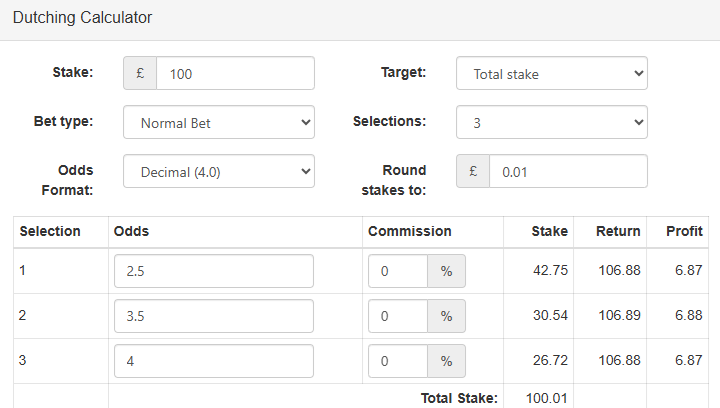
Example: An upcoming Premier League game has odds of 2.50 (home win), 3.50 (draw) and 4.00 (away win).
The calculation is:
1 ÷ 2.50 + 1 ÷ 3.50 + 1 ÷ 4.00 = 93.57% total implied probability
Calculating a dutch manually can become complicated when you have several selections or different odds.
OddsMonkey has two complementary tools that can do all the work for you. The Implied Probability Calculator can determine the total implied odds and the Dutching Calculator can tell you the stakes required for each selection and any profit you might make.
Here’s how the above example would look in the Dutching Calculator.
Rather than declaring one sport the “best”, consider the type of market you are looking at.
If you prefer…
You might consider…
Why
Simple two-outcome markets
Tennis or basketball
Fewer selections can make the calculations easier
Three-outcome markets
Football or some rugby markets
Several defined outcomes can be covered
Multiple-selection markets
Horse racing or golf
You can select several runners/players
Sport-specific strategies
Football, tennis or horse racing
Dedicated approaches can account for market characteristics
Finding bookmaker price differences
Multiple sports
Comparing prices can reveal different opportunities
The key takeaway is that the market matters more than the sport's name.
Once you understand which sports can be used for dutching, you can explore the strategy in more detail:
Dutching isn't limited to one particular sport. You can potentially use it across football, horse racing, tennis, golf, basketball, cricket, rugby and many other markets.
But the sport itself isn't what makes a dutching opportunity attractive.
The more important factors are the available selections, the odds, the combined implied probability and whether you can place all the required bets at the calculated prices.
If you're new to the technique, start with a straightforward market, check the numbers carefully and use a calculator to work out the stakes before placing anything.
The OddsMonkey Dutching Calculator can handle the staking maths. Explore the OddsMonkey Dutching Calculator →
You can use dutching in many sports, including football, horse racing, tennis, golf, basketball, cricket and rugby. The key requirement is a market with multiple selections that can be backed and where the available odds make the staking worthwhile.
Dutching can be profitable when the combined implied probability of your selected outcomes is below 100%, but profitability isn't guaranteed. The available odds, stake limits, market changes and whether all bets can be placed at the required prices can affect the outcome.
No. Dutching does not remove the risk of losing money, particularly when the combined implied probability is above 100% or when odds change before all bets are placed.
The sport itself is less important than the betting market. Markets with clearly defined outcomes, competitive odds, different prices across bookmakers and sufficient liquidity can be more suitable for dutching.
You can potentially dutch all outcomes where the market is suitable, but doing so does not automatically create a profit. The combined implied probability of the prices determines whether the dutch represents a potential profit, break-even position or loss.
Two-outcome markets, such as tennis or basketball match-winner markets, can be relatively straightforward because there are fewer selections to calculate. However, the odds still need to be assessed carefully before placing a dutching bet.
No. Dutching can be carried out without a betting exchange by backing multiple selections, although the exact approach depends on the market and prices available. This differs from traditional matched betting, which generally involves backing with a bookmaker and laying at an exchange.
Calculate the combined implied probability of the selections using 1 ÷ odds for each selection and add the results together. A total below 100% indicates a potential arbitrage/profit opportunity before other factors are considered, while a total above 100% means a loss is built into the prices when stakes are set to equalise returns.

Unlock £29+ with our offer guides. Each guide will walk you through the back and lay bets needed to make your first matched betting profits.
Earn immediately. No payment details required
Start your FREE Trial
*DISCLAIMER: We’re legally required to state that there is no guarantee of specific results each month. The amount of money that you earn can vary dependant on the time and effort that you commit each month.
This website is strictly for over 18’s. If you do have any concerns about gambling please contact GambleAware
© Copyright 2011-2026 Terms of Use | Privacy Statement